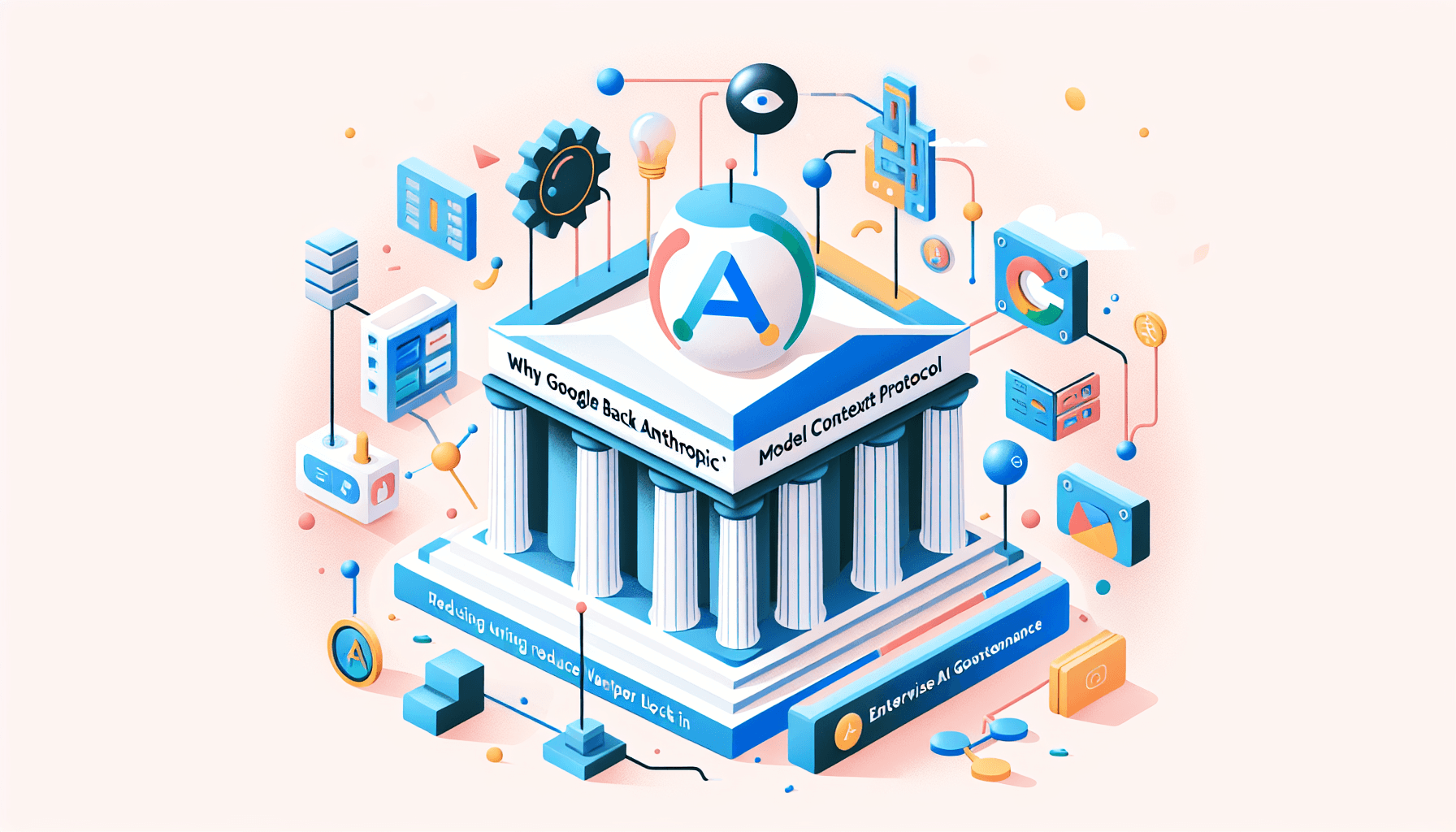
Why Google Backing Anthropic’s Model Context Protocol Could Be a Turning Point for AI Tooling
Why Google Backing Anthropic’s Model Context Protocol Could Be a Turning Point for AI Tooling
TL;DR: Google is set to support Anthropic’s Model Context Protocol (MCP), an open standard for connecting AI models to tools and data. If delivered as reported, this could sharply reduce vendor lock-in, make enterprise integrations reusable across model providers, and accelerate safer, more governed AI deployments. But success will hinge on security-hardening, shared semantics, and broad ecosystem adoption.
Google will embrace Anthropic’s Model Context Protocol (MCP), a vendor-agnostic way for AI systems to access tools and data sources, according to new reporting [1]. The move signals growing momentum for interoperability in an AI stack that’s been fragmented by bespoke plug-in systems and provider-specific tool calling. If Google follows through, MCP could become to AI tooling what the Language Server Protocol (LSP) became to IDEs: a pragmatic standard that helps everything talk to everything else [4].
What is MCP, in plain English?
Anthropic’s Model Context Protocol is an open specification that standardizes how AI clients (like assistants, IDE plug-ins, or agent frameworks) connect to MCP servers that expose three key things: tools (actions the model can invoke), resources (read-only data), and prompts (reusable templates) [2][3]. Instead of writing one-off adapters for each model provider, developers can implement or adopt an MCP server once and reuse it across many clients and models.
At a high level, MCP provides:
- A common message format and lifecycle for discovering capabilities and invoking tools.
- Support for multiple transports (e.g., streams or sockets) so it can run locally or over the network [2][3].
- A separation of concerns: clients focus on reasoning; servers handle data access and side effects.
The design goal is portability: the same payroll, CRM, codebase, or data warehouse integration can be surfaced to different models and user experiences with minimal rework.
Why Google’s support matters
When a hyperscaler backs a protocol, it can quickly move from “interesting” to “industry default.” As reported, Google’s embrace would mean MCP-based integrations are more likely to work across popular AI tooling and cloud environments, lowering integration costs and the risk of vendor lock-in [1]. It also pressures other providers to either support MCP or clearly articulate an alternative.
If LSP unified how editors talk to language tooling, MCP aims to unify how AI systems talk to data and action tooling.
Practically, enterprises stand to benefit in three ways:
- Reusability: Build an MCP server once for internal systems; reuse across assistants, agents, or copilots from multiple vendors.
- Governance: Centralize policy, access control, and observability at the integration layer rather than scattering logic across per-model adapters.
- Speed: Faster experimentation and rollout, since new clients can discover and invoke standardized capabilities immediately.
How MCP works (technical snapshot)
Per Anthropic’s documentation and spec references, MCP defines a JSON-based request/response protocol between clients and servers. Servers advertise capabilities (tools, resources, prompts), handle invocations, and return structured results; clients handle planning and reasoning about when to call what [2][3]. Key concepts include:
- Tools: Functions the model can call with typed arguments; servers perform side effects and return results.
- Resources: Read-only data the model can inspect (files, database queries, documents).
- Prompts: Parameterized templates that standardize how tasks are framed.
- Transport-agnostic: Implementations exist for local and network transports, making it usable in desktop apps, IDEs, or cloud-hosted services [2][3].
This division lets teams keep sensitive keys and business logic in the MCP server, while letting multiple AI experiences safely consume the same capabilities.
Security and safety: the make-or-break factor
Standardizing access doesn’t automatically make it safe. The OWASP Top 10 for LLM Applications highlights risks like prompt injection, excessive agency, and data exfiltration when models gain tool access [5]. NIST’s AI Risk Management Framework likewise emphasizes governance, access control, and monitoring for trustworthy AI [6]. If MCP becomes widely adopted, the biggest wins will be in shared security practices:
- Least-privilege tool design: Narrow scopes, explicit permissions, and constrained inputs/outputs.
- Defense-in-depth: Input/output validation, content filtering, and sandboxing for file and network operations.
- Human-in-the-loop and policy checks: Require approvals for high-impact actions.
- Auditable trails: Log every tool invocation with provenance and outcomes for forensics and compliance.
- Robust secrets management: Keep credentials server-side; never leak tokens into model-visible context.
How this compares to today’s fragmented landscape
Before MCP, most model providers offered bespoke “tool calling,” “functions,” or plug-in ecosystems. Those are useful but siloed, often forcing developers to rebuild the same integration repeatedly. MCP’s promise is a common, open baseline that different runtimes and models can share. The comparison to Microsoft’s Language Server Protocol is instructive: LSP didn’t replace language tooling; it standardized the wire between editors and tools, enabling a flourishing ecosystem [4]. MCP aims to do the same for AI tools and data access.
What teams can do now
- Inventory candidate tools and data: Identify read-mostly resources (docs, knowledge bases) and safe, narrow-scope actions (ticket creation, analytics queries).
- Design an MCP server facade: Wrap internal APIs and data sources behind an MCP server. Start with low-risk tools and add guardrails from day one.
- Pilot with multiple clients: Test the same MCP server via different assistants or IDEs to validate portability claims.
- Measure and log: Track tool call rates, error modes, latency, and user outcomes to guide iteration and risk controls.
- Plan for governance: Map MCP capabilities to your IAM, DLP, and audit requirements; align with NIST AI RMF practices [6].
Open questions to watch
- Authorization and delegation: How will fine-grained, user-specific permissions flow to MCP servers across clients?
- Schema and semantics: Will common data/response conventions emerge to improve cross-client reliability?
- Rate limits and QoS: How will shared MCP servers protect themselves from overuse and coordinate backpressure with clients?
- Versioning and capability discovery: How will servers advertise breaking changes and optional features safely?
- Ecosystem breadth: Will other hyperscalers and major SaaS platforms ship first-party MCP servers or gateways?
Bottom line
If Google’s reported support materializes, MCP could become the default way AI systems tap into real enterprise work. The upside is faster, safer, and more portable integrations; the risk is assuming a wire protocol alone solves safety. Treat MCP as the interoperability layer—and invest just as much in governance, testing, and monitoring on top of it.
Sources
- TechCrunch: Google to embrace Anthropic’s standard for connecting AI models to data
- Anthropic Docs: Model Context Protocol (overview)
- Model Context Protocol (official site/spec and ecosystem)
- Microsoft: Language Server Protocol (background and analogy)
- OWASP Top 10 for LLM Applications (security risks and mitigations)
- NIST AI Risk Management Framework (governance and risk guidance)
Thank You for Reading this Blog and See You Soon! 🙏 👋
Let's connect 🚀
Latest Insights
Deep dives into AI, Engineering, and the Future of Tech.
I Tried 5 AI Browsers So You Don’t Have To: Here’s What Actually Works in 2025
I explored 5 AI browsers—Chrome Gemini, Edge Copilot, ChatGPT Atlas, Comet, and Dia—to find out what works. Here are insights, advantages, and safety recommendations.
Read Article


