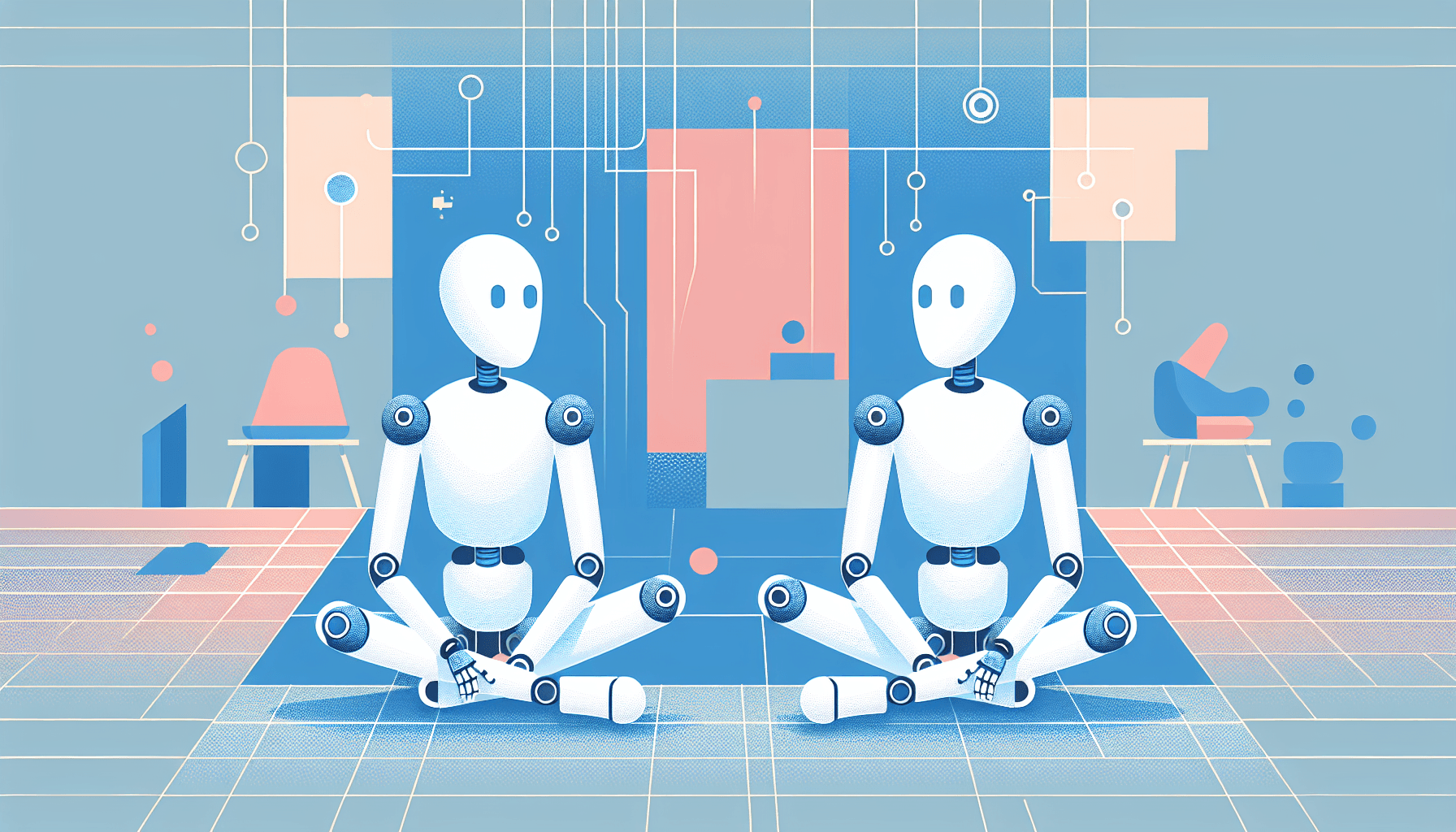
Why Big Tech Is Betting on Robots: How Google, OpenAI, Meta, and Amazon Are Bringing AI Into the Real World
AI's next act: from chatbots to robots
AI wowed the world with chatbots and image generators. Now, the biggest players in tech are aiming at the physical world. Google, OpenAI, Meta, and Amazon are each pushing into robotics to create embodied AI—systems that can see, reason, and act. The bet: pairing today's powerful foundation models with real-world robots could transform logistics, manufacturing, retail, and even home assistance.
Here's what's happening, why it matters, and how entrepreneurs and professionals can prepare.
What is embodied AI—and why now?
Embodied AI combines perception (vision, audio), reasoning (language and planning), and action (robot control). Instead of answering questions on a screen, embodied AI decides what to do next in a dynamic environment—like picking a product off a shelf or folding laundry.
Three trends are accelerating the shift from screen-based AI to real-world robots:
- Foundation models for actions: Vision-language-action models can map natural language and images to robot commands. Google DeepMind's RT‑2 showed that models trained on web-scale data can help robots generalize to new tasks, while RT‑X scaled learning across many robots and datasets.
- More and better data: Shared, cross-robot datasets and high-fidelity simulators reduce the need for costly, task-specific data collection. Meta's Habitat 3.0 platform helps train interactive agents safely in simulation before they deploy in the real world.
- Hardware maturity: Safer mobile bases, compliant arms, and better grippers are reaching price points and reliability levels that make business pilots feasible. Amazon's large-scale warehouse deployments demonstrate where commercial value shows up first.
How the giants are moving—company by company
Google (DeepMind): training robots like we train language models
Google’s robotics work is increasingly tied to its frontier AI research. The core idea: use the same playbook that made large language models powerful—lots of diverse data and general-purpose architectures—to help robots learn flexible behaviors.
- RT‑2: A model that translates vision and language into actions, enabling robots to perform tasks they weren’t explicitly trained on by leveraging web and image-text data (DeepMind).
- RT‑X and cross-robot learning: A collaborative effort to scale robot learning across many platforms and datasets, improving generalization and sample efficiency (DeepMind).
Why it matters: If models can generalize from language and vision to actions, robots can move beyond brittle, task-specific scripts to more adaptable, useful assistants.
OpenAI: from language to limbs via partnerships
After focusing on software, OpenAI has re-engaged with robotics through partnerships. In 2024, humanoid startup Figure raised funding from OpenAI-linked investors and showed a demo of a robot responding to natural language and instructions powered by advanced multimodal models (Reuters). Figure also published updates on its work with OpenAI on safe, general-purpose robot intelligence (Figure).
Why it matters: LLMs and multimodal models can act as planners and interfaces, turning voice and vision into step-by-step actions for robots—especially in semi-structured settings like factories or backrooms.
Meta: the tooling to train embodied agents
Meta isn’t shipping warehouse robots, but it has become a major force in the tooling that makes embodied AI possible. Its Habitat 3.0 simulator supports human-robot interaction at scale, and Meta’s egocentric datasets (like Ego4D) help models learn from first-person perception.
Why it matters: Better simulators and datasets reduce the cost and risk of training embodied agents, accelerating research that startups and enterprises can adopt.
Amazon: robots at industrial scale
Amazon operates one of the largest fleets of industrial robots and continues to pilot more human-centric forms. In 2023, the company began testing Digit, a bipedal robot designed to move totes and navigate spaces built for people. Amazon also highlights how robotics improve safety and throughput across its operations.
Why it matters: Amazon shows where robotics creates ROI today—repetitive handling, sorting, and movement—and how human-robot collaboration (rather than full autonomy) can deliver near-term value.
Where value will emerge first
Robots won’t take over every task. But in the next 1–3 years, expect embodied AI to gain traction in:
- Warehousing and logistics: Mobile manipulation for picking, sorting, and pack-out; dynamic palletization; inventory scanning.
- Manufacturing: Flexible, vision-driven assembly and rework; inspection and quality assurance.
- Retail backrooms and dark stores: Shelf replenishment, tote movement, and cycle counting—especially after-hours.
- Facilities and services: Cleaning, inspection, and monitoring in hospitals, hotels, and airports.
Home robots are farther out. General-purpose assistance in unstructured homes is a harder problem—expect meaningful consumer use cases closer to the 5–10 year horizon.
How to pilot embodied AI in your business
For leaders curious about value—without the hype—start small and measure:
- Pick tractable tasks: High-volume, repetitive workflows in controlled areas (e.g., moving totes between fixed stations) beat open-ended chores.
- Design for human-in-the-loop: Use teleoperation or exception handling for the long tail of edge cases. This boosts uptime and safety.
- Instrument everything: Track minutes per task, success rates, interventions, and downtime to calculate payback periods.
- Prioritize safety and compliance: Define stop zones, audit logs, and incident reporting; train staff thoroughly.
- Plan change management: Involve frontline teams early, set clear roles, and align incentives around safety and throughput.
Risks and realities to keep in mind
- Reliability over demos: Foundation models can be brittle in the real world. Expect “last 10%” edge cases to dominate engineering time.
- Safety and liability: Even slow-moving robots can cause harm. Clear governance and fail-safes are essential. The EU's AI Act will classify many embodied systems as high-risk, requiring transparency, testing, and oversight.
- Data governance: Robots capture sensitive video and audio. Set retention, anonymization, and access policies up front.
- Integration costs: Seemingly simple workflows may require fixtures, layout changes, or IT integrations that affect ROI.
What this means for entrepreneurs and professionals
Opportunities are opening across the stack:
- Software layers: Planning, simulation-to-real transfer, policy monitoring, and safety shims for foundation-model-driven robots.
- Vertical solutions: Preconfigured robots plus workflows for specific industries (food service prep, hospital supply runs, retail replenishment).
- Data and evaluation: Datasets, benchmarks, and QA services for embodied agents. Expect demand for scenario generation and automatic evaluation.
- Change management and training: Providers who make robots easy to adopt—playbooks, training content, and support—will stand out.
Careers will evolve, too. Robot supervisors, exception handlers, and AI operations roles are growing, especially in logistics and manufacturing.
The bottom line
Big Tech is turning AI’s abstract intelligence into physical capability. Google is building generalist robot skills, OpenAI is pairing powerful models with capable partners, Meta is supplying the simulation and data stack, and Amazon is proving what works at scale. The path to value is practical: start with narrow, repetitive tasks, keep humans in the loop, and measure relentlessly. The upside is real—but so are the engineering and safety challenges.
FAQs
What's the difference between traditional robotics and embodied AI?
Traditional robots follow preprogrammed routines in controlled settings. Embodied AI uses perception and foundation models to understand scenes, plan, and adapt actions in more dynamic environments.
Are humanoid robots necessary for business value?
No. Wheels and arms solve many problems more safely and cheaply. Humanoids are compelling for spaces designed for people, but most near-term ROI comes from mobile bases, collaborative arms, and fixed automation.
How do large language models help robots?
LLMs can parse instructions, reason about steps, and interface with vision and control modules. They act as planners and user interfaces, while specialized policies execute low-level motion safely.
What should I budget for a pilot?
Costs vary widely. Many pilots start in the low-to-mid six figures, including hardware, integration, and support. Focus on payback within 12–24 months and instrument metrics from day one.
What regulations apply to AI robots?
Expect workplace safety rules (e.g., OSHA in the U.S.), product safety standards for collaborative robots, data protection laws, and new AI-specific rules like the EU AI Act for high-risk systems.
Sources
- Google DeepMind — RT‑2: New model translates vision and language into action
- Google DeepMind — Scaling robot learning with RT‑X and cross-robot data
- Reuters — Figure raises $675M from OpenAI, Microsoft, Nvidia and others (2024)
- Figure AI — Figure and OpenAI progress toward safe, human-level AI for humanoid robots
- Meta AI — Habitat 3.0: A platform for embodied AI
- Amazon — Amazon is testing a new robot called Digit
- European Parliament — AI Act: Parliament endorses landmark rules (2024)
Thank You for Reading this Blog and See You Soon! 🙏 👋
Let's connect 🚀
Latest Insights
Deep dives into AI, Engineering, and the Future of Tech.
I Tried 5 AI Browsers So You Don’t Have To: Here’s What Actually Works in 2025
I explored 5 AI browsers—Chrome Gemini, Edge Copilot, ChatGPT Atlas, Comet, and Dia—to find out what works. Here are insights, advantages, and safety recommendations.
Read Article


