Why AI Researchers Are Choosing Meta Over Rivals: Beyond The $100 Million Myth
Why AI Researchers Are Choosing Meta Over Rivals: Beyond The $100 Million Myth
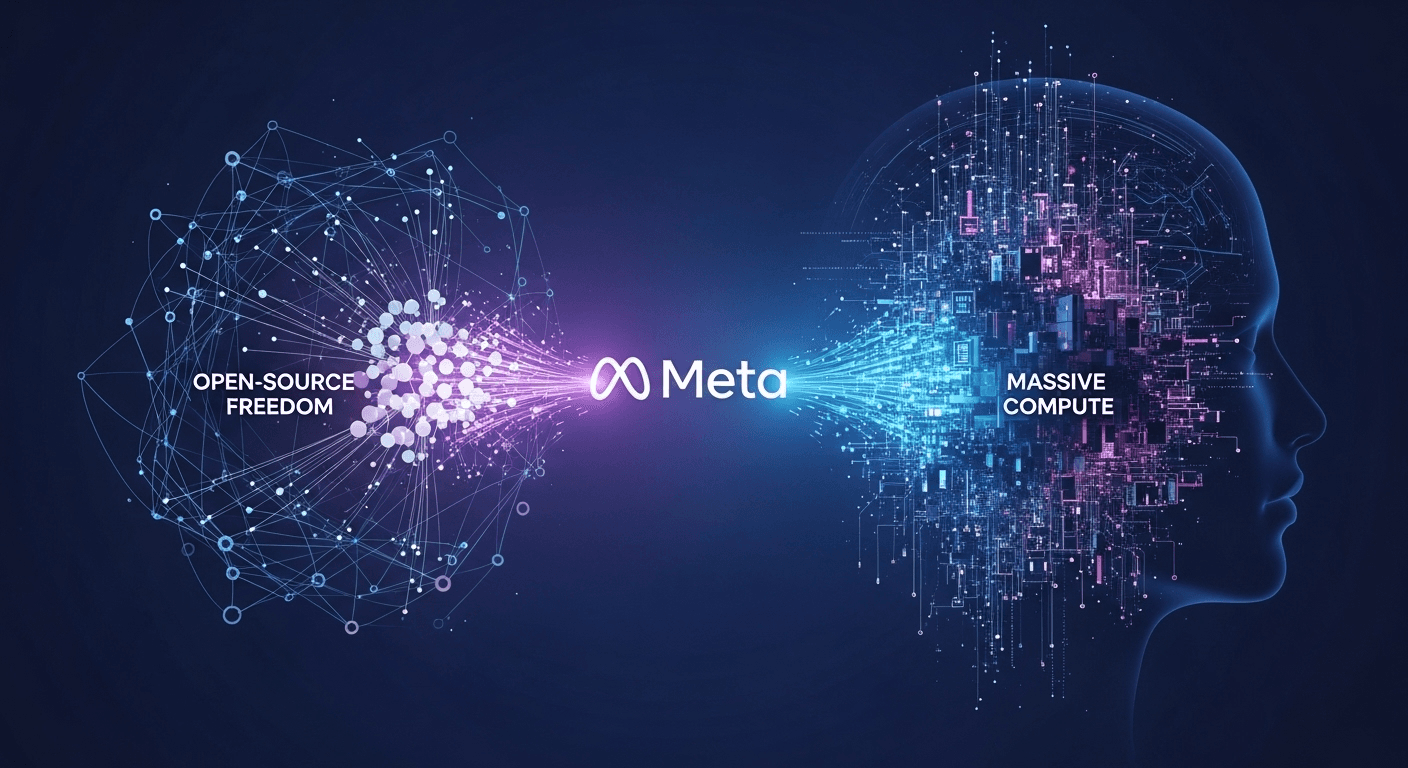
In one of the most competitive job markets for AI talent in tech history, reports of extravagant pay packages have taken center stage. However, according to Mark Zuckerberg, the true story behind why researchers are flocking to Meta involves more than just money. In recent comments featured by Windows Central, Zuckerberg refuted rumors of $100 million signing bonuses and emphasized two major factors driving AI talent from companies like OpenAI and Anthropic to Meta: a commitment to an open-source-first research culture and unparalleled access to massive compute resources at an unprecedented scale (Windows Central).
The Short Version
- Zuckerberg asserts that Meta attracts AI researchers primarily due to its open-source approach and unmatched compute resources, rather than through extravagant cash offers.
- Meta has launched the Llama family of models under a permissive community license and is investing tens of billions of dollars in GPUs to develop frontier-scale systems (Meta AI), (The Verge).
- According to Zuckerberg, the rumored $100 million signing bonuses are inaccurate. While compensation is competitive, researchers are more focused on impact, openness, and scale (Windows Central).
Why This Matters Now
Leading AI researchers hold the potential to significantly shape the evolution of models and safety practices in the industry. Their employer choice dictates where innovative ideas get transformed into products impacting billions of users. If Meta successfully attracts more of this top talent, it could hasten advancements in open-source AI and the integration of AI features into popular applications like Facebook, Instagram, and WhatsApp (Meta Newsroom).
The Two Big Reasons, According to Zuckerberg
1) Open-Source-First Research Culture
Meta prioritizes sharing models and research openly. The Llama series has emerged as a foundational element of the open ecosystem, with Llama 3 enhancing reasoning, coding, and multilingual capabilities and lowering entrance barriers for startups and researchers (Meta AI). This open approach sets it apart from the more closed strategies adopted by companies like OpenAI and Anthropic, where API access is the primary means for external developers to engage.
For many scientists, the ability to publish, share weights, and collaborate openly is a significant advantage. This fosters reproducibility, independent safety evaluation, and quicker iteration by the broader community. Numerous independent surveys and analyses underscore how open-weight models have driven innovation across various platforms, including edge devices, on-premises deployments, and academic institutions (Stanford AI Index 2024).
It’s important to clarify that while Meta’s Llama license is permissive, it is not OSI-approved open source; it is a community license with specific usage terms. Nevertheless, it supports a dynamic ecosystem for fine-tuning, tooling, and deployments that feels much more inclusive compared to entirely closed APIs (Llama 3 License).
2) Unmatched Compute at Scale
Developing and scaling next-gen models necessitate extraordinary amounts of computational power. As of early 2024, Zuckerberg stated that Meta would possess approximately 350,000 Nvidia H100 GPUs by year’s end, with around 600,000 H100-equivalents once factoring in other hardware. This positions Meta in an exclusive category capable of training frontier-scale models and operating them across billions of user interactions (The Verge).
Access to compute resources is a significant bottleneck for top researchers. In practical terms, it dictates whether ambitious scaling experiments, high-context multimodal models, or thorough safety interventions can even be attempted. Meta’s capital expenditure strategy consistently emphasizes AI infrastructure, committing tens of billions to data centers and GPUs (Reuters).
About Those $100 Million Signing Bonuses
Zuckerberg has rejected claims that Meta is offering $100 million signing bonuses to attract talent, labeling such figures as exaggerated. While compensation for elite AI researchers can reach substantial amounts through multi-year equity packages, the reality does not support the notion of routine nine-figure checks (Windows Central), (Wall Street Journal), (Bloomberg).
The truth is that although competition is fierce and pay is high, most researchers prioritize impact, the freedom to publish, access to compute, team dynamics, and long-term equity potential when deciding their workplace.
Who is Moving Where, and Why It’s Complex
The AI talent market is highly dynamic. Noteworthy transitions between leading labs indicate researchers are seeking better alignment with their research aspirations and values. For instance, concerns about long-term safety priorities prompted significant departures from OpenAI in 2024, including the head of its Superalignment team, who cited disagreements about safety and product velocity, leading to a move to Anthropic to pursue alignment work (Jan Leike on X), (Anthropic). This movement illustrates that values and research direction are as significant as compensation.
Against this backdrop, Zuckerberg’s assertion that researchers from OpenAI and Anthropic are gravitating toward Meta aligns with a visible trend: Meta’s investment in open-weight releases and vast compute resources appeals to those eager to develop frontier systems and deliver them to billions. Although individual hiring statistics are rarely public, this trend is consistent with Meta’s aggressive investments in infrastructure and ongoing open model releases (Meta AI Blog).
Open vs. Closed AI: The Strategic Trade-Offs
The debate over the open-sourcing of powerful models is not new, but the stakes are considerably higher at frontier scales.
- Benefits of Open Weights: Transparency, reproducibility, ecosystem growth, and the ability for independent labs to engage in safety research (Stanford AI Index 2024).
- Benefits of Closed Models: Increased control over deployment risks, centralized monitoring, and the potential for more predictable safety updates (Anthropic, Constitutional AI).
Regulators are also considering these trade-offs. The EU’s AI Act, finalized in 2024, adopts a risk-based approach, including specific provisions that affect open-source developers differently from those managing high-risk systems. The regulatory landscape will directly influence how open or closed companies can operate as they scale (EU Council).
Meta’s Product Edge: Impact at Global Scale
Another attraction for researchers is the potential for impact. Meta can deliver AI features to billions of users across platforms like Facebook, Instagram, WhatsApp, Messenger, and Ray-Ban Meta smart glasses. Its assistant, Meta AI, is being integrated into the company’s applications, showcasing multimodal capabilities that leverage the latest Llama models (Meta Newsroom).
This rapid product deployment allows researchers to convert experiments into real-world applications quickly, providing invaluable feedback at a scale few others can achieve—essential for refining models, safety classifiers, and guardrails.
How Compute Shapes Research Possibilities
With abundant compute resources, teams can explore ideas that would be impractical elsewhere. Some capabilities include:
- Training extensive multimodal models that can reason across text, images, and video.
- Investigating longer context windows and retrieval pipelines requiring substantial memory bandwidth.
- Executing large-scale reinforcement learning or tool-use training protocols.
- Conducting extensive red-teaming and safety evaluations with massive synthetic data generation.
These are not merely theoretical exercises; they lead to capabilities such as superior code generation, more reliable answers with citations, enhanced workflows, and improved safety filters. At scale, these advancements can redefine the competitive landscape in a matter of months.
Safety, Responsibility, and Openness Can Coexist
Being open doesn’t have to equate to being unsafe. Meta and other labs are increasingly publishing model cards, safety evaluations, and policies alongside open-weight releases. Independent researchers and civil society organizations can critically examine and stress-test open models, a task that is more challenging when access is restricted to closed APIs (Meta Llama), (Hugging Face on Model Cards).
Nonetheless, open-weight models can also be misused if fine-tuned improperly. This risk underscores the importance of responsible release practices, clear usage guidelines, and collaboration with platforms that host or distribute models.
What This Means for Researchers, Builders, and Leaders
- Researchers: If open publication, weight access, and large-scale experiments are priorities for you, Meta’s environment may be particularly appealing. However, consider the specifics: compute allocation, internal review processes, and your ability to share work externally.
- Startup Builders: Open-weight ecosystems like Llama can mitigate costs and platform risks. Examine license terms carefully, and consider hybrid strategies that blend local models with the use of closed APIs as necessary.
- Enterprise Leaders: Prepare for faster integration of AI features into Meta’s consumer apps, as well as growing opportunities for private deployments. Expect open-weight models to become more efficient.
- Safety and Policy Teams: The field of safety research will be split between open and closed ecosystems. Funding independent evaluations and red-teaming of open models is a crucial public good.
Bottom Line
The battle for AI talent isn’t solely about financial incentives. Zuckerberg contends that Meta attracts researchers by fostering an open, high-impact research environment with exceptional computing power. Whether you agree with this approach or not, it is undeniable that these factors offer a research velocity and community engagement that many scientists find compelling.
As the industry races toward more advanced multimodal and agentic systems, anticipate an intensifying struggle between open and closed strategies. For now, Meta’s strategy is clear: prioritize open weights whenever possible, build massive infrastructure, and enable rapid product integration. This combination serves as a powerful attractor for talent.
FAQs
Did Meta really offer $100 million signing bonuses?
Zuckerberg has labeled those claims as inaccurate. While elite AI talent can earn significant compensation in the industry, there is no consistent evidence of regular $100 million signing bonuses. Expect packages that feature competitive multi-year equity, but not nine-figure checks (Windows Central), (WSJ).
What makes Meta attractive to researchers compared to OpenAI or Anthropic?
Two key factors stand out: open-weight releases and substantial compute availability. Researchers who value publishing and community collaboration often prefer open ecosystems, while others may opt for closed labs for reasons such as tighter safety controls and focused product development (Meta AI), (Anthropic).
How many GPUs does Meta have?
As of early 2024, Zuckerberg indicated that Meta would have around 350,000 Nvidia H100 GPUs by year-end, and approximately 600,000 H100-equivalents when factoring in additional hardware. Exact current counts are not publicly confirmed, but Meta continues to highlight significant investments in AI infrastructure (The Verge), (Reuters).
Is Llama truly open source?
Llama models are distributed under the Llama Community License, which is permissive but not recognized as OSI-approved open source. Still, it allows for broad usage, fine-tuning, and deployment, facilitating a vibrant open-weight ecosystem (Llama License).
What are the risks of open-weight AI models?
Open weights carry a risk of being fine-tuned for misuse. Strategies to mitigate this involve establishing license terms, implementing safety measures, and fostering community-driven evaluation. The benefits of openness include transparency, reproducibility, and quicker progress in safety research (Hugging Face), (Stanford AI Index 2024).
Sources
- Windows Central – Zuckerberg explains why researchers are moving to Meta…
- The Verge – Meta’s ambitious GPU plans for 2024
- Meta AI – Launching Meta Llama 3
- Meta Llama – Models and Research Documentation
- Llama 3 Community License
- Meta Newsroom – Launch of the AI Assistant
- Reuters – Meta’s increased AI infrastructure spending
- Wall Street Journal – Trends in AI researcher salaries
- Bloomberg – The rising stakes in the AI talent war
- Stanford AI Index 2024
- EU Council – Agreement on the AI Act
- Anthropic – Insights on Constitutional AI
- Jan Leike – Statement about his move
- Anthropic – Announcement of Jan Leike joining
- Hugging Face – The importance of model cards and responsible AI
Thank You for Reading this Blog and See You Soon! 🙏 👋
Let's connect 🚀
Latest Insights
Deep dives into AI, Engineering, and the Future of Tech.
I Tried 5 AI Browsers So You Don’t Have To: Here’s What Actually Works in 2025
I explored 5 AI browsers—Chrome Gemini, Edge Copilot, ChatGPT Atlas, Comet, and Dia—to find out what works. Here are insights, advantages, and safety recommendations.
Read Article


