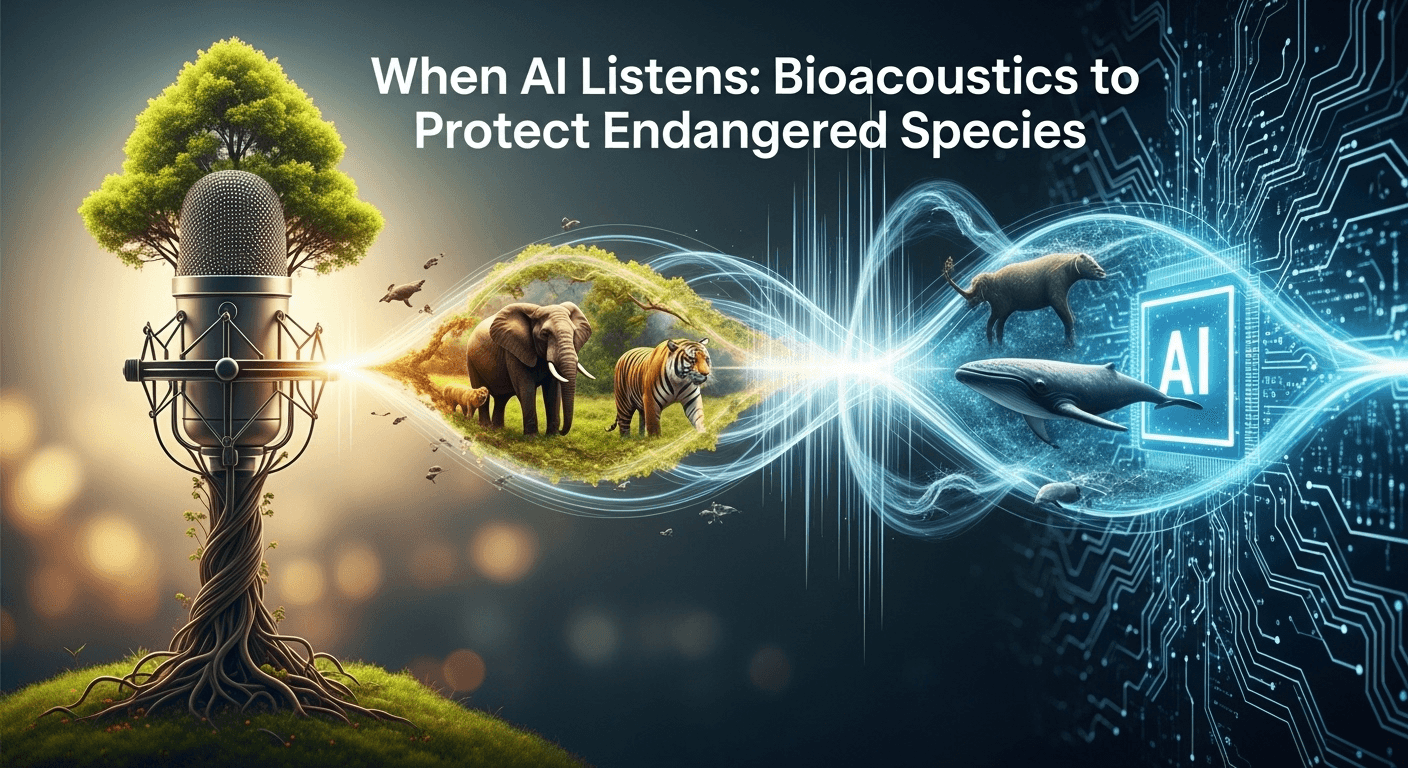
When AI Listens: Bioacoustics to Protect Endangered Species
When AI Listens: Bioacoustics to Protect Endangered Species
From lush rainforests to vibrant coral reefs, the planet is rich with sounds of life that often go unseen. Advances in artificial intelligence are transforming these hidden soundscapes into vital insights for conservation. In this article, we’ll explore how AI-driven bioacoustics functions, why it is crucial for endangered species, current advancements in this field, and how organizations like Google DeepMind are collaborating with conservation partners to enhance these efforts (source).
Why Listening to Nature Matters Now
Biodiversity is vanishing at an alarming rate. A significant global assessment has indicated that around 1 million species are at risk of extinction in the coming decades, primarily due to habitat destruction, exploitation, pollution, climate change, and invasive species (IPBES Global Assessment). Effective conservation requires reliable, up-to-date information on species distribution and population dynamics. While traditional field surveys are foundational, they tend to be expensive, slow, and often miss elusive or nocturnal species.
Bioacoustics enhances field data collection by capturing the sounds animals produce while moving, eating, mating, and defending their territories. With the advent of modern recording devices, researchers can monitor remote locations around the clock without disrupting wildlife. However, the challenge lies in managing the massive amount of data produced—one recorder can generate thousands of hours of audio, and that is where AI comes into play.
Bioacoustics 101: What We’re Learning from Listening
Bioacoustics is the study of animal sounds and their relationship to behavior and ecology. In conservation, this typically involves passive acoustic monitoring: placing microphones or underwater hydrophones in various environments to record continuously or on a set schedule.
Here’s why sound is such an effective tool for monitoring endangered species:
- Non-invasive and scalable—devices can run for months with minimal human intervention.
- Operational day and night—audio can capture behaviors in darkness, fog, dense vegetation, and underwater.
- Species-specific signatures—many species produce distinctive calls, songs, or drumming patterns that can be recognized.
- Community-level signals—ecoacoustic techniques enable researchers to summarize entire soundscapes, tracking changes in ecosystems (Sueur & Farina 2015).
These benefits make bioacoustics especially effective in habitats where visual surveys face challenges, like tropical forests or open oceans (NOAA Fisheries).
From Field Microphones to AI Models: The Process
Transforming raw auditory data into actionable conservation insights generally follows these steps:
- Deploy Recorders: Low-power devices are mounted on trees, buoys, or seabeds. Some devices send audio snippets in near real-time, while others store data for later access.
- Preprocess Audio: The raw audio is filtered, resampled, and converted into spectrograms. Basic quality checks help remove wind, rain, and human noise where possible.
- Detect and Classify Sounds with AI: Convolutional and transformer-based models analyze recordings to identify target sounds (like a gibbon call, a frog chorus, or a chainsaw). Popular tools include BirdNET for avian monitoring (Kahl et al. 2021) and open models like YAMNet trained on AudioSet for general sound recognition (AudioSet) (YAMNet).
- Summarize Patterns: Outputs are accumulated across space and time to track presence, provide abundance estimates, and uncover seasonal trends. Alerts can also be triggered for threats like illegal logging.
- Ground Truth and Act: Predictions are validated through expert reviews, field checks, and additional data sources (like camera traps or satellite imagery). Conservation managers use this information to prioritize patrols, protect critical habitats, or assess intervention effectiveness.
Due to the lack of annotated wildlife audio for many species, methods such as transfer learning and self-supervised pretraining on large collections of unlabeled audio are becoming increasingly valuable. These techniques enable models to generalize better across diverse recording environments, devices, and acoustic conditions.
Real-World Conservation Successes Powered by AI Listening
Bioacoustics are already yielding tangible conservation benefits across various ecosystems:
- Rainforests: Rainforest Connection employs solar-powered recorders and AI to detect chainsaws and gunshots, sending real-time alerts to rangers to thwart illegal logging and poaching. Their Guardian devices have been deployed across several countries, protecting millions of hectares (Rainforest Connection).
- Oceans: NOAA and Google have showcased that deep learning can identify the songs of humpback whales from years of underwater recordings, enhancing monitoring of their migrations and helping to reduce ship strikes (Google AI Blog) (NOAA).
- Forest Elephants: The Cornell Elephant Listening Project utilizes passive acoustic monitoring to track elusive African forest elephants, providing critical data on population dynamics and threats in Central Africa (Cornell ELP).
- Birds at Scale: BirdNET and the Merlin Bird ID app empower researchers and citizen scientists to identify hundreds of bird species by sound. Studies indicate this method can effectively support large-scale biodiversity monitoring when appropriately validated (Kahl et al. 2021) (Merlin Sound ID). Community-driven libraries like Xeno-canto and challenges like LifeCLEF BirdCLEF provide essential training data and benchmarking (Xeno-canto) (LifeCLEF) (DCASE).
- Amphibians and Bats: Platforms like ARBIMON assist conservation teams in rapidly analyzing vast audio archives for specific frog and bat calls, thus informing quick assessments and long-term management strategies (ARBIMON).
Each initiative addresses a unique aspect of the bioacoustic challenge, collectively demonstrating that AI can transform the cacophony of natural sounds into valuable and actionable insights for conservation.
What Google DeepMind and Partners Are Doing
Researchers at Google DeepMind are teaming up with ecologists and technologists to develop and assess AI systems that function effectively under the complexities of field audio. Their efforts focus on achieving generalization across various sites and species, creating practical tools for annotators and biologists, and establishing open benchmarks that foster reproducibility and progress. To learn more about their ongoing initiatives and partner projects, check out their blog post on advancing bioacoustics using AI.
Key themes include:
- Scalable Detection and Classification: Developing models capable of parsing lengthy recordings and reliably detecting significant events, even when calls are faint, overlapping, or obscured by background noise.
- Learning from Limited Labels: Utilizing self-supervised pretraining and few-shot learning methods to help models adapt swiftly to new species and environments.
- Open Datasets and Tools: Promoting the use of shared datasets, labeling procedures, and evaluation standards that the scientific community can utilize and build upon.
- Responsible Deployment: Building systems that respect privacy, data sovereignty, and energy limitations encountered in the field.
Technical Advances Pushing the Field Forward
Self-Supervised and Transfer Learning
Large audio models trained on unlabeled data yield robust representations that translate well to bioacoustic applications, lessening the dependency on extensive manual labeling. Techniques such as contrastive learning and masked prediction can learn from months of field audio without requiring species-specific labels. Pretraining on diverse datasets like AudioSet followed by fine-tuning using wildlife audio has proven effective (AudioSet) (YAMNet).
Event Detection, Segmentation, and Diarization
Modern detection systems do more than determine if a species is present; they also segment continuous recordings into individual calls, estimate their start and end times, and even distinguish overlapping signals from multiple animals. This capability enables detailed analyses, such as estimating call rates, mapping territories, or assessing behavioral reactions to disturbances.
Generalization and Domain Adaptation
Real-world performance tends to decrease when models are employed in environments with noise differences from those seen in training. To bridge this gap, researchers utilize:
- Augmentation: Including background noise, reverberation, and pitch modifications during training.
- Domain Adversarial Learning: Encouraging the creation of representations that remain consistent across different sites or devices.
- Active Learning: Selecting the most informative audio snippets for expert labeling, expediting the data curation process.
On-Device and Low-Power Inference
Processing audio at the edge enhances efficiency by decreasing bandwidth, latency, and operational costs. Quantization and model distillation can reduce model sizes suitable for microcontrollers or single-board computers, allowing for near real-time alerts in the field while minimizing energy consumption. This is vital for solar-powered deployments in remote areas.
From Species IDs to Ecosystem Indicators
Beyond identifying species, ecoacoustic indices provide a summary of the richness, diversity, and temporal dynamics within soundscapes. When calibrated against field data, these indices can serve as early indicators of ecological changes and aid in assessing conservation outcomes (Sueur & Farina 2015).
Challenges and How the Community Is Addressing Them
Data Gaps and Annotation Bottlenecks
Many endangered species have limited audio recordings. Vocalizations may vary based on location, season, age, and context. Assembling clean, well-labeled datasets is a labor-intensive challenge. Community initiatives like Xeno-canto and collaborative benchmarks such as LifeCLEF and DCASE help to fill these gaps and standardize evaluations (Xeno-canto) (LifeCLEF) (DCASE). New tools are also speeding up expert review processes through assisted labeling and uncertainty estimations.
Noisy Real-World Recordings
Environmental factors such as wind, rain, insects, and human noise complicate sound detection. Models trained with realistic augmentations, negative examples, and site-specific adjustments prove to be more effective. It’s also essential to assess uncertainty, enabling decision-makers to gauge when to trust alerts and when to seek further verification.
Ethics, Privacy, and Data Governance
Acoustic sensors may inadvertently capture human voices. Responsible projects work to minimize this risk by carefully installing devices, filtering human speech on-site, and adhering to strict data governance policies. When recordings are made in Indigenous lands or community-managed areas, it is essential to respect Indigenous data sovereignty using frameworks like the CARE Principles for Indigenous Data Governance (GIDA). Transparency regarding objectives, benefits, consent, and access is vital for building trust.
Measuring Conservation Impact
High model accuracy doesn’t necessarily correlate with improved conservation results. The most effective initiatives link AI outputs to actionable steps such as ranger patrols, policy changes, or habitat restoration. They also evaluate what could have transpired without the system in place, utilizing counterfactual scenarios or phased implementations when applicable.
What Comes Next
The upcoming advancements are likely to encompass:
- General-Purpose Bioacoustic Models: Self-supervised models trained on extensive, diverse wildlife sound collections that can swiftly adapt to new species and environments.
- Multimodal Sensing: Integrating audio recordings with camera traps, environmental DNA (eDNA), and satellite data to create richer, cross-validated biodiversity metrics.
- Real-Time Decision Support: Implementing edge AI that translates detections into prioritized patrols, dynamic area closures, or ship speed recommendations.
- Open, Equitable Infrastructures: Establishing shared platforms that make advanced analytics accessible to local practitioners while respecting local governance and benefits-sharing.
These advancements align with global conservation goals, such as the Kunming-Montreal Global Biodiversity Framework, which advocates for monitoring and protecting biodiversity on an unprecedented scale (CBD GBF).
How You Can Get Involved
- Record and Share Sounds: Contribute wildlife audio to community repositories like Xeno-canto, adhering to local regulations and species protection laws.
- Help Label Data: Volunteer with conservation laboratories or citizen science projects in need of annotators.
- Deploy Low-Cost Recorders: Collaborate with local organizations to monitor priority sites, especially where other survey techniques face limitations.
- Use and Cite Open Tools: Evaluate models with caution, report uncertainty, and provide contributions back to the community.
Conclusion
Listening is one of the most potent tools we have to protect life on Earth. With the help of AI, extensive audio recordings from remote forests or marine environments can be distilled into timely and reliable insights that aid in the conservation of endangered species. Thanks to partnerships between ecologists, local communities, technologists, and organizations like Google DeepMind, bioacoustics is evolving from experimental initiatives to scalable, accountable conservation practices. The more we invest in sound science, open tools, and equitable governance, the better we can support the Earth’s recovery.
FAQs
What is bioacoustics?
Bioacoustics is the study of animal sounds and their ecological implications. In conservation, it employs passive acoustic monitoring to track species presence, behavior, and ecosystem changes using field recorders and AI analysis.
How accurate are AI models at identifying species by sound?
Accuracy can vary depending on species, recording quality, and training data. For well-documented bird species, tools like BirdNET perform strongly when used with appropriate validation thresholds (Kahl et al. 2021). For rare or poorly documented species, models often benefit from local fine-tuning and expert verification.
Can acoustic sensors record human speech? What about privacy?
Incidental recordings of voices can occur. Responsible projects strive to mitigate this risk by configuring sensor placements, implementing on-device filtering of human speech, and following rigorous data governance policies, including adherence to frameworks like the CARE Principles (GIDA).
Do acoustic recorders disturb wildlife?
Passive recorders are usually compact and quiet, resulting in minimal disturbance compared to frequent human presence. Ethical guidelines still recommend careful placement and regular monitoring to ensure no harm is done.
How can I start contributing?
Begin by recording local wildlife using a smartphone or low-cost recorder. Share your findings responsibly with repositories like Xeno-canto and explore open tools and tutorials available online. Partnering with local conservation groups can ensure your recordings address real management needs.
Sources
- Google DeepMind – How AI is Helping Advance the Science of Bioacoustics to Save Endangered Species
- IPBES Global Assessment Report on Biodiversity and Ecosystem Services
- NOAA Fisheries – Passive Acoustic Technology
- Google AI Blog – Tuning in: Monitoring Humpback Whale Populations
- Cornell Elephant Listening Project – Acoustic Monitoring
- Kahl et al. 2021 – BirdNET: A Deep Learning Solution for Avian Diversity Monitoring (Ecological Informatics)
- Cornell Lab – Merlin Bird ID Sound ID
- Xeno-canto – Bird Sounds from Around the World
- LifeCLEF – Biodiversity Identification Challenges
- DCASE Challenge – Bird Audio Detection
- AudioSet – A Large-Scale Ontology and Dataset of Audio Events
- YAMNet – Pretrained Audio Event Classifier
- Sueur & Farina 2015 – Ecoacoustics: The Ecological Investigation of Environmental Sound
- Rainforest Connection – Guardian Technology
- ARBIMON – Acoustic Monitoring Platform
- Convention on Biological Diversity – Kunming-Montreal Global Biodiversity Framework
Thank You for Reading this Blog and See You Soon! 🙏 👋
Let's connect 🚀
Latest Insights
Deep dives into AI, Engineering, and the Future of Tech.
I Tried 5 AI Browsers So You Don’t Have To: Here’s What Actually Works in 2025
I explored 5 AI browsers—Chrome Gemini, Edge Copilot, ChatGPT Atlas, Comet, and Dia—to find out what works. Here are insights, advantages, and safety recommendations.
Read Article


