Exploring Retrieval-Augmented Text Generation: Revolutionizing Natural Language Processing
The Emergence of Retrieval-Augmented Text Generation
As artificial intelligence (AI) continues to evolve, so too do the methods and technologies that power its capabilities. One of the most significant advancements in natural language processing (NLP) is the development of Retrieval-Augmented Text Generation (RATG). This technique combines the traditional text generation methods with an innovative retrieval component, enhancing the system’s ability to produce contextually relevant and accurate texts based on a vast array of external sources.
Understanding Retrieval-Augmented Text Generation
RATG is a hybrid approach that leverages both generative and retrieval systems to enhance the quality and relevance of machine-generated text. It integrates the conventional generative models, like GPT (Generative Pre-trained Transformer), with a retrieval component that accesses a large external knowledge base. This amalgamation allows the AI to fetch information relevant to the context of the query before generating a response, leading to outputs that are not only coherent but also factually accurate and deeply informative.
How RATG Works
At its core, RATG operates through a two-step process: retrieval and generation. Initially, the system identifies and retrieves relevant documents or data points from an extensive external knowledge base. These retrieved items are then used as a reference or a grounding layer for the generative model, which crafts the final text output. This process ensures that the generated text is not only contextually appropriate but also enriched with factual precision.
Benefits of Retrieval-Augmented Text Generation
- Enhanced Accuracy: By incorporating external data, RATG significantly reduces the generation of erroneous or irrelevant information, thereby increasing the factual accuracy of the responses.
- Contextual Relevance: The retrieval component allows RATG systems to produce responses that are more aligned with the specific context or domain of the query, thereby enhancing the relevance and usefulness of the text.
- Scalability: RATG models can efficiently handle large-scale data retrieval from diverse sources, making them scalable and adaptable to various domains and applications.
Applications of Retrieval-Augmented Text Generation
RATG is finding applications across a wide range of fields, from customer service and content creation to more specialized domains like legal and medical advis…
Thank You for Reading this Blog and See You Soon! 🙏 👋
Let's connect 🚀
Latest Insights
Deep dives into AI, Engineering, and the Future of Tech.
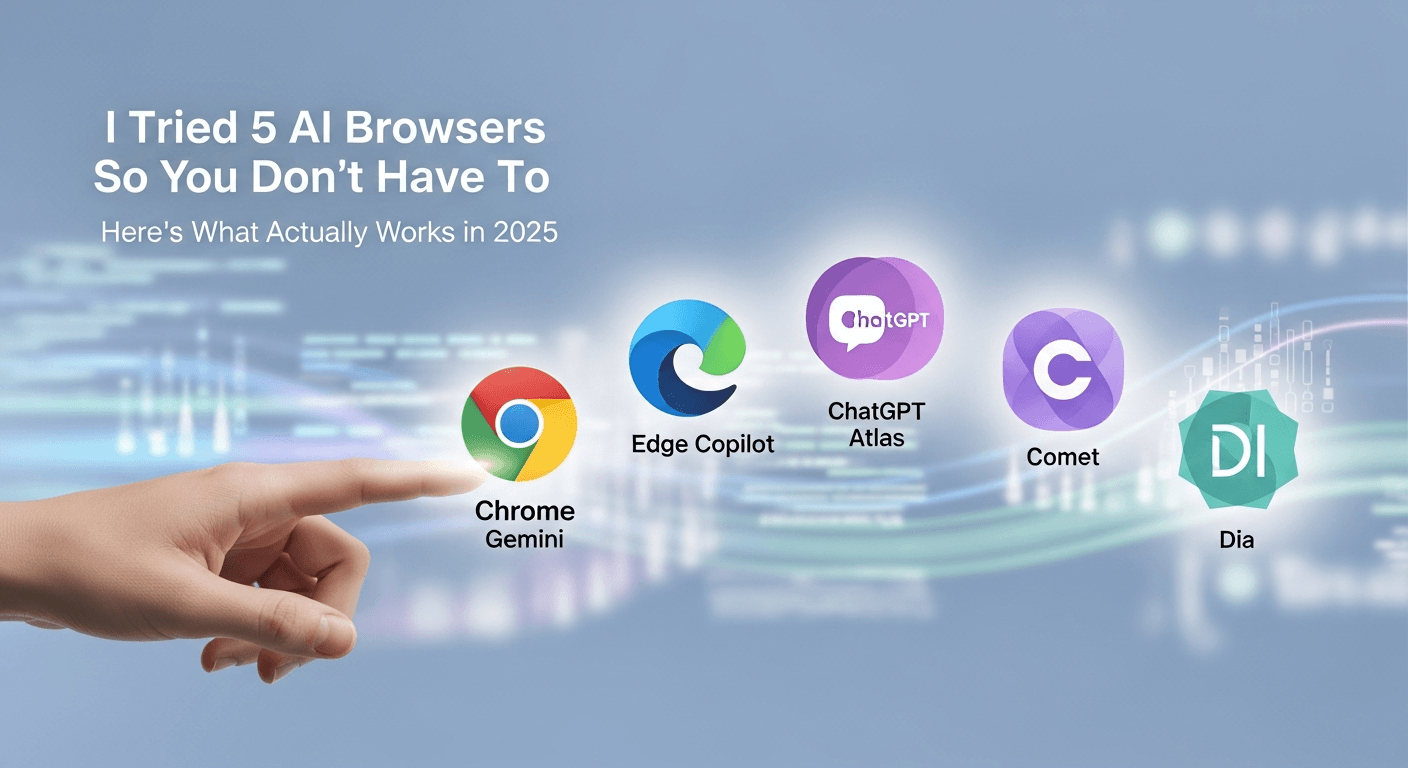
I Tried 5 AI Browsers So You Don’t Have To: Here’s What Actually Works in 2025
I explored 5 AI browsers—Chrome Gemini, Edge Copilot, ChatGPT Atlas, Comet, and Dia—to find out what works. Here are insights, advantages, and safety recommendations.
Read Article


