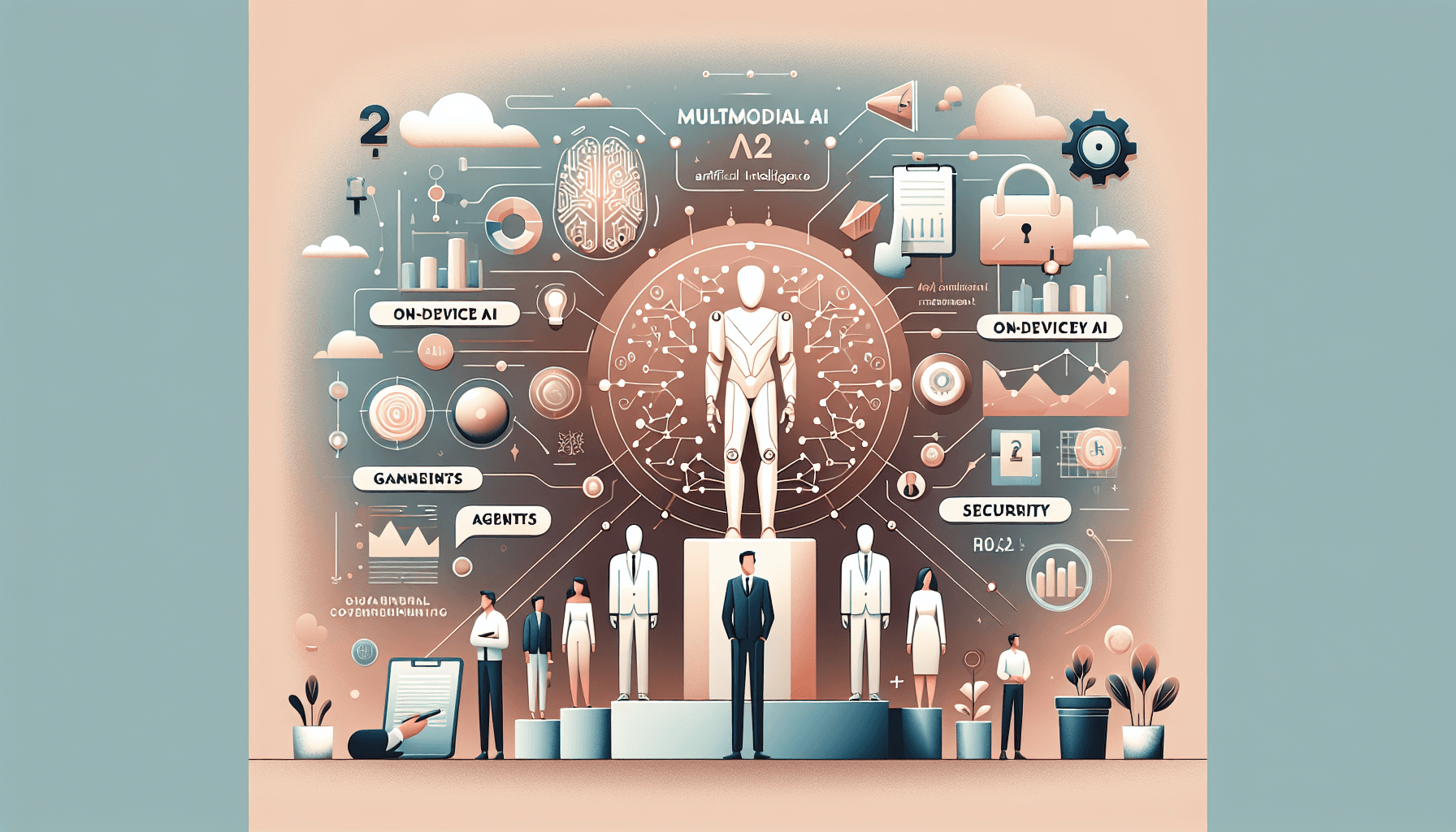
The AI Trends That Will Matter Most in 2025
AI made significant strides in 2024, and as we step into 2025, the narrative is shifting from flashy demonstrations to delivering real, lasting value. This includes safer deployments, improved speed and cost efficiency, and tangible productivity gains. Below are the key AI trends that will influence how teams build, manage, and scale AI solutions this year, accompanied by practical tips and credible resources for further exploration.
1) Multimodal Models Become the Norm
Models that can comprehend and generate text, images, audio, and video are quickly becoming standard. This creates richer assistants that can see, hear, and respond in real time.
- OpenAI has released GPT-4o, a real-time multimodal model that enhances voice and visual interactions, making them feel more conversational source.
- Google’s Gemini 1.5 features extended context windows and multimodal capabilities, enabling it to understand long documents and videos source.
What to do now: When designing your use cases, consider incorporating multimodal inputs and outputs, not just text. Focus on high-impact workflows like summarizing meetings, visual troubleshooting in customer support, or implementing voice-led field operations.
2) Smaller, Specialized, On-Device Models
The AI landscape in 2025 is not only about massive models. Smaller, task-specific, and on-device models are advancing rapidly, offering benefits in terms of privacy, cost savings, and speed.
- Apple launched Apple Intelligence, a privacy-first initiative that combines on-device models with private cloud computing for more demanding tasks source.
- Copilot+ PCs feature powerful NPUs for local processing, enabling swift offline AI functions source.
What to do now: Consider a hybrid approach. Utilize smaller models for tasks like classification and summaries, while reserving larger models for more complex reasoning tasks. Evaluate latency, privacy, and costs for both options.
3) Moving Beyond Chat: The Rise of AI Agents and Workflow Automation
AI is evolving from static Q&A interactions to intelligent agents that can plan, utilize tools, and act within safe boundaries. Expect improvements in orchestration, auditing, and recovery after failures.
- APIs for structured tool use and orchestration are advancing, with options like OpenAI’s Assistants API providing frameworks for managing multi-step tasks and memory source.
- Companies are leveraging these capabilities to develop domain-specific agents via low-code platforms like Microsoft Copilot Studio source.
What to do now: Start with narrow, high-value agents that can handle tasks like triaging emails, filing tickets, updating CRM entries, or reconciling invoices. Incorporate human oversight checkpoints for actions that modify data or incur expenses.
4) RAG 2.0: Enhanced Grounding, Retrieval, and Governance
Retrieval-augmented generation (RAG) has progressed from basic vector searches to sophisticated pipelines that address freshness, access control, citations, and assessment.
- Contemporary RAG strategies integrate metadata filtering, hybrid searching, reranking, and structured prompts to minimize hallucinations and bolster traceability source.
- Vendors now focus on data lineage and content provenance, helping businesses govern the information models utilize source.
What to do now: Treat RAG as a data management project. Invest in methods for segmenting documents, ensuring the quality of embeddings, implementing Access Control Lists (ACLs) for retrieval, and automating quality assessments of responses. Require citations in customer-facing outputs.
5) Governance Becomes Essential: EU AI Act, NIST RMF, and Content Provenance
In 2025, regulatory requirements are more defined, and procurement teams are posing tougher questions regarding safety, privacy, and intellectual property.
- The EU AI Act presents risk-based obligations with phased timelines for AI developers and implementers. Non-EU companies serving EU customers should begin categorizing their use cases based on risk source.
- NIST’s AI Risk Management Framework is rapidly becoming a standard guide for identifying, measuring, and addressing AI risks throughout the lifecycle source.
- Provenance standards like C2PA and watermarking technologies like Google DeepMind’s SynthID aid in labeling AI-generated content and combatting misinformation source, source.
What to do now: Establish an AI governance board, adopt a template for model cards, and implement content provenance for external media. Align critical use cases with EU AI Act risk classifications and document mitigation strategies.
6) Security by Design: Safeguarding AI and Employing AI for Defense
As AI adoption accelerates, so too do potential attack vectors. Risks from prompt injection, data breaches via tools, and threats to model supply chains are of utmost concern.
- Security advice from national agencies emphasizes building AI systems with security in mind, focusing on data management, model exposure, and fortifying deployments source.
- The OWASP Top 10 for LLM Applications identifies risks including prompt injections, training data manipulations, and insecure plugins source.
What to do now: Conduct a threat assessment for your AI applications. Isolate execution environments, sanitize input and output data, log all prompts and tool accesses, and employ red teaming with adversarial prompts. Utilize AI to streamline incident alerts, summarize events, and enhance threat detection.
7) Compute, Cost, and Sustainability Challenges
Training and deploying advanced models demand significant computational resources. The upcoming generation of chips and architectures aims to improve efficiency in both performance and energy usage.
- NVIDIA’s Blackwell platform is set to deliver substantial efficiency improvements for large-scale training and inference source.
- Simultaneously, energy consumption in data centers is rising, making efficiency and workload placement increasingly critical source.
What to do now: Monitor economics for individual tasks rather than per token. Implement caching, model distillation, and quantization where feasible. Perform latency-sensitive tasks on the edge, and schedule heavy workloads during off-peak hours or in eco-friendly regions.
8) The Open vs. Closed Model Debate: Adopting a Balanced Approach
Both open and closed models are rapidly advancing. Many teams are embracing a mix: utilizing open models for control and cost-efficiency, while reserving closed models for high-performance reasoning or specialized tasks.
- Open model ecosystems like Llama 3 and Mistral provide solid foundations and favorable licenses for enterprises source, source.
- Closed models continue to excel in cutting-edge performance benchmarks, offering integrated tools for voice, video, and real-time applications source, source.
What to do now: Create an abstraction layer that allows for easy switching of models without needing to rewrite applications. Assess models based on your specific data and tasks, not merely public performance rankings.
9) From Pilot Projects to Measurable ROI: A Practical Approach to Adoption
Businesses are moving past experimental phases towards achieving concrete outcomes. The focus is now on quality assessment, change management, and the essential infrastructure that ensures reliable AI at scale.
- Independent assessments indicate a growing enterprise adoption of AI, alongside heightened attention to safety, cost efficiency, and tailored evaluation methods source, source.
What to do now: Clearly define success metrics for each use case (such as accuracy, time savings, resolution rates, and user satisfaction). Conduct A/B testing against human standards. Invest in prompt management, ongoing monitoring, and evaluations post-deployment.
Key Takeaways
- Design solutions for multimodal, on-device, and hybrid model architectures.
- Consider RAG as a data product that requires governance and assessment.
- Implement secure-by-design principles and ensure content provenance.
- Focus on unit economics and ecological impact rather than solely on model quality.
- Utilize a model portfolio and evaluate ROI based on actual performance.
FAQs
What distinguishes a chatbot from an AI agent?
A chatbot primarily addresses inquiries, while an AI agent can plan complex tasks, access tools or APIs, and execute actions within defined limits. Agents often include features like memory, tracking, and human oversight.
Is it necessary to train a model from scratch to gain value?
Not usually. Many teams achieve excellent results through effective prompt engineering, RAG, and light fine-tuning for specific tasks. Training from scratch is typically reserved for cases with unique data, resources, and objectives.
How can I prepare for the EU AI Act?
Compile a list of your AI use cases, categorize them by risk levels, document data sources and mitigation strategies, and align your processes with the NIST AI RMF. Emphasize transparency, human oversight, and responsive incident management.
What is RAG and why is it significant?
Retrieval-augmented generation enables models to draw relevant, up-to-date information from your knowledge base at the time of inquiry. This enhances accuracy, adds citations, and helps reduce inaccuracies or “hallucinations.”
How do I assess ROI for AI initiatives?
Establish a clear baseline, then monitor metrics such as time saved, accuracy, resolution rates, revenue improvements, or costs per task. Conduct A/B testing and continue to track quality after launch.
Conclusion
The year 2025 will see AI solidify its role as a reliable element in everyday products and operations. Success will come from combining strong model capabilities with robust data strategies, security protocols, governance structures, and a relentless focus on achieving results. Start small, measure effectively, and remain adaptable.
Sources
- OpenAI – GPT-4o
- Google – Gemini 1.5
- Apple – Introducing Apple Intelligence
- Microsoft – Introducing Copilot+ PCs
- OpenAI – Assistants API Overview
- Microsoft – What is Copilot Studio
- AWS – RAG patterns and tradeoffs
- IBM – What is RAG
- European Parliament – EU AI Act
- NIST – AI Risk Management Framework
- C2PA – Content provenance
- Google DeepMind – SynthID
- UK NCSC – Secure AI System Development
- OWASP – Top 10 for LLM Applications
- NVIDIA – Blackwell Platform
- IEA – Data centres and data transmission networks
- Meta – Llama 3
- Mistral AI – News and model updates
- Stanford – AI Index Report
- McKinsey – The State of AI in 2024
Thank You for Reading this Blog and See You Soon! 🙏 👋
Let's connect 🚀
Latest Insights
Deep dives into AI, Engineering, and the Future of Tech.
I Tried 5 AI Browsers So You Don’t Have To: Here’s What Actually Works in 2025
I explored 5 AI browsers—Chrome Gemini, Edge Copilot, ChatGPT Atlas, Comet, and Dia—to find out what works. Here are insights, advantages, and safety recommendations.
Read Article


