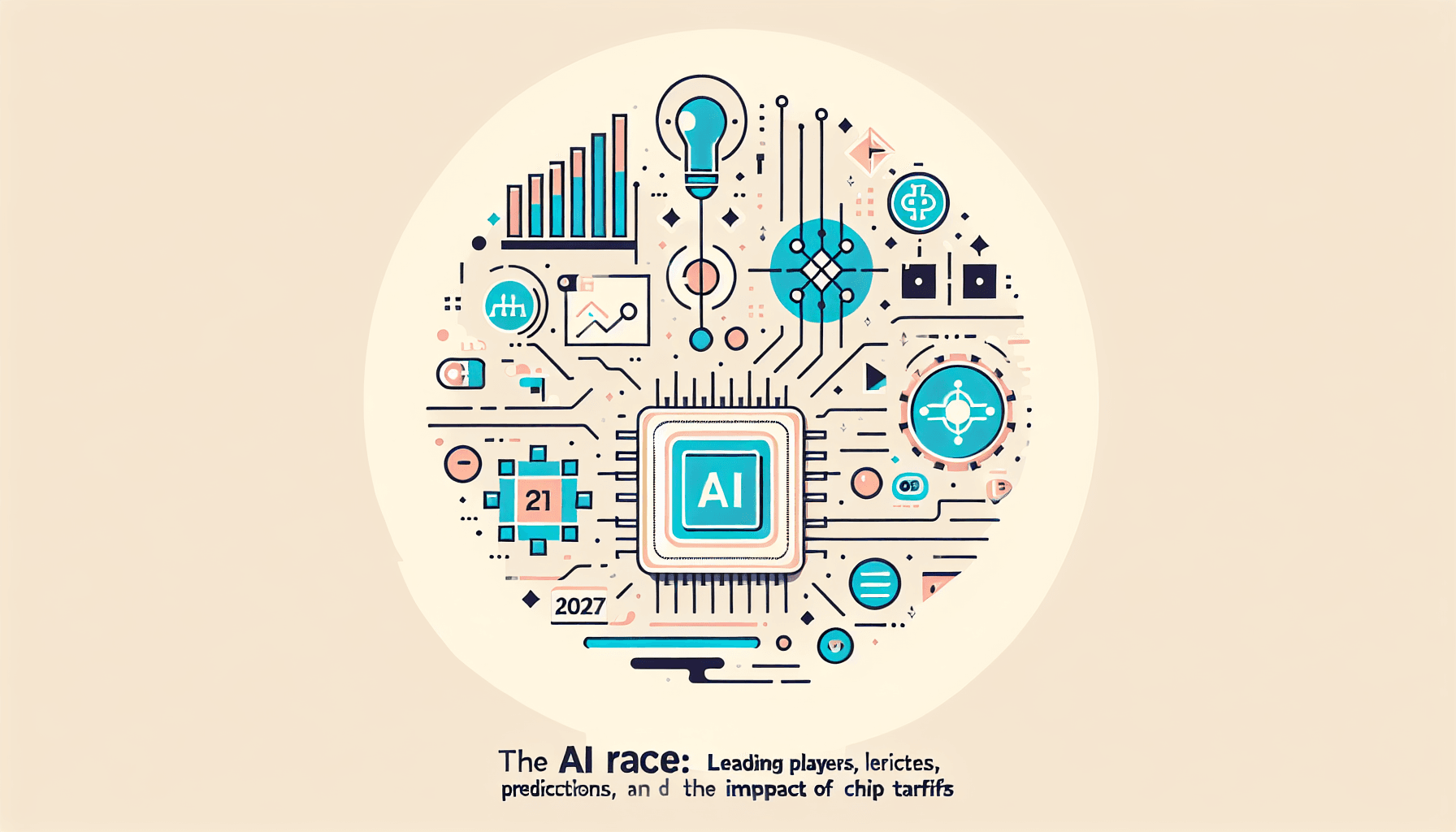
The AI Race: Leading Players, Predictions for 2027, and the Impact of Chip Tariffs
The AI Race: Leading Players, Predictions for 2027, and the Impact of Chip Tariffs
The rivalry among Google, OpenAI, and Meta is transforming the landscape of artificial intelligence (AI) from research undertakings to essential enterprise tools. Beyond the flashy leaderboards and new model launches, we face critical questions: How do we assess who is genuinely ahead? What might the coming years look like if current trends continue? Additionally, how will chip tariffs and supply chain dynamics alter the economics of AI? Here’s a clear guide tailored for both curious readers and busy professionals.
Why AI Leaderboards Matter Now
While leaderboards in AI aren’t a new concept, their significance has surged. With large language models (LLMs) advancing from intriguing prototypes to vital business tools, buyers and policymakers increasingly rely on rankings and benchmarks to navigate this rapidly evolving market. The primary question remains: Who holds the lead—Google, OpenAI, or Meta? The actual answer is more complex.
Different models excel in different areas. Some lead in reasoning-heavy benchmarks, while others excel at long-context retrieval or multimodal understanding. Furthermore, evaluation methods are evolving, incorporating human preference tests, safety checks, and developing standards to keep pace.
Current Leaders: Google, OpenAI, and Meta
All three companies present strong claims to leadership, each excelling in distinct areas. Here’s a concise overview, with public sources for reference.
OpenAI
- GPT-4o: This model offers a more integrated multimodal experience, targeting lower latency and cost for text, vision, and audio applications, thus expanding real-time usability (OpenAI).
- OpenAI emphasizes tool integration, making it easier for developers to link models with structured data and external functionalities.
- Gemini 1.5: This model extends long-context capabilities for coding, document processing, and video, showcasing retrieval capabilities across extensive materials and complex inputs (Google).
- Google enhances its ecosystem by embedding Gemini across Workspace and Android, giving it a distribution edge in productivity and mobile applications.
Meta
- Llama 3: This model provides high-quality open weights, offering developers robust base and instruction-tuned models for self-hosting or fine-tuning, accompanied by comprehensive tools for inference and safety filters (Meta).
- Meta continues to champion the open ecosystem, influencing pricing structures and accelerating innovation among startups and enterprises.
Third-party comparisons, like the LMSYS Chatbot Arena, provide valuable, if imperfect insights. This platform ranks models based on blind, pairwise human preferences, serving as a widely recognized indicator of conversational quality. Nevertheless, results can vary depending on the task, and leaderboards evolve with new models and training techniques.
Decoding AI Leaderboards: Avoiding Common Pitfalls
No singular metric can encapsulate a general-purpose model’s capabilities. To navigate the AI landscape effectively:
- Look beyond single benchmarks. Notable tests, such as MMLU or coding suites, represent only aspects of performance. User preference tests, like Arena, can better reflect perceived quality but vary by task and target audience.
- Consider system-level features. Attributes like long context, multimodality, tool use, and trade-offs in latency and cost often outweigh minor accuracy advantages in practical applications.
- Monitor safety and reliability practices. Aspects like model guardrails, red teaming, and transparency reports are crucial for organizations considering large-scale model adoption. The NIST AI Risk Management Framework has gained traction as a reference for establishing AI risk controls.
- Assess overall ownership costs. Factors like inference costs, GPU availability, and integration complexity are critical, especially for projects with high transaction volumes.
In summary, OpenAI, Google, and Meta each excel in areas that can shape outcomes depending on your specific use case. There’s no one-size-fits-all champion, only optimal solutions for particular tasks.
Understanding “AI 2027”: A Cautious Outlook
The term “AI 2027” has emerged as shorthand for a near-future scenario where advancements in capability, infrastructure demands, and policy pressures converge around the mid-2020s. Although no single report defines this concept, multiple credible indicators suggest potential challenges by the 2026-2027 phase.
Growing Energy and Infrastructure Needs
- The International Energy Agency (IEA) projects that global data center electricity consumption could potentially double by 2026, with AI training and inference as primary contributors (IEA).
- Analysts predict a multi-year investment surge in AI infrastructure, with some projections estimating hundreds of billions of dollars devoted to data centers, chips, and power requirements for AI workloads (Goldman Sachs Research).
Compute and Model Scalability Pressures
- Typically, leading AI systems benefit from rapid growth in training compute. Independent research groups highlight that cutting-edge models increasingly demand significantly greater compute resources, although this trend may slow as efficiency becomes a focus (Epoch AI).
- As models scale, factors such as power, memory bandwidth, and networking become critical constraints, putting pressure on power grids and supply chains.
Challenges in Safety, Reliability, and Governance
- The Stanford AI Index 2024 notes both improvements and rising incident reports, emphasizing the need for stringent evaluations, integrity tools, and specific domain guardrails.
- Governments are advancing frameworks like the NIST AI RMF and the Bletchley Declaration. However, translating these principles into effective oversight at a platform level remains a challenge.
Regulatory and Market Fragmentation
- The EU AI Act establishes a comprehensive, risk-tiered framework with phased obligations. As this takes effect, global companies will encounter varying compliance timelines and documentation requirements across different jurisdictions.
- Inconsistent rules regarding data localization, model transparency, and safety testing may increase costs and impede cross-border deployments.
All in all, “AI 2027” outlines a plausible near-term future adorned with substantial potential yet accompanied by tighter limitations relating to power, chips, and regulatory compliance. The outlook appears grim not due to stagnation in progress but because the challenges associated with scaling are approaching rapidly.
The Impact of Upcoming Chip Tariffs
Chip tariffs have re-entered discussions in the semiconductor realm, significantly affecting AI by contributing to training and inference costs. Two policy aspects are particularly relevant:
Increased U.S. Tariffs on Chinese Semiconductors
- In May 2024, the U.S. announced increased Section 301 tariffs on various categories, including semiconductors. The tariff rate for these items is expected to reach 50 percent by 2025 (White House fact sheet; Reuters).
- Although many advanced AI accelerators are produced outside mainland China, these broader tariff measures can still disrupt supply chains for inputs, legacy nodes, memory, packaging, and equipment, creating uncertainty and potential costs throughout the industry.
Export Controls and Restrictions
- U.S. export regulations limit the sale and transportation of advanced AI chips and semiconductor manufacturing equipment to specified destinations, with recent updates tightening these restrictions as of October 2023 (U.S. BIS).
- Funding from the CHIPS Act comes with national security guardrails that restrict the expansion of advanced semiconductor manufacturing in certain countries for recipients of U.S. subsidies (White House CHIPS guardrails).
These actions coincide with a concentrated supply chain for leading-edge logic chips, predominantly controlled by a few firms and regions. Industry analyses highlight how much of the most advanced fabrication occurs in East Asia, particularly Taiwan, exposing AI purchasers to both geopolitical and logistical risks (SIA).
For AI development teams, the practical takeaway is straightforward: prepare for price fluctuations and lead-time variances, and maintain flexibility across different cloud providers, models, and hardware.
Implications for Teams Delivering AI Products
Whether you’re selecting a model for a product launch or budgeting for infrastructure over the next 24 months, the strategic takeaways remain consistent.
Model Strategy
- Fit to task is more important than leaderboard position. For example, in retrieval-heavy workflows, long-context models may perform better than their higher-scoring counterparts. In creative writing, user preference based on style often surpasses minor benchmark differences. Always test on your specific data.
- Utilize a portfolio approach. Mix a leading model for complex tasks with smaller, more economical models for routine operations. Route requests based on cost-quality balances.
- Prioritize safety from the start. Align with the NIST AI RMF from day one: document intended use, identify potential risks, monitor systems, and prepare an incident response plan.
Infrastructure and Cost Management
- Account for hardware limitations. GPU availability can be cyclic. Negotiate multi-cloud solutions, ensure inference is portable, and keep an eye on the performance-cost dynamics of new accelerators.
- Focus on efficiency. Incorporate techniques such as retrieval augmentation, distillation, and quantization to reduce latency and costs without sacrificing quality.
- Consider energy and compliance expenses. Factors like power availability, targets for carbon intensity, and changing regulatory landscapes can impact deployment decisions.
Policy and Compliance
- Prepare for stricter content integrity measures. Major platforms are increasingly committed to tracking and mitigating the misuse of AI, particularly in elections, indicating that tools for provenance and watermarking will soon become essential (Tech Accord).
- Align EU AI Act timelines with your product strategies. High-risk applications will require documentation, testing, and monitoring after deployment. Even general-purpose providers are gearing up for transparency obligations.
Future Trends to Monitor
Pay attention to several indicators that will inform the trajectory of the AI race and the evolving outlook of “AI 2027.”
- Breakthroughs in evaluation methods. Anticipate improved human-in-the-loop benchmarks, more thorough safety evaluations, and standardized reporting on performance concerning long-context and tool use.
- Overall inference costs. Keep an eye on cloud pricing, new accelerator rollouts, and the quality of open models. A reduced baseline for inference can favor on-device and near-device AI deployments.
- Energy and site considerations. Energy constraints in data centers will influence how quickly AI capabilities expand. Factors like grid connections and clean energy agreements will increasingly figure into product strategies.
- Policy coherence. The relationship among export controls, tariffs, and standards will shape supply reliability and regulatory burdens for global operations.
Conclusion
There isn’t a singular victor in today’s AI landscape. Google, OpenAI, and Meta are each advancing in diverse areas: multimodality, latency, long-context retrieval, and the open ecosystem. The forthcoming “AI 2027” perspective emphasizes our ability to scale responsibly across power, chips, and governance rather than identifying a single smartest player.
For organizations, the strategic approach is clear: select models aligned with your objectives, invest in safety from the outset, keep your technology stack adaptable, and anticipate regulatory hurdles. By doing so, you can filter through the leaderboard noise while fostering enduring capabilities.
FAQs
Are leaderboards like the LMSYS Arena reliable for selecting a model?
They provide valuable insights, especially for assessing conversational quality, but they shouldn’t be relied on as the sole factor. Complement them with focused evaluations on your specific data and tasks. Combine preference-based rankings with metrics for latency, cost, tool use, and long-context fidelity.
What does “AI 2027” forecast?
This term summarizes a near-future outlook whereby AI demand intersects with constraints related to power, chip supply, and tighter regulation. Several sources support this view, including IEA projections for data center electricity consumption, export control policies on semiconductors, and the new EU AI Act.
Will increased U.S. tariffs elevate AI costs?
They could, depending on your hardware supply chain and bill of materials. While most cutting-edge AI accelerators aren’t typically sourced from China, tariffs on semiconductors and related inputs may indirectly heighten expenses. Export controls and restrictions impact where production can grow as well.
How can companies address uncertainties surrounding models and chips?
Implement a diverse model portfolio, keep inference adaptable across various clouds and runtimes, and adopt efficiency methods like retrieval, distillation, and quantization. Secure long-term capacity agreements when feasible and stay updated on policies affecting sourcing.
Is open-source still competitive with proprietary advanced models?
Yes, particularly in numerous applications. Open models are improving in reasoning, coding, and long-context capabilities, and they can be tailored for specific domain tasks. Proprietary models tend to lead in cutting-edge scenarios, but open-source options can excel in cost-effectiveness, customization, and privacy.
Sources
- OpenAI, “GPT-4o” – https://openai.com/blog/gpt-4o
- Google, “Next-generation model: Gemini 1.5” – https://blog.google/technology/ai/next-generation-model-gemini-1-5/
- Meta AI, “Introducing Meta Llama 3” – https://ai.meta.com/blog/meta-llama-3/
- LMSYS, “Chatbot Arena” – https://lmsys.org/arena/
- NIST, “AI Risk Management Framework” – https://www.nist.gov/itl/ai-risk-management-framework
- Stanford HAI, “AI Index Report 2024” – https://aiindex.stanford.edu/report/
- IEA, “Data centres and data transmission networks” – https://www.iea.org/reports/data-centres-and-data-transmission-networks
- Goldman Sachs Research, “AI infrastructure investment” – https://www.goldmansachs.com/insights/pages/gs-research/ai-infrastructure/
- U.S. BIS, “Updates to restrictions on advanced computing and semiconductor manufacturing items” (Oct 2023) – https://www.bis.doc.gov/index.php/documents/about-bis/newsroom/press-releases/3330-2023-10-17-bis-announces-updates-to-restrictions-on-advanced-computing-and-semiconductor-manufacturing-items-destined-to-the-prc/file
- White House, “Fact Sheet: President Biden takes action…” (May 2024) – https://www.whitehouse.gov/briefing-room/statements-releases/2024/05/14/fact-sheet-president-biden-takes-action-to-protect-american-workers-and-businesses-from-chinas-unfair-trade-practices/
- Reuters, “Biden to increase tariffs on Chinese EVs and other sectors” (May 2024) – https://www.reuters.com/world/us/biden-increase-tariffs-chinese-evs-other-sectors-2024-05-14/
- White House, “CHIPS and Science Act guardrails” (Sep 2023) – https://www.whitehouse.gov/briefing-room/statements-releases/2023/09/22/fact-sheet-biden-harris-administration-announces-implementation-of-the-chips-and-science-act-guardrails-to-protect-national-security/
- SIA, “The State of the U.S. Semiconductor Industry 2023” – https://www.semiconductors.org/the-state-of-the-u-s-semiconductor-industry-2023/
- UK Government, “AI Safety Summit 2023 – Bletchley Declaration” – https://www.gov.uk/government/publications/ai-safety-summit-2023-bletchley-declaration/ai-safety-summit-2023-bletchley-declaration
- Microsoft Security Blog, “Tech Accord to combat deceptive use of AI in 2024 elections” – https://www.microsoft.com/en-us/security/blog/2024/02/16/tech-accord-to-combat-deceptive-use-of-ai-in-2024-elections/
- Epoch AI, Research site on compute trends – https://epochai.org/
- Anthropic, “Claude 3.5 Sonnet” – https://www.anthropic.com/news/claude-3-5-sonnet
Thank You for Reading this Blog and See You Soon! 🙏 👋
Let's connect 🚀
Latest Insights
Deep dives into AI, Engineering, and the Future of Tech.
I Tried 5 AI Browsers So You Don’t Have To: Here’s What Actually Works in 2025
I explored 5 AI browsers—Chrome Gemini, Edge Copilot, ChatGPT Atlas, Comet, and Dia—to find out what works. Here are insights, advantages, and safety recommendations.
Read Article


