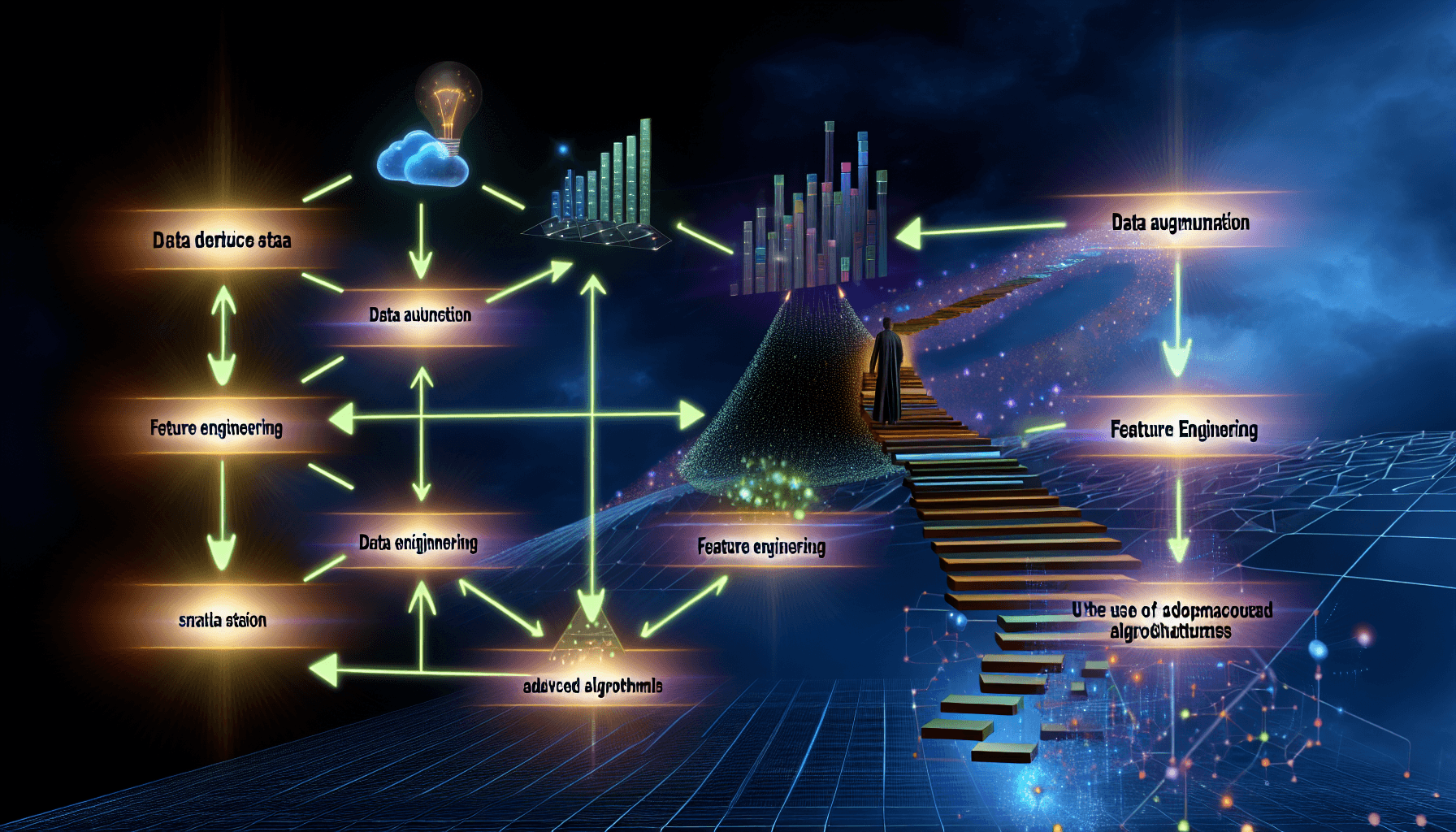
Overcoming Challenges: Scaling Models with Sparse Data
Introduction to Handling Sparse Data in Model Scaling
When building and scaling machine learning models, one challenge that frequently arises is dealing with sparse data. Sparse data refers to datasets that have a large proportion of missing or zero-value elements, which can significantly impact the performance of machine learning models. This blog post will delve into the strategies and techniques to effectively handle and utilize sparse data for scaling models.
Understanding Sparse Data
Sparse data is commonly found in various domains, such as natural language processing, recommendation systems, and image processing. It is characterized by large datasets with many inputs that are predominantly zeros. The sparsity of data can result from various factors like large feature spaces with little information available for many features, or incomplete data collection. Handling sparse data effectively is crucial as it directly impacts model performance, making it a key consideration in the model development process.
Challenges Posed by Sparse Data
The presence of sparse data in a dataset can lead to several challenges:
- Model Complexity: Sparse data tends to increase the complexity of the model as more parameters are required to make accurate predictions with less information.
- Overfitting: With sparse data, there is a higher risk of overfitting as the model may end up learning noise in the data instead of useful patterns.
- Computational Efficiency: Handling large sparse matrices can be computationally intensive and inefficacious, often requiring specialized techniques and tools.
Strategies for Scaling Models with Sparse Data
To effectively scale models while dealing with sparse data, several strategies can be employed:
- Data Imputation: Techniques such as mean imputation, last observation carried forward, or using machine learning models like k-nearest neighbors (KNN) can be used to impute missing values and reduce data sparsity.
- Dimensionality Reduction: Techniques like Principal Component Analysis (PCA) or Truncated Singular Value Decomposition (TSVD) can help reduce the feature space dimensions, making the sparse data more manageable.
- Regularization Techniques: Using regularization methods such as L1 or L2 regularizations helps prevent overfitting by penalizing the larger weights in a model.
- Feature Engineering: Creating new features or transforming existing ones can unveil underlying patterns in the sparse data and enhance model performance.
- Using Appropriate Algorithms: Some algorithms, like decision trees and gradient boosting machines (GBMs), inherently handle sparse data better than others.
Advanced Techniques and Technologies
In addition to basic strategies, several advanced techniques can be utilized to scale models with sparse data:
- Deep Learning: Deep learning models, particularly those with embedding layers or convolutional layers, are well-suited for learning from sparse datasets.
- Data Synthesis: Techniques like SMOTE for oversampling can generate more examples from existing sparse data, aiding in better model training.
- Specialized Libraries and Tools: Utilizing libraries like SciPy for sparse matrix operations, or TensorFlow and PyTorch’s built-in functions for handling sparse inputs, can optimize computational efficiency.
Case Studies
Several successful implementations of models handling sparse data can be seen in industry:
- E-commerce Recommendation Systems: Online retailers use sparse matrices for user item interactions to recommend products effectively.
- Text Classification and Sentiment Analysis: NLP tasks commonly deal with sparse datasets due to the large vocabulary but limited usage of words in documents or sentences.
- Medical Data Analysis: In healthcare, dealing with sparse genetic data for predicting diseases or responses to treatments is common.
Conclusion
Scaling models with sparse data involves understanding the nature of sparsity, the challenges it poses, and applying appropriate strategies to mitigate its effects. By employing a mix of basic techniques like data imputation, advanced methods like deep learning, and leveraging specialized tools, practitioners can efficiently scale models that not only perform well but are also computationally viable.
Thank You for Reading this Blog and See You Soon! 🙏 👋
Let's connect 🚀
Latest Insights
Deep dives into AI, Engineering, and the Future of Tech.

I Tried 5 AI Browsers So You Don’t Have To: Here’s What Actually Works in 2025
I explored 5 AI browsers—Chrome Gemini, Edge Copilot, ChatGPT Atlas, Comet, and Dia—to find out what works. Here are insights, advantages, and safety recommendations.
Read Article


