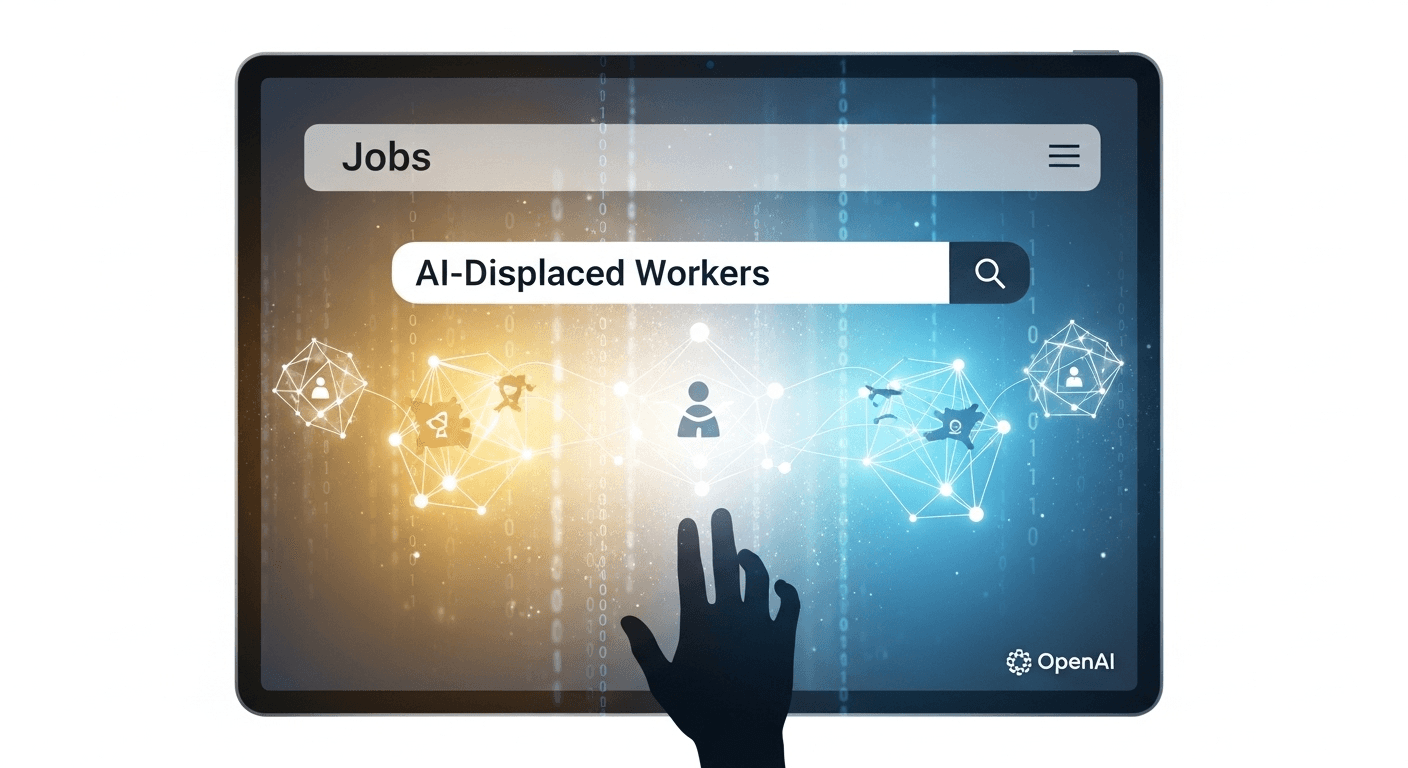
OpenAI’s Jobs Board for Displaced Workers: Genuine Solution or PR Move?
OpenAI’s Jobs Board for Displaced Workers: Genuine Solution or PR Move?
Recent reports about OpenAI piloting a jobs board to assist individuals displaced by AI have generated mixed reactions. Is this a valuable resource or merely a PR strategy to mitigate AI’s impact? Here’s what we know, why it’s essential, and how both workers and organizations can respond.
What’s Being Reported
The Register reports that OpenAI is testing a jobs board designed for workers whose jobs are being automated or reshaped by AI, potentially listing roles from major retailers like Walmart. The irony is apparent: the very company that develops tools reducing human labor is now directing those displaced to new jobs, often lower-paid and outside their original career paths. For more details, see the original report: The Register.
OpenAI has consistently stated its commitment to ensuring the economic benefits of AI are distributed broadly and has identified job transitions as a critical area of concern in its charter and safety guidelines. For more information, check out OpenAI’s charter and responsibility pages: OpenAI Charter, Safety and Responsibility.
Walmart, meanwhile, has significantly invested in automation and AI to enhance its operations and customer experience. The company has introduced generative AI tools for both staff and customers and continues to hire aggressively across stores and supply chains. Learn more about Walmart’s AI initiatives: Walmart on AI and ML, and their 2024 updates: Walmart 2024 AI vision.
As of now, OpenAI has yet to make a formal announcement regarding product specifics or timelines for the jobs board. The Register’s insights should be regarded as preliminary as we await further confirmation and details.
Why This Matters Now
AI is rapidly transforming the workplace. While it can enhance productivity and create new roles, it also has the potential to reshape and even eliminate various jobs. The extent of this change varies by industry and region. Several respected institutions highlight these trends:
- The International Monetary Fund estimates that about 40 percent of global employment could be affected by AI, with advanced economies facing heightened exposure and risks of widening inequality if transitions aren’t well managed. IMF, 2024.
- The OECD reports that nearly a third of jobs in member countries are at high risk of automation or significant transformation, particularly those involving routine and predictable tasks. OECD, 2023.
- The World Economic Forum projects both creation and loss of jobs, with net outcomes depending on policy responses, reskilling efforts, and technology adoption. WEF Future of Jobs 2023.
- Early evidence indicates that generative AI can enhance productivity, especially among less experienced workers, but also alters skill requirements and may reduce certain support roles. See related research: NBER, 2023; Stanford, 2023.
In this context, a jobs board that aims to connect displaced workers with new opportunities could be beneficial, but it also raises crucial questions regarding job quality, wages, worker autonomy, data privacy, and whether corporate solutions can effectively replace public policy initiatives.
What an OpenAI Jobs Board Could Look Like
While we lack official product details, insights based on common features of hiring platforms suggest that a pilot program might offer:
- Aggregated job listings from large employers and staffing agencies, likely including retailers and logistics firms that are hiring extensively.
- AI-assisted resume and application tools that automatically summarize experience, refine bullet points, and match transferable skills to job requirements.
- Skills gap analysis with recommendations for short courses or micro-credentials to help candidates qualify for adjacent roles.
- Interview preparation tools with practice questions and feedback, along with scheduling and status tracking capabilities.
- Employer screening tools that can highlight candidates with relevant skills, immigration or licensing status, and shift availability.
These features are already seen across major platforms like LinkedIn, Indeed, ZipRecruiter, and Workday, many of which use generative AI. The potential distinguishing factor for an OpenAI-branded board would be its focus on AI-displaced workers and seamless integration with advanced language models.
The Core Tension: Does This Solve the Problem It Helped Create?
There is nothing wrong with an AI company assisting users in adapting to change. However, the tension arises from perceived incentives: the same technologies that allow employers to reduce costs through automation may also compress wages or eliminate positions, subsequently funneling displaced individuals into jobs that might not align with their skills or career aspirations.
Two realities can co-exist:
- AI adoption is likely to create new job opportunities in areas like engineering, data, product management, compliance, and content creation. It will also enhance roles in healthcare, education, and customer support.
- Conversely, AI may diminish demand for tasks in clerical, back-office, routine analytical, and entry-level creative roles, with inconsistent impacts across regions and demographics. See IMF, 2024 and OECD, 2023.
In this environment, a jobs board can serve as a transitional tool. However, its effectiveness must be evaluated based on outcomes such as job quality, pay scales relative to previous roles, career advancement, and overall worker wellbeing.
What Good Looks Like: Principles for Responsible AI Job Transitions
If OpenAI — or any tech company — aims to genuinely support displaced workers, it should adhere to several design and governance principles:
- Transparency: Clearly communicate who funds and manages the platform, what data is collected, and how algorithms match candidates and jobs.
- Worker Agency: Empower candidates by allowing them control over data sharing with employers and options to opt out of low-quality or high-turnover roles.
- Quality Metrics: Track and publish statistics on job placement rates, wages, retention, and satisfaction — beyond just clicks or application numbers.
- Skills-First Hiring: Prioritize transferable skills over formal qualifications to broaden opportunities for individuals transitioning across careers.
- Privacy and Safety: Implement strict data minimization and prohibit using application data to train general-purpose models without explicit, informed consent.
- Independent Oversight: Involve labor economists and worker advocates to review outcomes and provide guidance for improvements.
- Public Interest Partnerships: Collaborate with workforce development boards, community colleges, and unions to link job matching with subsidized training and supportive services.
Walmart’s Role and Retail Realities
Major retailers often serve as anchors in job programs due to their consistent hiring across diverse regions. Walmart alone employs over 2 million people globally and offers pathways into management and specialized roles. The company’s digital transformation includes training employees to effectively use AI tools while continuing to hire across stores, distribution, and e-commerce operations. Check out Walmart’s public resources on associate tools and career pathways: My Assistant, Walmart Careers.
However, not all retail roles are created equal; they vary significantly in pay, stability, and scheduling. For a worker transitioning from a specialized clerical or creative position, moving to an entry-level retail job can seem like a downgrade unless it involves a structured upskilling plan. Hence, any AI-driven job initiative should emphasize quality, advancement opportunities, and skills alignment, rather than merely speed of placement.
Evidence from the Field: What We Know About AI and Career Transitions
Several studies provide insight into how AI may transform work and what support systems are effective:
- Generative AI can enhance productivity for customer support agents, with the most significant gains observed among less experienced workers, which helps narrow performance gaps. NBER, 2023.
- Initial corporate pilots demonstrate that AI tools for auto-completion and retrieval assistance can reduce time spent on routine tasks. However, achieving real benefits requires redesigning processes and training workers. For examples, see case studies summarized by McKinsey, 2023.
- The costs of adoption, integration challenges, and accuracy concerns may slow the pace of displacement. A 2023 MIT analysis suggests that automation may be less economically appealing for certain tasks than predicted, at least in the short term. MIT Working Paper, 2023.
- Effective reskilling is most successful when paired with wage support, career coaching, and tangible job opportunities that utilize new skills. Public-private collaborations and community colleges play a vital role in this process. See insights from Brookings and ILR Review, 2023.
Potential Pitfalls and How to Avoid Them
A well-intentioned jobs board can still fall short if not designed with the needs of workers in mind. Be cautious of the following risks:
- Steering Effects: Algorithms that prioritize easily fillable positions can lead workers into lower-wage jobs, reinforcing existing inequalities.
- Data Exploitation: Application data should not be used to train unrelated models or sold to third parties without clear, informed consent.
- Resume Spam: Over-automated application processes could inundate employers with similar resumes, resulting in more filtering and ghosting.
- Credential Creep: If employers impose AI-generated requirements, candidates may face heightened barriers without transparent benefits.
- Fairness Gaps: Without bias testing and accessible design, tools may inadequately serve individuals with disabilities, non-native speakers, or those with non-traditional career paths.
To mitigate these issues, implement transparent ranking algorithms, allow worker control over profiles, utilize skills-based filters, and engage third-party audits to assess bias and outcomes.
What Workers Can Do Right Now
If your job is being reshaped by AI, consider these practical steps to stay ahead:
- Map Your Tasks: Document your weekly activities, noting which ones are repetitive, which require judgement, and which depend on interpersonal relationships. The first group is most vulnerable while the last two represent your enduring strengths.
- Skill Up in Place: Familiarize yourself with the AI tools relevant to your role, from prompt design to data analysis. Free resources like vendor academies and community college micro-courses are readily available. Explore offerings on Coursera, edX, and IBM SkillsBuild.
- Translate Your Skills: Reframe your experience in terms of transferable abilities—operations, customer service, communication, compliance—rather than strictly job titles.
- Test the Market: Apply selectively to roles that leverage your strengths. Avoid one-click applications; instead, customize your resumes to highlight clear achievements and metrics.
- Protect Your Data: Use distinct email addresses for job applications, opt-out of data sharing where possible, and avoid sharing sensitive information with chatbots unless you trust the provider and are familiar with its data policies.
What Employers and Policymakers Should Prioritize
To facilitate fair and effective transitions, companies and governments should consider these complementary actions:
- Employers: Integrate automation with retraining and internal mobility programs. Offer wage insurance or retention bonuses for redeployed staff, while emphasizing job quality over mere cost reductions.
- Educational Providers: Accelerate modular training programs aligned with emerging job roles, offering credits for prior learning and stackable credentials.
- Workforce Boards: Facilitate partnerships between local employers and training institutions. Utilize wage subsidies and holistic supports to ease the transition for affected workers.
- Policymakers: Expand lifelong learning accounts, establish portable benefits, and introduce targeted tax credits for apprenticeships and on-the-job training. Fund unbiased labor market research and data collection.
- All Stakeholders: Publicly share results. Independent assessments can foster trust and inform scaling of effective initiatives.
Bottom Line
If OpenAI is indeed developing a jobs board for individuals displaced by AI, it could offer substantial value — particularly if it focuses on quality jobs, skill-first hiring, strong privacy protections, and transparent outcomes. However, good intentions alone are insufficient. The platform must ultimately be evaluated based on its ability to help individuals secure better employment opportunities swiftly, with clear pathways for growth. Until further details emerge, a balanced skepticism alongside constructive advocacy remains crucial.
FAQs
Is OpenAI officially launching a jobs board?
Currently, there is no formal announcement regarding the product. The Register reports that OpenAI is testing a jobs board aimed at AI-displaced workers. Updates will be provided as soon as OpenAI releases more information.
Will the jobs primarily come from retail and logistics, like Walmart?
Large employers frequently anchor these platforms due to their extensive hiring practices. Expect a variety of roles spanning retail, logistics, customer support, and operations, alongside some technical and compliance positions based on partnerships.
Can AI genuinely assist me in changing careers?
AI tools can expedite the process of tailoring resumes, mapping skills, and preparing for interviews. The key is to focus on transferable skills and pursue positions that genuinely leverage your strengths. Combining tools with coaching and reliable training enhances the chances of success.
How do I safeguard my privacy while using AI job tools?
Review data usage policies, opt-out of model training whenever possible, use unique email addresses for applications, and refrain from uploading sensitive information to chatbots unless the provider guarantees robust privacy measures.
What policies best support workers impacted by AI?
Evidence suggests that wage support during training, affordable reskilling initiatives, internal mobility programs, and transparent reporting on outcomes are practical steps. Public-private partnerships are vital for scaling these interventions effectively.
Sources
- The Register: OpenAI Eases Job Losses with New Job Board
- IMF: GenAI’s Impact on Global Employment (2024)
- OECD: AI’s Influence on Jobs, Innovation, and Skills (2023)
- World Economic Forum: Future of Jobs Report 2023
- NBER Working Paper 31161: The Role of Generative AI in the Workplace (2023)
- Stanford: Boosting Productivity in Customer Support with Generative AI (2023)
- Walmart: Future Retail Vision with AI (2024)
- Walmart: My Assistant – AI Tools for Associates (2023)
- OpenAI Charter
- OpenAI Safety and Responsibility
- McKinsey: The Economic Landscape of Generative AI (2023)
- Brookings: Ensuring Shared Benefits from AI
- MIT Working Paper on AI’s Adoption Costs and Labor Impact (2023)
- ILR Review: Outcomes in Workforce Development Programs (2023)
Thank You for Reading this Blog and See You Soon! 🙏 👋
Let's connect 🚀
Latest Insights
Deep dives into AI, Engineering, and the Future of Tech.

I Tried 5 AI Browsers So You Don’t Have To: Here’s What Actually Works in 2025
I explored 5 AI browsers—Chrome Gemini, Edge Copilot, ChatGPT Atlas, Comet, and Dia—to find out what works. Here are insights, advantages, and safety recommendations.
Read Article


