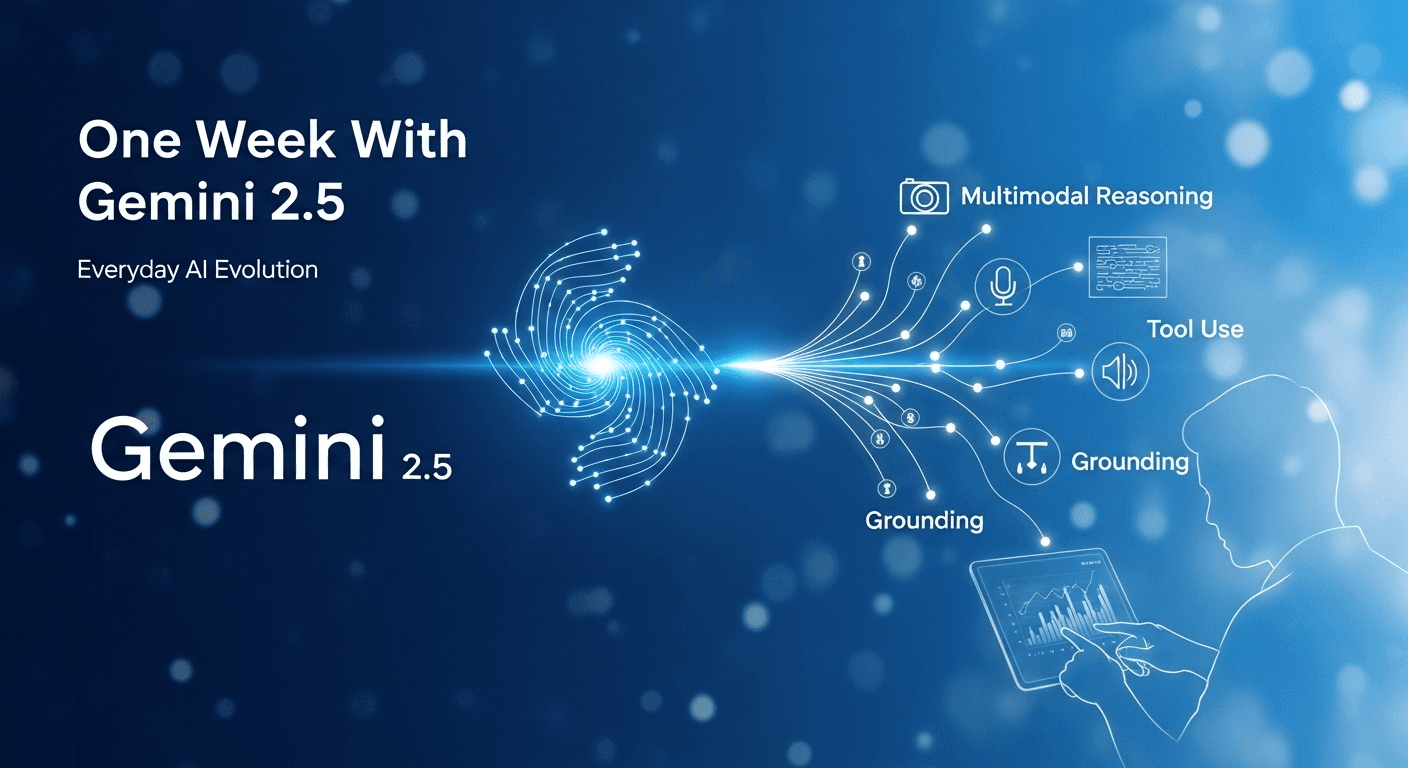
One Week With Gemini 2.5: What Google Changed About Everyday AI
One Week With Gemini 2.5: What Google Changed About Everyday AI
Just a week ago, Google launched Gemini 2.5, and we’re already starting to see its differences: faster, more capable multimodal reasoning, better integration with your everyday tools, and a more straightforward approach to creating real workflows. If you’re eager to understand these changes and how they can benefit you daily, this guide breaks down the key highlights, trade-offs, and what you can try next.
Why This Release Matters
Google is evolving from basic chatbots to advanced multimodal systems that can reason through text, code, images, and audio. With Gemini 2.5, they’re pushing deeper into agentic AI — systems capable of planning steps, utilizing tools, and handling multi-phase tasks. This evolution is important for anyone seeking AI that does more than just answer questions: from data professionals managing spreadsheets to product teams crafting smart assistants and everyday users needing reliable support for routine tasks.
Even if you’re not a developer, expect to feel the impact in environments like the Gemini web app, Android, Google Workspace, and apps utilizing the Gemini API and Vertex AI. Google hinted at this direction during I/O 2024, showcasing reasoning, multimodality, and agent capabilities as the future of AI (Google I/O highlights). Gemini 2.5 represents a significant step forward.
What is Gemini 2.5?
Gemini 2.5 is the latest iteration in the Gemini series, built to enhance reasoning over longer inputs, deepen multimodal understanding, and improve tool reliability. You can access it through the Gemini web and mobile apps or via the Gemini API and Vertex AI for developers (Gemini API) (Vertex AI).
This update focuses not only on sheer model power but also on agentic capabilities like function calling, structured outputs, tool orchestration, and grounding models in real-time information.
What’s New and Why It Matters
1) Enhanced Multimodal Reasoning
Gemini 2.5 processes a variety of inputs — documents, images, tables, snippets of code — more naturally, reasoning through them for coherent outputs. For everyday users, this means you can upload a PDF and a screenshot of a dashboard and request a clear summary with actionable items. For teams, this capability allows richer workflows like sorting customer emails with attachments or reviewing product images alongside specification sheets (Google I/O highlights) (Gemini API).
2) Agentic Workflows and Tool Usage
Tool integration is becoming more reliable and easier to manage. Gemini 2.5 can generate well-structured JSON, select from multiple tools, and execute them in sequence. This enables assistants capable of planning steps and executing them seamlessly – for instance, analyzing a dataset, calling a visualization service, and drafting a summary complete with charts. Developers can set up functions and schemas using the Gemini API or utilize Vertex AI’s server-side tools for enterprise-level orchestration (Gemini API) (Vertex AI).
3) Longer Context, Fewer Copy-Paste Loops
In previous releases, long-context capability was a highlight, and Gemini 2.5 continues to build on this. The advantage is straightforward: the model considers much more of your material at once, which minimizes the need for pre-chunking or summarizing. This is particularly beneficial for tasks like literature reviews, drafting responses for RFPs, and navigating codebases (Gemini product updates).
4) Grounding with Trusted Sources
Grounding helps curtail hallucinations by allowing the model to reference external sources. Google provides grounding via Google Search in consumer applications, while enterprise developers can utilize Vertex AI Grounding to link models with private knowledge bases and verify information against reliable sources (Vertex AI Grounding). Expect improved citations, decreased errors, and clearer responses.
5) Live and Real-Time Interactions
The real-time functionalities of Gemini are continuing to evolve, enhancing both latency and user interactivity. You can now interrupt, guide, and resume conversations — crucial features for voice assistants, coaching, and co-browsing. Developers can leverage the streaming APIs to create experiences that feel conversational rather than purely request-response (Gemini API).
6) Improved Code and Data Handling
Gemini 2.5 is more adept at generating structured outputs, performing tabular transformations, and making step-by-step code adjustments. This results in fewer retries when requesting function refactoring, SQL cleanups, or reconciling CSV files against business rules. While it’s not a compiler or data warehouse, it certainly enhances reliability in the process.
Hands-On Impressions After a Week
In practical applications, Gemini 2.5 enhances the user experience significantly. Here are the noteworthy trends observed following early tests and community feedback:
- Speed and Stability – Initial responses are quicker in real-time mode, and long-context tasks experience fewer timeouts. This increases responsiveness during brainstorming and document organization.
- Fewer Formatting Issues – Structured outputs and function calling have become more consistent, reducing the need for fragile post-processing.
- Enhanced Multimodal Grounding – Tasks combining image and text are more reliable when requesting references or citations, particularly through Vertex AI Grounding.
- Math and Code – While verification remains essential, there are fewer subtle logic errors in multiphase prompts. Adding tool calls to a Python or SQL runtime boosts reliability.
- Everyday Time-Savers – Summarizing PDFs with actionable items, drafting context-aware emails, and rewriting tables are smoother and require fewer retries.
Despite these improvements, it’s essential to confirm outputs. For critical tasks, maintain human oversight and utilize grounding or retrieval methods to validate claims.
Benchmarks, Claims, and Their Real Implications
Every major model release comes packed with impressive figures. While these benchmarks can be informative, real productivity hinges on how well your tasks perform with your unique data and tools. Remember:
- Vendor Benchmarks Are Curated – They typically highlight strengths. Seek out independent assessments like Chatbot Arena’s crowdsourced rankings and research benchmarks where available (LMSYS Chatbot Arena).
- Agent Tasks Are Complex to Measure – Planning, tool selection, and error recovery remain challenging. Expect variability and implement guardrails.
- Grounding Changes the Game – A smaller model grounded in up-to-date, credible sources may outperform a larger model solely relying on parameterized memory (Vertex AI Grounding).
- Context Helps, but Doesn’t Solve Everything – Long context alleviates some pain points in prompt engineering, yet retrieval strategies, chunking, and schema design remain vital.
For a broader perspective on the AI landscape, the Stanford AI Index provides useful annual insights into capability and impact trends (Stanford AI Index).
How to Try Gemini 2.5 Right Now
- Gemini Web and Mobile Apps – Ideal for daily tasks such as summarization, brainstorming, and Q&A with images and documents. Check out the Gemini site or app on Android and iOS (Gemini updates).
- Gemini API – Create chat and tool-using applications with multimodal functionalities. Get started with the official documentation and quickstart guides (Gemini API).
- Vertex AI on Google Cloud – For enterprise deployments, this offers governance, private networking, monitoring, and grounding capabilities. It’s great for connecting to internal data and tools (Vertex AI).
Developer Guide: Building Agents That Actually Ship
Gemini 2.5 works best when you design for tool utilization and structured outputs from the onset. A solid approach includes:
- Define Clear Roles and Goals – Clearly outline the model’s mission and constraints, specifying steps, success criteria, and when to seek assistance.
- Utilize Schemas – Request JSON that aligns with a predetermined schema. Validate stringently and aim for rapid failure. Keep schemas concise and iterate on them.
- Break Down the Task – Divide tasks into understanding, planning, execution, and review phases. Store intermediate artifacts and outputs explicitly.
- Ground Before Generating – Retrieve context from trusted sources and input that into the model. Use Vertex AI Grounding or your own retrieval systems (Vertex AI Grounding).
- Instrument Everything – Keep logs of prompts, tool inputs, outputs, and error states. Implement evaluations for your top tasks and track them weekly.
Regarding cost and latency, be cautious: agent chains can become expensive and time-consuming. Be strategic about caching, opt for smaller models for classification and retrieval, and employ high-tier models for complex reasoning tasks.
Privacy, Safety, and Governance
Consumer and enterprise experiences vary in their data handling, storage, and improvement processes. If you’re developing with Gemini, it’s critical to understand data flows:
- Enterprise Controls – Vertex AI offers organization-level policies, VPC peering, CMEK options, and audit logging. Data logging can be disabled, and data residency can be customized (Vertex AI).
- Responsible AI Tools – Safety filters, content moderation, and the capacity to prevent certain requests are essential for production (Vertex AI Responsible AI).
- Model Transparency – Look for model cards, safety notes, and evaluations detailing limitations and intended use cases (Google AI Safety).
Ultimately, treat Gemini 2.5 as a powerful asset — supply only the necessary data, ground answers in credible sources, and mandate human oversight for critical outputs.
Comparative Analysis with Leading Models
No single model excels across all tasks. Here’s a practical comparison to consider:
- OpenAI GPT-4o and Newer Reasoning Models – Excellent for real-time multimodal experiences and strong coding assistance. Gemini 2.5 narrows some gaps in latency and tool usage, particularly when grounded in Google Search or specific enterprise knowledge (OpenAI GPT-4o).
- Anthropic Claude 3.5 Sonnet – Lauded for helpfulness and exceptional writing quality, with robust long-context capabilities. Gemini 2.5 competes effectively in multimodal tasks and integrates effectively with Google’s ecosystem (Claude 3.5 Sonnet).
- Open-Source Models – Llama and other models are rapidly improving and suitable for privacy-sensitive uses. Gemini 2.5 offers superior out-of-the-box multimodal features and agent tools, especially for Google Cloud users.
When unsure, prototype your most critical workflows across the top three models and let results, not marketing hype, guide your decision.
Real-World Use Cases to Explore
- Research Brief with Citations – Upload a whitepaper and some screenshots, request a five-bullet summary, include three questions for the author, and require citations for all claims. Consider adding Grounding for added reliability.
- Customer Support Triage – Direct incoming queries using a smaller model, then leverage Gemini 2.5 to draft responses that reference relevant database articles. Ensure human approval for any significant issues.
- Marketing Operations – Input the latest brand guidelines and past campaign materials, then let Gemini generate a messaging brief, image prompts, and a 15-second script—all aligned with a validated JSON schema.
- Engineering Support – Provide Gemini with a repository map and specifications, ask for a detailed change plan along with file paths and commit messages, and selectively approve diffs once tests are completed.
- Analytics Quality Checks – Paste a dashboard export with KPI definitions, ask for outliers, likely causes, and data quality assessments. Ensure integrity by grounding it against your internal documentation.
Limitations to Consider
- Hallucinations Are Reduced, Not Eradicated – Grounding and citations assist, but thorough verification is still necessary.
- Agent Chains Might Drift – Extended, complex plans could stray off course. Incorporate checkpoints and safety measures.
- Latency vs. Quality Tradeoffs – Increased reasoning often translates to longer processing times. Optimize caching and select appropriate model sizes.
- Compliance Requires Team Collaboration – Even with excellent tools, deploying solutions necessitates rigorous security, privacy, and risk assessments.
What to Watch for Next
A few key areas to look forward to following the release of Gemini 2.5:
- Deeper Workspace Integration – Expect intelligent summaries and drafting within Docs, Sheets, and Gmail, complete with clearer citations and improved data handling.
- More Robust Agent Frameworks – Simplified patterns for planning and multi-tool orchestration, along with improved observability and retry mechanisms.
- Evaluation and Safety Transparency – More detailed model cards, publicly accessible evaluation suites, and features geared toward responsible AI implementation.
- Hybrid Retrieval – Combining Search grounding with private retrieval, ensuring answers cite both public and internal knowledge when necessary.
Final Thoughts
One week in, Gemini 2.5 has proven to be more than just a flashy release; it feels like a dependable upgrade. Enhanced multimodal reasoning, improved tool usage, and clearer pathways to grounded workflows make it easier for users to engage productively. If you encountered issues with latency or reliability in earlier versions of Gemini, now is an excellent time to give it another shot — particularly with your own datasets, tasks, and criteria for success.
FAQs
Is Gemini 2.5 Free to Try?
You can explore Gemini through its web and mobile applications, which offer free tiers in many regions. Developer and enterprise access via the Gemini API and Vertex AI may incur usage charges. Check Google’s pricing pages for the latest details (Gemini API) (Vertex AI Pricing).
Can Gemini 2.5 Browse the Web?
Consumer applications can use Google Search grounding to access recent information and provide citations. In enterprise contexts, you can connect Gemini to both public and private data sources using Vertex AI Grounding and retrieval systems to validate assertions (Vertex AI Grounding).
What is the Context Window Size?
Google provides long-context variants and is consistently expanding these limits. The effectiveness of context also hinges on how you structure and retrieve relevant information. When unsure, pair long context with retrieval techniques and well-defined schemas (Gemini Updates).
Can Gemini 2.5 Replace My Coding Assistant?
It can certainly expedite code comprehension and drafting, particularly with clear specifications and tests. For production-level adjustments, keep human resources involved, enforce testing protocols, and validate changes.
Is Gemini 2.5 Safe for Sensitive Data?
Enterprise deployments on Vertex AI ensure governance, network controls, and data residency options. You can deactivate logging and use your encryption keys. Always ensure alignment with your organization’s security and compliance standards (Vertex AI) (Responsible AI).
Sources
- Google I/O 2024: AI Highlights and Innovations
- Google Gemini API Documentation
- Vertex AI Generative AI Overview
- Vertex AI Grounding – Connect Models to Authoritative Sources
- Vertex AI Responsible AI Overview
- Google AI Safety Resources and Model Transparency
- OpenAI GPT-4o Multimodal Overview
- Anthropic Claude 3.5 Sonnet Announcement
- LMSYS Chatbot Arena – Community Model Comparisons
- Stanford AI Index Report
- Google Gemini Product Updates
Thank You for Reading this Blog and See You Soon! 🙏 👋
Let's connect 🚀
Latest Insights
Deep dives into AI, Engineering, and the Future of Tech.
I Tried 5 AI Browsers So You Don’t Have To: Here’s What Actually Works in 2025
I explored 5 AI browsers—Chrome Gemini, Edge Copilot, ChatGPT Atlas, Comet, and Dia—to find out what works. Here are insights, advantages, and safety recommendations.
Read Article


