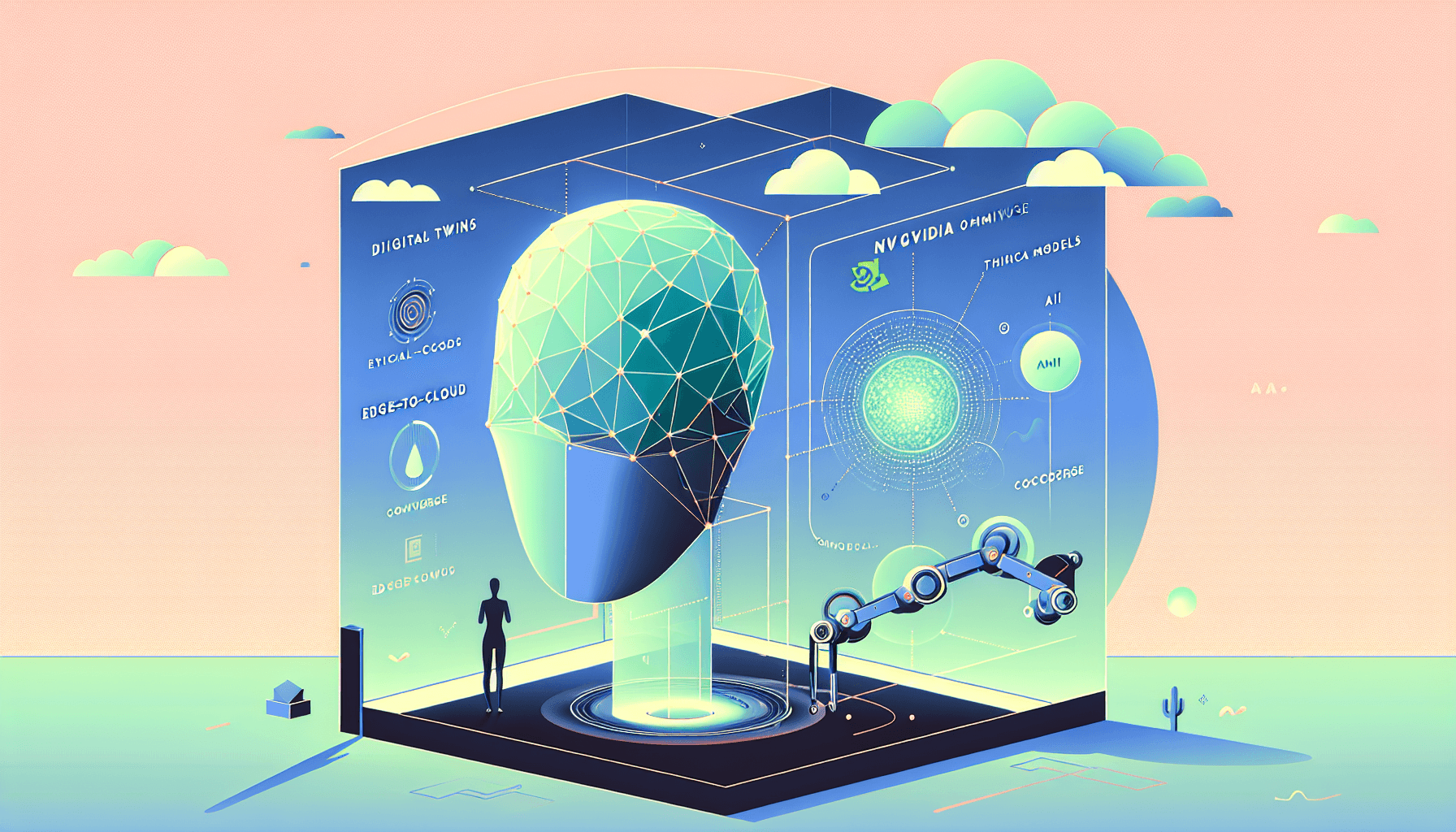
NVIDIA Omniverse and Cosmos: A New On-Ramp to Real-World Robotics
NVIDIA Omniverse and Cosmos: A New On-Ramp to Real-World Robotics
Robots learn best when they can practice safely millions of times in rich virtual worlds, then apply those skills in the real world. NVIDIA is reinforcing this idea with new Omniverse libraries, Cosmos physical AI models, and an enhanced computing stack designed to help teams transition smoothly from simulation to real-world deployment, boosting confidence in the process.
This overview breaks down NVIDIA’s latest announcements into simpler terms, explains their significance, and directs you to reliable sources for further exploration.
At a Glance: What NVIDIA Announced
- New Omniverse Libraries: Building blocks for creating high-fidelity digital twins and robotics simulations based on OpenUSD, a scene description standard initially developed by Pixar and now supported by a wide industry coalition.
- Cosmos Physical AI Models: Foundation models trained to understand and predict real-world physics and interactions, intended to help robots perceive, plan, and act more reliably.
- Expanded AI Computing Infrastructure: From cloud-scale GPU systems for training and simulation to NVIDIA Jetson for edge deployment, plus microservices that simplify the integration of AI into products.
For the official announcement, check out NVIDIA’s newsroom post: NVIDIA opens portals to a world of robotics with new Omniverse libraries, Cosmos physical AI models, and infrastructure.
Why This Matters for Robotics
Robotics teams often face a common challenge: how to train and validate AI policies across numerous scenarios without risking equipment or safety. High-fidelity simulation offers a safe environment, but for it to be truly valuable, virtual worlds must be physically accurate, work well with existing tools, and connect to real sensors, controllers, and workflows.
This is where NVIDIA Omniverse shines, pushing for OpenUSD, a standardized method to describe complex 3D scenes. OpenUSD is gaining support from major industry players like Pixar, Apple, Adobe, Autodesk, and NVIDIA through the Alliance for OpenUSD. On this foundation, NVIDIA is adding physics-based rendering, sensor simulation, and AI model integration so robots can learn in a world that accurately mirrors the one they will eventually operate in.
Omniverse Libraries: Building Digital Twins on OpenUSD
NVIDIA Omniverse serves as a platform for constructing virtual worlds and digital twins using OpenUSD. The new libraries unveiled by NVIDIA focus on three main pillars:
- Interoperability: OpenUSD allows teams to build scenes from various DCC and CAD tools without continuous import-export tasks. This means that a robot simulation can incorporate a factory layout from CAD, materials from a renderer, and dynamic assets from game engines while maintaining synchronization.
- Physical and Sensor Realism: Omniverse integrates high-quality physics and photorealistic rendering, along with sensor models for cameras, LiDAR, and IMUs. Accurate sensor simulation is crucial for training and validating perception systems before interacting with hardware. Discover more about the robotics stack in NVIDIA Isaac and Isaac Sim.
- Scalability: Because OpenUSD scenes are composable, you can scale from a single cell to an entire facility. Companies like BMW have utilized factory digital twins to enhance planning and throughput. For context, see how BMW uses Omniverse on Reuters.
In summary, Omniverse libraries assist in constructing worlds that are shareable, accurate, and interconnected with your entire toolset.
Cosmos Physical AI Models: Teaching Robots About the World
Cosmos comprises NVIDIA’s physical AI models, crafted to learn the rules and regularities of the real world from both data and simulation. Rather than solely recognizing pixels or texts, these models capture how objects, materials, and forces interact. This knowledge empowers robots to plan ahead, choose safer actions, and adapt to new situations.
How Cosmos Fits Into the Stack
- Perception: Enhance object understanding with models that reason about depth, occlusion, and physical affordances.
- Planning: Anticipate how a scene will evolve if the robot undertakes a particular action, leading to better motion plans.
- Simulation: Generate physically consistent scenarios to rigorously test policies before deploying them on real hardware.
The concept of a model that internalizes physics aligns with broader trends in AI, such as world models and model-based reinforcement learning. Though specifics will evolve, NVIDIA envisions Cosmos as an engine for physical common sense, capable of bridging simulation to real-world gaps for robots. For insights on NVIDIA’s broader robotics roadmap, refer to its GTC 2024 updates, including the Isaac platform and Project GR00T for general-purpose robot learning here.
AI Computing Infrastructure: From Cloud Training to Edge Deployment
Simulation and model training require substantial computational resources, while real robots must operate reliably on the edge. NVIDIA is addressing both needs:
- Cloud and Data Center: GPU-accelerated systems for training and large-scale simulation, including reference architectures for digital twins like NVIDIA OVX.
- Edge AI with Jetson: The NVIDIA Jetson family powers robots, drones, and autonomous machines with on-device inference and sensor fusion capabilities.
- Microservices and Deployment: NVIDIA’s NIM inference microservices package optimized AI models behind stable APIs, facilitating integration into applications and products.
These components are integrated into the NVIDIA Isaac robotics stack, which includes GPU-accelerated libraries, ROS 2 integration, and simulation workflows. Developers can access Isaac resources here and find ROS 2 information here.
What This Unlocks: Practical Use Cases
- Industrial Automation: Simulate new assembly lines, optimize robot cell layouts, and ensure safety before any materials are installed.
- Warehouse Robotics: Train perception and navigation policies across numerous layouts, lighting conditions, and edge cases, then deploy with confidence across fleets.
- Field Robotics: Model complex physics like deformable terrain or weather effects to prepare robots for tasks in construction, agriculture, or inspection.
- Humanoids and Manipulation: Utilize world models and high-fidelity simulations to teach dexterous skills, fine-tuning them on real hardware with fewer trial runs.
The underlying goal: reduce costly real-world experimentation by leveraging realistic simulations for more learning and testing possibilities.
How to Get Started
- Standardize Assets with OpenUSD: Organize your environments, robots, and sensors into OpenUSD to foster collaborative efforts across tools. Learn more at openusd.org.
- Prototype in Isaac Sim: Build and test perception and control loops using Isaac Sim; connect with ROS 2 stacks to reapply drivers and planners.
- Incorporate Physical AI Models: Experiment with models that predict scene dynamics or provide physical priors for planning and manipulation. Cosmos is designed for this purpose.
- Scale Up Testing: Utilize cloud GPUs or OVX-class systems for running comprehensive scenario batches and Monte Carlo testing across variations.
- Deploy to Edge: Package inference using NVIDIA NIM microservices and operate on Jetson devices for real-time performance.
Key Takeaways
- OpenUSD along with Omniverse provides teams with a unified, physics-aware language for developing digital twins.
- Cosmos physical AI models aim to impart robots with physical common sense and improve sim-to-real transfer.
- NVIDIA’s compute stack encompasses everything from training and simulation to edge deployment, reducing integration complexities.
FAQs
What is physical AI, and how does it differ from generative AI?
Generative AI focuses on creating content like images or text. In contrast, physical AI is concentrated on understanding and predicting real-world behaviors so that agents can act safely and effectively. Cosmos emphasizes this physics-centric layer for robotics and simulation.
Do I have to adopt OpenUSD to use Omniverse?
Omniverse is built around OpenUSD. Embracing OpenUSD enables teams to share assets and construct scenes seamlessly across tools without any loss of data, especially vital for large digital twins.
How does this relate to NVIDIA Isaac?
Isaac offers GPU-accelerated robotics libraries, bridges to ROS 2, and simulation tools like Isaac Sim. Omniverse provides the foundational world-building and rendering capabilities, while models like Cosmos infuse physical intelligence.
Can I deploy models trained in Omniverse to real robots?
Absolutely. The typical workflow involves training and validating in simulation, then deploying for inference on edge hardware like NVIDIA Jetson. Careful calibration and further real-world adjustments are suggested to minimize the sim-to-real gap.
Is this only for large enterprises?
No, while larger facilities can leverage full digital twins, smaller teams can still use Isaac Sim for prototyping, execute training in the cloud, and utilize compact Jetson devices for deployment.
Conclusion
The field of robotics is evolving from hand-crafted systems to data-driven models that learn from millions of simulated and real experiences. NVIDIA’s newest enhancements to Omniverse, the Cosmos family of physical AI models, and a comprehensive compute stack are accelerating this transition. The objective is straightforward: equip robots with a better understanding of the world, validate more in virtual environments, and enable faster deployment with fewer unforeseen challenges.
Sources
- NVIDIA Newsroom – Omniverse libraries, Cosmos physical AI models, and AI computing infrastructure
- NVIDIA Omniverse overview
- OpenUSD – Official site
- NVIDIA Isaac robotics platform
- NVIDIA Isaac Sim
- NVIDIA OVX systems for digital twins
- NVIDIA Jetson edge AI platform
- NVIDIA NIM inference microservices
- NVIDIA GTC 2024 keynote highlights – Robotics and AI
- Reuters – BMW taps NVIDIA’s Omniverse for virtual factories
Thank You for Reading this Blog and See You Soon! 🙏 👋
Let's connect 🚀
Latest Insights
Deep dives into AI, Engineering, and the Future of Tech.
I Tried 5 AI Browsers So You Don’t Have To: Here’s What Actually Works in 2025
I explored 5 AI browsers—Chrome Gemini, Edge Copilot, ChatGPT Atlas, Comet, and Dia—to find out what works. Here are insights, advantages, and safety recommendations.
Read Article


