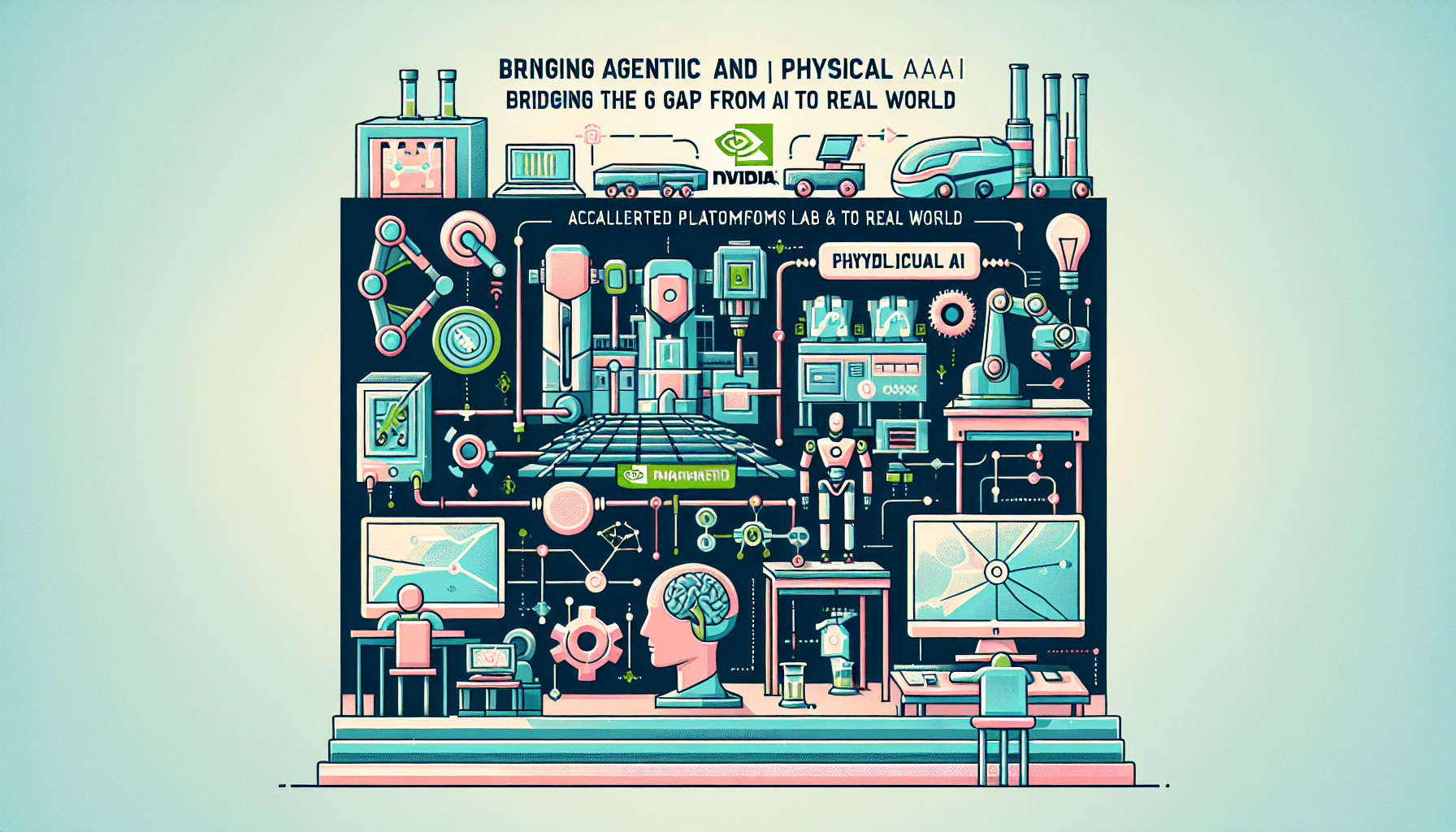
NVIDIA and Google Join Forces to Bring Agentic and Physical AI Into the Real World
NVIDIA and Google Join Forces to Bring Agentic and Physical AI Into the Real World
Two of the most influential players in AI—NVIDIA and teams across Alphabet, including Google—are teaming up to speed up the next wave of intelligent systems: agentic AI that can plan and act, and physical AI that can understand and operate in the real world. Let’s dive into what this collaboration means and why it’s happening now.
Why This Collaboration Matters
AI is evolving from static chatbots to agents that can reason, decide, and take actions across tools and environments—often referred to as agentic AI. Simultaneously, advancements in embodied or physical AI are transitioning robots from controlled labs to dynamic settings like warehouses, hospitals, and homes. The combination of NVIDIA’s accelerated computing and robotics technology with Google’s extensive models, research, and cloud capabilities aims to make these systems more effective, reliable, and widely applicable.
NVIDIA has announced its collaboration with Alphabet and Google to push forward both agentic and physical AI, building on existing efforts related to cloud infrastructure, model serving, and robotics simulation. You can find NVIDIA’s announcement with further details and updates here.
Quick Definitions
- Agentic AI: Systems that can plan, utilize tools and APIs, gather information, and perform multi-step tasks with minimal supervision. Examples include research assistants that browse information, coding agents that fix bugs, and customer service bots that resolve issues end-to-end.
- Physical AI: Embodied intelligence in machines and robots that can perceive, reason, and act in the physical world, often termed embodied AI, which includes skills like manipulation, navigation, and multi-modal understanding.
What NVIDIA Brings
NVIDIA provides the accelerated computing backbone, model-runtime software, and robotics platforms developers use to create, simulate, and deploy intelligent systems:
- Accelerated AI Software: NVIDIA AI Enterprise and NVIDIA NIM inference microservices assist teams in deploying advanced models as secure, optimized services across clouds and data centers.
- Robotics and Simulation: The NVIDIA Isaac platform, which includes Isaac Sim and Isaac Lab, allows developers to train and test robot skills in high-fidelity simulations, which can then be transferred to real robots, reducing costs and accelerating iteration for physical AI.
- Edge Compute for Robots: NVIDIA Jetson modules enable perception and control on-device, supporting low-latency autonomy for mobile and collaborative robots.
What Google and Alphabet Bring
Across Alphabet, Google and Google DeepMind contribute multi-modal foundational models, agent research, and extensive datasets—essential components for both agentic and physical AI:
- Agent and Multi-Modal Models: Google is investing in agent capabilities within its Gemini model family and tool orchestration, as showcased at Google I/O 2024 with advancements in long-context reasoning and real-time perception (Google).
- Robotics Foundation Models: Google DeepMind’s RT-2 vision-language-action model demonstrated how internet-scale knowledge can help robots perform a variety of open-ended tasks (DeepMind).
- Cross-Robot Datasets: The Open X-Embodiment initiative aggregates diverse robot data across platforms to enhance generalization—a vital step for physical AI to function across many types of robots (Open X-Embodiment).
Additionally, Google Cloud offers global reach and enterprise-level security for AI workloads and has an ongoing partnership with NVIDIA to ensure accessible accelerated infrastructure and software for developers (NVIDIA).
How the Collaboration Could Advance Agentic AI
Agentic AI excels when planning, tool usage, and model inference are efficient and safe at scale. The alignment between NVIDIA and Google is set to enhance this in several ways:
- Faster, More Affordable Inference: Optimized runtimes and accelerators can reduce the cost of long-context, multi-step agents, enabling richer reasoning and processing of multi-modal inputs.
- Tooling and Orchestration: Standardized APIs and microservices simplify the process of chaining tools, invoking specialized models, and monitoring end-to-end agent workflows.
- Enterprise Deployment: Cloud-native architectures aid organizations in deploying agents either behind their firewalls or in the cloud with observability, guardrails, and access controls.
Google has articulated a roadmap for more capable real-time agents, including Project Astra and agentic experiences showcased at I/O (Google). Running these systems on NVIDIA-accelerated platforms and services can help reduce latency and costs while enhancing reliability.
How the Collaboration Could Accelerate Physical AI
Bridging the simulation-to-reality gap is a crucial challenge in robotics. NVIDIA’s Isaac platform offers physics-accurate simulation and GPU-accelerated training, while Google DeepMind’s robotics models and datasets enhance generalization across various tasks and hardware. Collaborative efforts can:
- Scale Data and Training: Combine large, varied robot datasets with rapid simulation to create robust policies for manipulation and navigation.
- Improve Transfer to Real Robots: Utilize domain randomization, photorealistic rendering, and multi-modal grounding to reliably move skills from simulation to the real world.
- Standardize Evaluation: Establish shared benchmarks and testing suites to assess advancements in safety, reliability, and productivity for embodied AI.
Prior research, like RT-2 and Open X-Embodiment, has shown that leveraging web-scale knowledge and multi-robot data can broaden what robots comprehend and can achieve. Combining these insights with robust industrial-grade simulation and deployment stacks is a logical next step.
Where This Lands in the Real World
We can expect near-term impacts in sectors that already incorporate automation and AI-assisted workflows:
- Warehousing and Logistics: Agents coordinate fleets while robots manage picking, packing, and transportation more efficiently and safely.
- Manufacturing: Inspectors utilize vision models for early defect detection, while collaborative robots (cobots) adapt to new tasks more rapidly using general-purpose policies.
- Healthcare: Agents assist clinicians in summarizing records and scheduling care, while mobile robots transport supplies and support staff.
- Field Service: Autonomous systems handle inspections and maintenance, with AI copilots supervising and intervening as necessary.
- Customer Operations: Agentic AI oversees end-to-end workflows, invoking tools, updating records, and coordinating with humans for approvals.
Safety, Governance, and Evaluation
As agentic and physical AI increase system autonomy, responsible deployment becomes critical. Organizations should align with established frameworks and principles, such as:
- NIST AI Risk Management Framework for identifying, measuring, and mitigating risks.
- Google’s AI Principles focusing on fairness, safety, accountability, and privacy.
This translates to implementing guardrails, continuous evaluations, human oversight, and robust MLOps practices for both software agents and embodied systems.
How to Get Started
If you’re looking to explore agentic or physical AI, here are some practical next steps:
- Prototype an agent workflow incorporating tool usage, then assess latency and costs under realistic workloads.
- Utilize simulation to pre-train and stress-test robotic skills before conducting real-world trials.
- Implement standardized model-serving and observability, like microservices and tracing, to simplify deployment and ensure compliance.
- Prioritize safety from the outset with evaluation datasets, red-teaming, and staged rollouts.
Conclusion
The frontier of AI is shifting from merely providing answers to taking actions. NVIDIA’s accelerated platforms and robotics technologies, together with Google’s multi-modal models, agent research, and cloud capabilities, are positioned to advance both agentic and physical AI significantly. If successful, this collaboration could shorten the journey from research breakthroughs to real-world impact, empowering developers and businesses to create systems that think, act, and adapt effectively in our world.
FAQs
What is new about the NVIDIA and Google collaboration?
NVIDIA announced its partnership with Alphabet and Google to enhance both agentic and physical AI, merging NVIDIA’s computational and robotics technology with Google’s models, research, and cloud resources. You can view the announcement here.
How does agentic AI differ from traditional chatbots?
Agentic AI is capable of planning and executing multi-step tasks, utilizing tools and APIs to meet specific goals. In contrast, traditional chatbots focus mainly on generating responses without taking actions or managing workflows.
What is physical AI, and why is it challenging?
Physical AI, also known as embodied AI, enables robots to perceive, reason, and act. The challenge lies in the dynamic and unpredictable nature of real-world environments, which complicates the transfer of skills from simulation to reality and raises safety and reliability concerns.
What developer tools are relevant today?
Today’s essential tools include NVIDIA Isaac for simulation and robotics, NVIDIA NIM microservices for model serving, and Google and DeepMind’s multi-modal models and datasets, such as RT-2 and Open X-Embodiment.
How are safety and governance managed?
Teams should adopt frameworks like the NIST AI RMF and Google AI Principles, integrate guardrails and monitoring systems, and implement new capabilities with stepwise evaluations and human oversight.
Sources
- NVIDIA, Alphabet and Google Collaborate on the Future of Agentic and Physical AI – NVIDIA Newsroom
- NVIDIA and Google Cloud – collaboration on AI infrastructure and software
- NVIDIA Isaac – platform for AI robotics
- NVIDIA Isaac Sim – simulation for robotics
- NVIDIA NIM – inference microservices
- RT-2: Vision-Language-Action Models – Google DeepMind
- Open X-Embodiment – cross-robot dataset initiative
- Google I/O 2024 keynote – agents and multi-modal AI
- A new era for AI agents – Google
- NIST AI Risk Management Framework
- Google AI Principles
- Alphabet Inc.
Thank You for Reading this Blog and See You Soon! 🙏 👋
Let's connect 🚀
Latest Insights
Deep dives into AI, Engineering, and the Future of Tech.
I Tried 5 AI Browsers So You Don’t Have To: Here’s What Actually Works in 2025
I explored 5 AI browsers—Chrome Gemini, Edge Copilot, ChatGPT Atlas, Comet, and Dia—to find out what works. Here are insights, advantages, and safety recommendations.
Read Article


