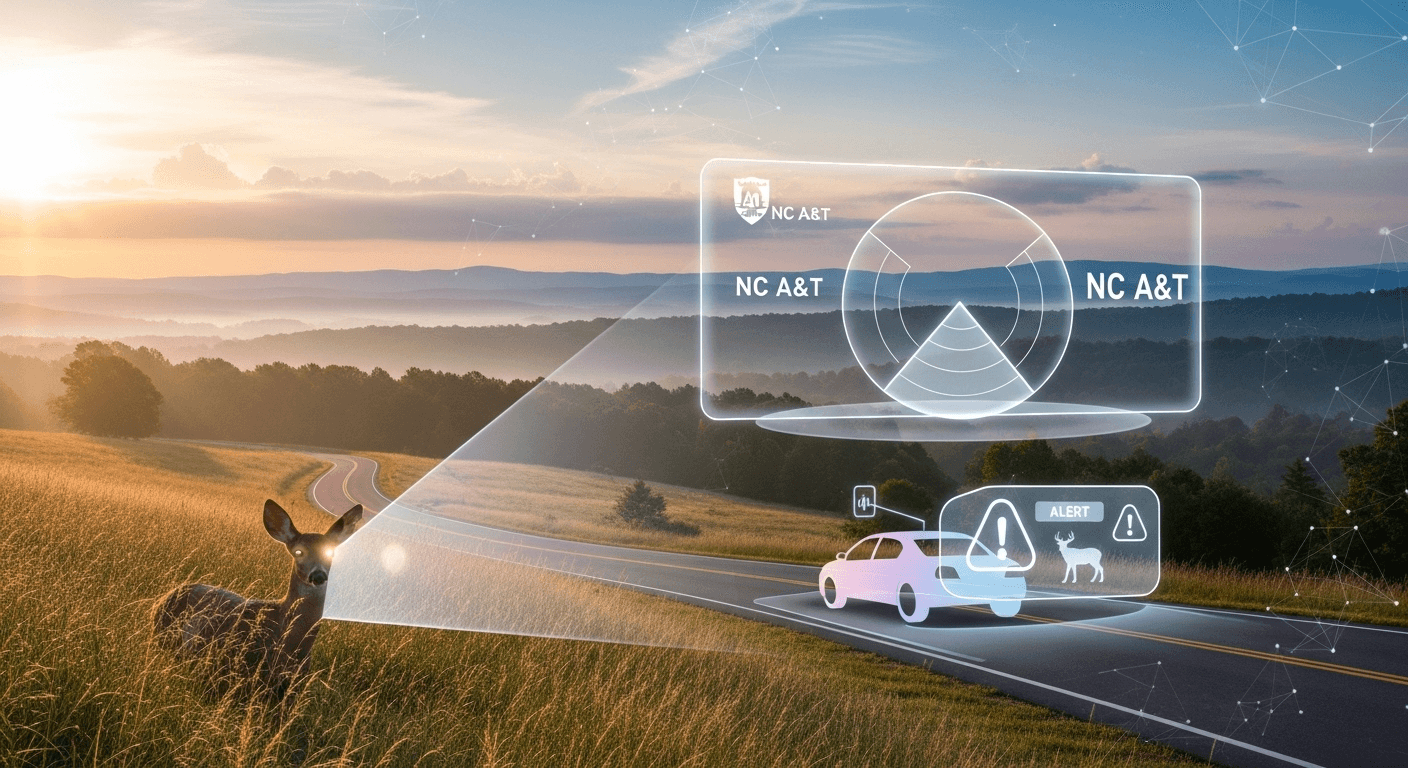
NC A&T Explores AI to Help Drivers Avoid Animal-Vehicle Collisions
Every fall, the risk of collisions between vehicles and wildlife, particularly deer, increases significantly during dawn and dusk. To address this pressing issue, researchers at North Carolina A&T State University (NC A&T) are delving into how artificial intelligence can detect animals in real time, anticipate potential crash sites, and alert drivers before accidents occur.
This initiative is not just important for North Carolina; wildlife-vehicle collisions represent a widespread safety concern across the United States. Various transportation agencies and researchers are testing a combination of traditional methods, such as fencing and wildlife crossings, alongside innovative technologies like roadside cameras, thermal imaging, and connected vehicle alerts. NC A&T’s research contributes to the broader goal of enhancing road safety and intelligence.
In this article, we will discuss the reasons behind the persistence of animal-vehicle collisions, the research efforts at NC A&T, the technology involved, how it can complement existing road safety measures, and the necessary steps to responsibly scale these systems.
Why Animal-Vehicle Collisions Remain a Problem
Wildlife-vehicle collisions are alarmingly common, costly, and occur during predictable times and locations. The Federal Highway Administration (FHWA) estimates that there are between 1 and 2 million wildlife-vehicle collisions each year in the United States, resulting in hundreds of fatalities, thousands of injuries, and billions of dollars in economic losses due to vehicle damage, medical expenses, and lost productivity. The risks are notably higher during breeding and hunting seasons in the fall and at times of reduced visibility, such as dawn and dusk. For more information on mitigation strategies, see FHWA’s overview of wildlife-vehicle collisions (FHWA).
Insurance companies have also observed these trends. A recent analysis by State Farm revealed that the annual number of animal-related insurance claims is in the millions, with a significant peak from October to December, primarily involving deer (State Farm).
In North Carolina, collisions involving animals rank among the most common types of reported accidents, particularly in suburban and rural areas close to forests and farmland. State agencies frequently advise drivers to reduce speed, wear seatbelts, and remain vigilant during the fall rut and as daylight hours shorten. NC A&T’s research aims to supplement this public advice with technology that provides critical warnings to drivers when they matter most.
What NC A&T is Exploring
According to a report from North Carolina Public Radio on September 26, 2025, NC A&T researchers are investigating how AI can assist in preventing animal-vehicle collisions by sensing wildlife near roadways and delivering timely warnings to drivers (WUNC).
Although this project is still in its early stages, it incorporates several innovative approaches:
- Roadside computer vision for detecting animals at night and in poor visibility conditions.
- Predictive models that identify potential crash hotspots based on land use, animal migration, weather patterns, and historical incident data.
- Alerts for connected vehicles and infrastructure that communicate critical information to drivers quickly without causing distractions.
As one of the nation’s leading public HBCUs with a prestigious engineering program, NC A&T is tapping into its expertise in computer vision, embedded systems, and transportation analytics to develop and test this approach.
How an AI Wildlife Detection System Works
The system operates on three interconnected layers: detection, prediction, and alerting.
1) Detection: Identifying Animals in Real Time
Low-power cameras and sensors positioned along roadways continuously monitor the shoulder and right-of-way. Many setups incorporate thermal imaging technology to detect heat signatures, enhancing visibility in low-light conditions and light fog. Computer vision algorithms process the video feeds locally through robust edge-computing devices, minimizing the need to transmit video to the cloud.
When the system identifies that an animal has entered a high-risk area or is approaching the road, it triggers an alert. These models are trained with thousands of annotated images from local settings, enabling them to differentiate between various animals and distinguish real threats from non-significant hazards. Understanding species behavior is crucial since different animals exhibit distinct crossing patterns and risk factors.
Why not simply increase the number of warning signs? Static deer signs can become lost in the landscape over time. Dynamic, context-aware alerts that activate only when animals are present are far more effective at capturing driver attention and reducing false alarms.
2) Prediction: Understanding When and Where Risks Increase
While detection is valuable, prediction adds another layer of safety. By leveraging historical data about crashes, habitat maps, land cover, traffic patterns, and seasonal behavior, machine learning models can identify potential hotspots and high-risk times. Research indicates that targeted interventions in identified hotspots yield significant safety benefits. For instance, studies show that strategic wildlife crossings and fencing can reduce large mammal collisions by over 80% with proper design and placement (Rytwinski et al., PLOS One).
In practical terms, predictive analytics assist agencies in prioritizing the monitoring of key corridors, determining the placement of dynamic warning signs, and scheduling patrols during critical risk periods like the fall rut or spring fawning season.
3) Alerting: Providing Timely Warnings to Drivers
After identifying a potential hazard, the system must deliver timely and trustworthy alerts without contributing to driver distraction. Several strategies exist for doing this:
- Activate roadside variable message signs with concise and clear warnings when animals are detected.
- Use connected vehicle technology (C-V2X or DSRC) to send standardized alerts to vehicles, allowing messages to appear in dashboards of modern cars and trucks.
- Integrate alerts into navigation applications to provide context-aware warnings within existing platforms.
Regardless of the method, alerts should be relevant, limited, and localized to build and maintain driver trust.
Integrating AI with Proven Safety Measures
AI should not replace established safety practices; rather, it should enhance them by assisting agencies in more intelligent resource allocation.
Wildlife Crossings and Fencing
Overpasses and underpasses, in conjunction with well-designed fencing and escape routes, remain the gold standard for minimizing collisions involving large mammals. Research in North America and Europe consistently demonstrates significant reductions in crashes when crossings are strategically placed and properly maintained. Cost-benefit analyses indicate that these investments can pay for themselves on high-risk corridors by mitigating crash costs and restoring habitat connectivity (Huijser et al., Ecology and Society).
AI technology can enhance these efforts by identifying optimal locations for crossings or fencing, monitoring the use of existing structures, and detecting breaches that require timely intervention.
Seasonal Enforcement and Driver Education
Transportation agencies typically boost messaging and enforcement during the fall, advising drivers to slow down, scan the shoulders, and avoid swerving. Strategies like dynamic speed limits and targeted speed enforcement in high-risk corridors can work harmoniously with AI-driven alerts. Research consistently shows that lower operating speeds correlate with reduced crash likelihood and severity.
Improved Data Sharing and Security
Wildlife collision data is often incomplete or underreported, especially for incidents that do not result in police intervention. AI-based detection methods can enhance official crash datasets with more specific, real-time observations while maintaining necessary privacy protections, ensuring that individuals remain unidentifiable in recorded footage. As this wealth of data accumulates, it can inform more effective investments and policies at both state and county levels.
Scaling Up in North Carolina
Transforming a successful pilot into a statewide capability requires meticulous planning. Drawing from past experiences in transportation technology deployment and other safety systems, the following are essential components:
- Identify targeted corridors and establish clear objectives. Begin with a select number of high-risk areas recognized through crash data and habitat models. Define success metrics upfront, such as reductions in animal collisions and improved compliance with warnings.
- Utilize edge-first architecture. Process video feeds on location, transmitting only relevant detections and brief clips when incidents occur, to enhance privacy and reduce bandwidth demands.
- Adopt open, standardized alert messaging. Leverage existing USDOT and SAE standards for safety alerts, enabling seamless integration for automakers, navigation providers, and highway agencies.
- Incorporate a human-in-the-loop approach. During initial phases, have traffic management center operators review high-confidence detections to validate ambiguous situations and send messages, thereby improving data quality and retraining of models.
- Ensure proactive maintenance. Regular inspections for cameras, enclosures, and power systems are crucial. Implement AI detection combined with automatic health checks and remote updates.
- Facilitate independent evaluations. Collaborate with academic safety evaluators to conduct before-and-after studies and publish the findings, addressing failure modes to maintain public trust.
Benefits, Limitations, and Ethical Considerations
Like any safety technology, AI for wildlife detection brings a mix of benefits and challenges. A comprehensive understanding helps agencies and communities determine the most effective applications.
- Potential Benefits: Reduced crashes and injuries, lower repair costs and insurance claims, decreased animal mortality, and enriched data for long-term habitat connectivity planning.
- Limitations: No system is infallible. False negatives can occur if animals remain concealed until the last moment, and frequent false positives can undermine driver trust. Environmental factors like severe weather, glare, and heavy traffic can hinder camera performance.
- Privacy and Equity: Despite edge processing, systems must be designed to prevent the capture of identifiable personal data. It is also crucial that rural and lower-income communities benefit equitably from these technologies, rather than shifting risks onto other road users.
- Species Recognition Bias: Models developed based on local wildlife may not perform well in other regions, making local data collection and accurate labeling necessary.
Comparing AI with Other Approaches
Animal detection systems are not entirely new; earlier versions utilized radar tripwires or break-beam sensors to activate warning signs when large animals approached the roadway. The newer generation of AI-enhanced technology builds on this foundation, providing species classification, improved range in low-light conditions using thermal imaging, and more precise geofencing for alerts.
Meanwhile, structural solutions like wildlife crossings offer enduring, passive safeguards and enhance ecological benefits through habitat reconnection. In areas with high deer strike rates and elevated speeds, agencies often prioritize fencing coupled with crossings, layering dynamic detection in complex areas such as interchanges and expanding suburban regions where animal movements may be unpredictable.
Actions Drivers Can Take Now
- Reduce speed during dawn and dusk, particularly in the fall and winter months.
- Carefully monitor the shoulders and use high beams when it’s safe.
- Avoid swerving; instead, brake steadily while maintaining lane position, as many serious accidents occur when drivers veer into oncoming traffic or obstacles.
- Keep in mind the herd: when you see one deer, anticipate more may follow.
- Report animal strikes to authorities and your insurance company to help enhance the data pool on this issue.
Conclusion
NC A&T’s investigation into AI for preventing animal-vehicle collisions is a step toward a smarter approach to road safety: utilizing data to predict risk, detect real hazards promptly, and provide dependable alerts that drivers can respond to in time. By integrating AI with established measures such as wildlife crossings, fencing, and seasonal enforcement, we can create a more humane and safer transportation system that protects both lives and wildlife.
FAQs
How accurate are AI animal detection systems?
The accuracy of these systems depends on several factors, including the environment, sensor types, and training data. Thermal cameras generally improve performance in low-light conditions. Initial pilots have reported favorable detection rates for deer at moderate distances but emphasize the importance of customizing models to local settings and maintaining the sensors.
Will this system work in heavy rain or fog?
Thermal and radar sensors can penetrate some weather conditions better than regular video cameras; however, performance may still decline during heavy rain, fog, or snow. Systems should convey confidence levels and be designed to fail gracefully, avoiding overly confident alerts.
How are alerts communicated to drivers?
Alerts may be displayed on roadside variable message signs, sent to in-vehicle connected systems that support standardized safety messages, or integrated into navigation apps that accept safety data feeds. The goal is to utilize channels that drivers already rely on, without causing distractions.
What measures are in place to protect privacy with roadside cameras?
Responsible designs process video on the device, discarding non-relevant footage and transmitting only brief clips or metadata when an animal is detected. Faces and license plates can be automatically blurred if recordings are necessary for evaluations.
Is AI meant to replace wildlife crossings and fencing?
No, AI serves to enhance, not replace, successful strategies. Wildlife crossings and fencing provide the most reliable and significant reductions in collisions when implemented correctly. AI can assist in targeting these investments and supplementing dynamic alerts in areas where structural solutions are not practical.
Sources
- WUNC: NC A&T Looks into AI Technology to Help Prevent Animal-Vehicle Collisions (Sept. 26, 2025)
- Federal Highway Administration: Wildlife-Vehicle Collisions Overview
- State Farm: Animal Collision Claims and Seasonal Risk
- Rytwinski et al. (2016), How Effective is Road Mitigation in Reducing Road-Kill? A Meta-Analysis, PLOS One
- Huijser et al. (2009), Cost-Benefit Analyses of Mitigation Measures Aimed at Reducing Collisions with Large Ungulates, Ecology and Society
Thank You for Reading this Blog and See You Soon! 🙏 👋
Let's connect 🚀
Latest Insights
Deep dives into AI, Engineering, and the Future of Tech.

I Tried 5 AI Browsers So You Don’t Have To: Here’s What Actually Works in 2025
I explored 5 AI browsers—Chrome Gemini, Edge Copilot, ChatGPT Atlas, Comet, and Dia—to find out what works. Here are insights, advantages, and safety recommendations.
Read Article


