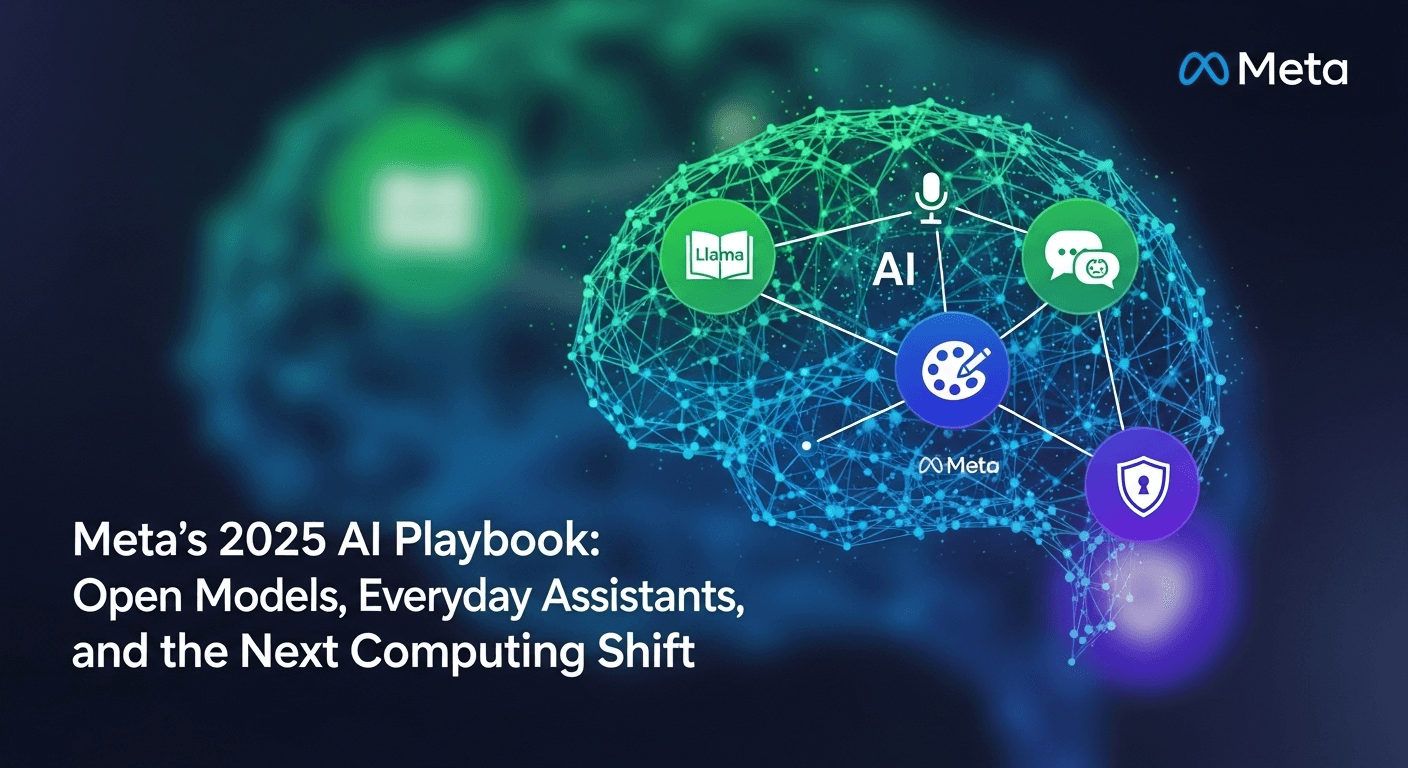
Meta’s 2025 AI Playbook: Open Models, Everyday Assistants, and the Next Computing Shift
Meta’s 2025 AI Playbook: Open Models, Everyday Assistants, and the Next Computing Shift
By 2025, Meta believes artificial intelligence will be as integral to our lives as mobile technology. With open models like Llama, real-time assistance integrated into WhatsApp and Instagram, and multimodal AI capabilities in Ray-Ban smart glasses, the messaging is clear: AI will increasingly inhabit the spaces we already frequent. This article explores Meta’s strategy, what’s currently available, what’s on the horizon, and the implications for consumers, creators, and businesses alike.
Why 2025 Marks a Defining Moment
With significant advancements in AI during 2023 and 2024, 2025 is poised to see these innovations seamlessly integrated into everyday products. Meta’s dual focus is evident: push for open AI models to stimulate ecosystem growth and develop assistants that operate across multiple apps and devices.
Different from past platform revolutions that relied on new hardware, Meta is leveraging the applications billions already use: Facebook, Instagram, WhatsApp, and Messenger. The vision extends beyond smarter chatbots; it aims for hands-free, real-time assistance that enriches everyday messaging, searching, creation, and commerce experiences.
Meta’s Open Model Strategy in Action
Positioning itself as the pioneer of open AI, Meta has launched the Llama series of models under an open license. This openness allows researchers and developers to inspect, fine-tune, and deploy these models, enhancing innovation and minimizing vendor lock-in, so organizations can run AI where it makes the most sense—whether in the cloud or on local devices.
From Llama 3 to Llama 3.2: Actual Releases
- Llama 3 (8B and 70B) – Released in April 2024, these models exhibit enhanced reasoning, coding capabilities, and multilingual support while remaining open for broader use.
- Llama 3.1 (up to 405B) – Announced in July 2024, this model enhances tool use, context handling, and multilingual performance, while incorporating safety features like Llama Guard.
- Llama 3.2 (small and multimodal) – Introduced in September 2024, these smaller variants are optimized for mobile and edge devices, emphasizing on-device AI capabilities.
Beyond being a mere philosophy, open models serve as a strategic approach to distribution. Startups can utilize Llama without incurring per-token fees, enterprises can manage their data internally, and educators and nonprofits can freely experiment. Moreover, community involvement allows for quicker identification of potential issues.
Safety Tools for Open Models
Meta complements its open releases with safety tools. Initiatives like Llama Guard and the Purple Llama provide classifiers, evaluation datasets, and guidelines for safer deployments, helping filter unsafe prompts or detect risky outputs before they reach users.
Meta AI: Your Built-in Assistant
Meta’s consumer assistant, known simply as Meta AI, is embedded within Instagram, WhatsApp, Messenger, and Facebook. Its capabilities include answering questions, summarizing, drafting text, generating images, and maintaining conversational flow in group chats. In 2024, Meta announced a significant expansion of its assistant, with continuous updates aimed at enhancing real-time and context-aware functionalities.
Current Features
- Search and Q&A – Pose questions within chats to receive answers with citations and relevant web results.
- Writing and Editing – Generate replies, brainstorm posts, rephrase messages, and enhance grammar effortlessly.
- Image Generation – Quickly create stickers, concept art, or marketing mockups via Meta’s Emu image model.
- Group Assistance – In group chats, the assistant can offer suggestions, summarize discussions, and provide quick contextual references.
Meta AI leverages Llama 3-class models supplemented with multimodal capabilities, enhancing real-time responsiveness and understanding across typing, voice, and images in streamlined interactions. This aligns with a broader industry trend toward real-time, integrated multimodal models.
AI You Can Wear: Ray-Ban Meta Smart Glasses
One of Meta’s most intriguing initiatives is embedding AI into everyday wearables. The Ray-Ban Meta smart glasses now feature a multimodal assistant capable of recognizing and describing visual inputs, translating text, and answering context-specific questions, effectively turning the glasses into a responsive device with just a voice command.
This innovation represents a step toward ambient computing. Queries like, “What does this sign say?” or “How should I modify this recipe?” can be answered without reaching for a phone. Although still in the early phases, potential applications include hands-free searches, live translations, and quick captures for content creators.
Meta emphasizes built-in privacy features, including voice activation indicators and opt-in capabilities, alongside visible lights during video recording. However, as social norms surrounding visible cameras evolve, it’s essential to establish proper guardrails, especially in public spaces.
Generative Media and Research: Emu, SAM, and Beyond
Meta’s research pipeline spans a broad range of domains, from vision and audio to world modeling. A few notable developments illustrate how these innovations translate into consumer-facing features.
- Emu for Images and Video – This family of tools supports image generation and editing while enabling AI stickers, short video creation, and creative style transfers.
- Segment Anything Model (SAM) – A versatile vision model capable of isolating objects in images with a simple click or command, facilitating rapid editing and AR effects.
- Audio and Speech Research – Projects like AudioCraft showcase how creators might soon generate music and voice assets with precise control over style and tone.
These functionalities contribute to feature enhancements in Instagram and Facebook, lowering costs for businesses needing on-brand assets for advertisements and product listings.
Infrastructure: The Backbone of Innovation
None of these advancements would be possible without monumental computational power. Meta is establishing some of the world’s largest AI clusters and data centers to train and deploy models. In early 2024, CEO Mark Zuckerberg stated aims for approximately 350,000 Nvidia H100 GPUs by the end of that year, alongside further investments that would raise the total to around 600,000 H100 equivalents.
Previously, Meta introduced its Research SuperCluster for AI in 2022, a critical step toward training larger multimodal models and enabling real-time data processing.
AI for Businesses: Enhanced Creativity and Support
Meta’s AI initiatives are equally focused on businesses, with two main areas standing out in 2025.
Ads and Creative Automation
The Advantage+ suite employs AI to assist advertisers in generating creative variations, selecting optimal image and text combinations, and budget optimization. AI-driven image editing and background generation significantly reduce the time needed to produce assets, particularly for smaller teams.
Customer Support and Commerce
As businesses increasingly engage with customers via WhatsApp and Messenger, Meta is rolling out AI agents to handle common inquiries, offer product recommendations, and escalate issues to human representatives when necessary. This aligns with a broader effort to establish messaging as a primary channel for service and sales.
Privacy, Provenance, and Policy
As generative AI becomes more prevalent on social platforms, concerns about safety and authenticity are paramount. Meta is implementing invisible watermarking for AI-generated images produced with its tools. Additionally, it’s developing methods to detect and label AI content from other services, employing metadata standards like C2PA and IPTC where possible.
Data usage practices are under scrutiny. Meta indicates that it trains its models using a blend of publicly available and licensed data. In the European Union, plans for certain training initiatives were paused in 2024 while awaiting regulatory review, reflecting how local regulations can influence deployment.
Two significant regulatory frameworks—
- EU AI Act – Enacted in 2024, this legislation will introduce requirements over 2025 and 2026, focusing on high-risk systems, transparency for generative models, and risk management responsibilities.
- Digital Services Act (DSA) – Currently applicable to very large platforms, requiring transparency, data access for vetted researchers, and risk mitigations related to AI-generated content and recommendations.
Anticipate platforms, including Meta, to implement more transparent labeling for synthetic media, enhanced provenance information, and improved appeal processes for flagged content.
Open vs. Closed Models: Understanding the Trade-offs
Open weights significantly lower barriers to entry, allowing developers to run and customize models on-premises while independently evaluating safety. However, this openness brings added responsibility for users to manage potential risks. In contrast, closed APIs provide centralized control but can lead to vendor lock-in and hinder experimentation.
Meta’s thesis is that open ecosystems foster more robust and transparent AI over time. As a result, many organizations may adopt a hybrid model, utilizing open systems when control and cost are crucial, closed APIs for superior proprietary features, and compact models on devices that prioritize latency and privacy.
What to Watch from Meta in 2025
- Increased Multimodality and Responsiveness – Anticipate quicker, more intuitive assistants capable of seeing, hearing, and conversing fluidly, especially across smart glasses and messaging platforms.
- On-Device Models – Following Llama 3.2, expect enhancements in compact models that can run on mobile devices for private tasks.
- Enhanced Creator and Commerce Tools – Expect improvements in product photography, video editing, and storefront creation powered by Emu and SAM-derived technologies.
- Stronger Safety Measures – Look for clearer labels on synthetic media, improved provenance details, and enhanced reporting and appeals for AI-labeled content.
- Continual Infrastructure Investments – Ongoing efforts to enhance training clusters and optimize runtimes, making real-time assistants economically sustainable at scale.
The Bottom Line
Meta’s initiatives for 2025 aim to convert AI from an isolated innovation into a foundational capability that quietly enhances your daily activities. Open models like Llama empower developers to innovate while assistants integrated into familiar apps facilitate a smoother user experience. Smart glasses provide a glimpse into a future where AI is seamlessly integrated into everyday tasks.
However, challenges remain—safety, provenance, and responsible data usage are critical issues to navigate. The pathway forward is clear: transitioning AI from exciting demos into the fabric of daily workflow. If Meta executes effectively, the advent of everyday AI will be gradual, marked by smarter applications incrementally enhancing our lives.
FAQs
What is Meta AI and where can I use it?
Meta AI is the company’s assistant, integrated into Instagram, WhatsApp, Messenger, and Facebook. You can ask questions, create images, and draft messages directly within these apps, with availability expanding regionally.
Is Llama really open source?
Llama models are available as open weights under a permissive license, allowing for downloading, studying, fine-tuning, and deployment, but they are not classified under a strict OSI open-source license.
How does Meta label AI-generated content?
Meta employs invisible watermarking for images produced using its tools and provides labels in products where AI-generated content is recognized. They also aim to detect and label AI outputs from other sources using standards like C2PA and IPTC metadata.
What about privacy and training data?
Meta indicates that it trains models with a mix of publicly available and licensed data. In the EU, the company paused certain training operations in 2024 due to regulatory review. Anticipate more region-specific disclosures as regulations like the EU AI Act are implemented.
How does Meta’s approach compare to those of OpenAI and Google?
While OpenAI and Google predominantly offer proprietary models through APIs and consumer applications, Meta emphasizes open model releases (Llama) in conjunction with integrated assistants within existing platforms. Many developers will likely adopt a blend of solutions based on specific needs.
Sources
- Meta – Llama 3 announcement (April 2024)
- Meta – Llama 3.1 announcement (July 2024)
- Meta – Llama 3.2 for mobile and multimodal (September 2024)
- Meta Newsroom – Meta AI updates across apps (April 2024)
- Meta Connect 2023 – Ray-Ban Meta smart glasses
- Meta – Emu for image and video generation
- Meta – Segment Anything Model (SAM)
- Meta – AudioCraft and MusicGen
- Meta – Purple Llama safety tools
- Meta – Llama Guard safety classifier
- The Verge – Meta’s H100 GPU plans (January 2024)
- Reuters – Zuckerberg on GPU investments (January 2024)
- Meta AI – Research SuperCluster (RSC)
- Meta Newsroom – Labeling AI-generated content (May 2024)
- Meta Newsroom – Manipulated media policy update (February 2024)
- C2PA – Content provenance standard
- BBC – Meta pauses AI training in Europe (June 2024)
- European Parliament – EU AI Act adopted (March 2024)
- European Commission – Digital Services Act overview
- Meta for Business – AI in Ads Manager and Advantage+
- Meta Connect 2024 – AI for businesses
- OpenAI – GPT-4o overview (May 2024)
- Google – Gemini 1.5 overview
- Anthropic – Claude 3.5 Sonnet announcement (June 2024)
Thank You for Reading this Blog and See You Soon! 🙏 👋
Let's connect 🚀
Latest Insights
Deep dives into AI, Engineering, and the Future of Tech.
I Tried 5 AI Browsers So You Don’t Have To: Here’s What Actually Works in 2025
I explored 5 AI browsers—Chrome Gemini, Edge Copilot, ChatGPT Atlas, Comet, and Dia—to find out what works. Here are insights, advantages, and safety recommendations.
Read Article


