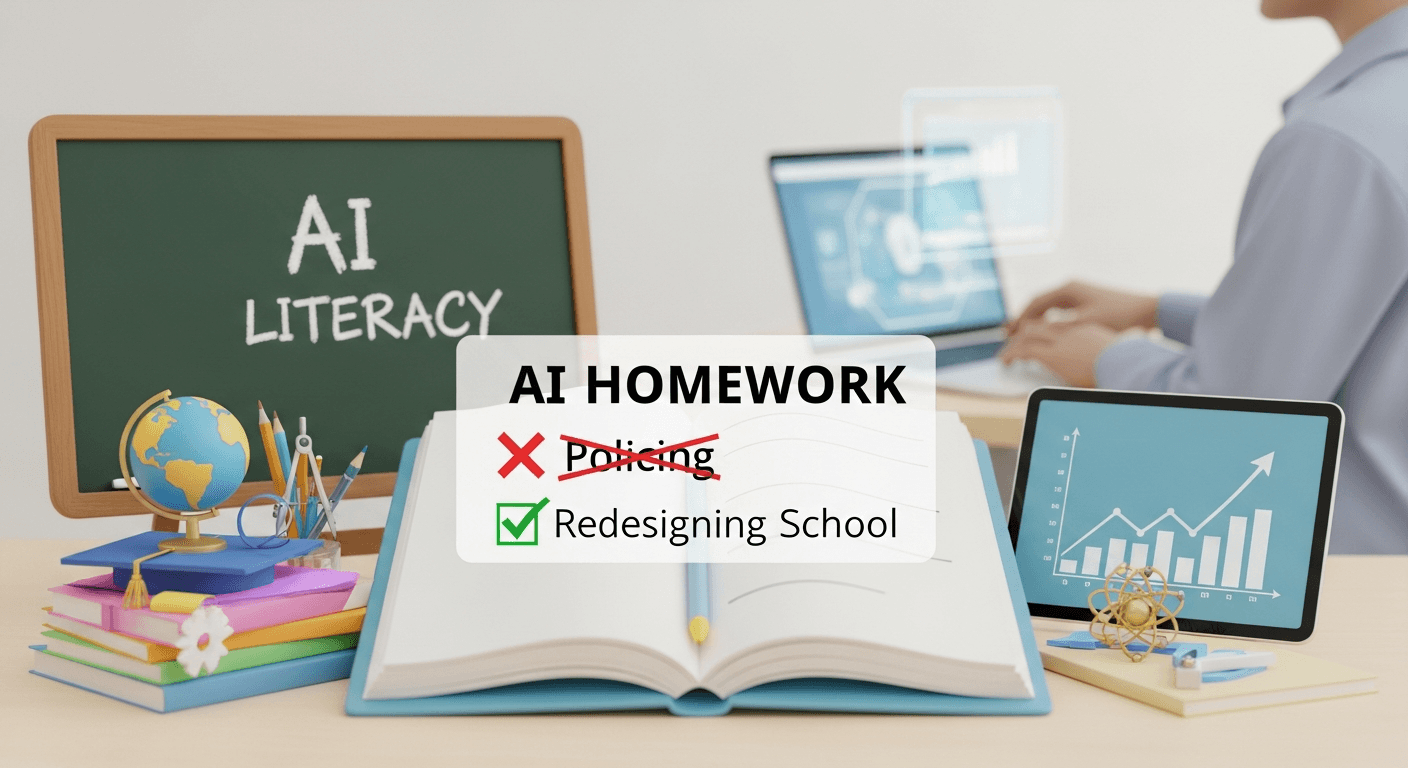
Karpathy’s Verdict on AI Homework: Stop Policing, Start Redesigning School
Karpathy’s Verdict on AI Homework: Stop Policing, Start Redesigning School
When a leading AI researcher declares that the battle against AI-generated homework is futile, educators take notice. On November 24, 2025, Andrej Karpathy delivered a straightforward message to school leaders: you cannot reliably detect AI in take-home assignments, so it’s time to stop enforcing outdated measures and rethink how we assess learning. His perspective isn’t about abandoning standards; rather, it’s about adapting assessments to reflect reality, equipping students to use AI effectively, and ensuring they can also perform independently when necessary.
Karpathy’s insights ignited discussions that resonate with the current educational climate: AI assistance is ubiquitous, detection methods are often unreliable, and in-class demonstrations of skill are more pivotal than ever. Coverage from The Decoder summarized his main arguments and their implications for education.
What Karpathy Actually Said
Karpathy noted that:
- Detecting AI in Homework: Attempts to identify AI use in homework will not be reliable. The ongoing battle between detectors and students is counterproductive and undermines trust.
- Assumption of AI Use: Schools should operate under the assumption that AI tools may be used in off-campus assignments.
- In-Class Assessments: The majority of grading should return to monitored settings where students can demonstrate comprehension without real-time AI assistance.
- AI Literacy: Students must be taught to use AI responsibly and effectively, just as they learn math before using calculators.
A recap by Indian Express highlighted his key statement: “You will never be able to detect the use of AI in homework. Full stop.” The article also referenced his calculator analogy and the concept of designing assessments that allow for flexible tool usage.
Why This Message Resonates Now
Karpathy’s message comes at a pivotal time when many schools are reevaluating their assessment strategies, shifting the focus back to the classroom, and clarifying how AI can enhance learning. Recent reports indicate that educators are opting for in-class writing, oral presentations, and monitored assessments to emphasize demonstrated understanding.
Meanwhile, the technology landscape shows that AI text detectors have significant limitations. OpenAI even discontinued its own AI text classifier in 2023 due to its inadequacies, and studies have demonstrated that even minor edits can evade detection.
The Short Version
- Policing AI at Home Does Not Scale: Reliance on AI detection tools is impractical.
- In-Class Assessment Is Crucial: This approach anchors fairness in evaluations.
- Students Must Master AI and Verification: It’s vital for them to learn how to use AI effectively, while also being able to operate independently.
- Redesign Course and Exam Structures: Educational frameworks must evolve to meet the realities of AI.
Evidence That Detection-First Strategies Fall Short
Educators have attempted to implement AI detection tools as a quick solution, but their shortcomings became apparent:
- Low Accuracy Rates: OpenAI’s removal of its AI detector underscores the difficulty in reliably proving authorship.
- Issues with Detection Tools: Research has shown that these tools can produce biased results, often misidentifying non-native writers and struggling with simple avoidance tactics.
- Shift Away From Detectors in Universities: After experiences with false accusations, many institutions have abandoned reliance on detection methods due to their lack of reliability.
While detection can have some utility in specific contexts, it cannot be the cornerstone of academic integrity policies. When the foundation is shaky, trust and due process are compromised.
Karpathy’s Recommendations for Schools
Karpathy’s approach is straightforward: align educational strategies with our current landscape.
- Focus on In-Class Demonstrations:
- Utilize timed writing, oral defenses, practical laboratories, and supervised tasks to assess true understanding.
-
Create clear, transparent rules regarding AI usage for different assignments: no tools, limited tools, open-book, or allowed AI use with critiques.
-
Teach AI Literacy:
- Educate students on using AI for brainstorming, planning, and fact-checking, while ensuring they engage with the material authentically.
-
Highlight the importance of verifying information and logging their processes, including prompts used and modifications made.
-
Reframe Homework as Practice:
-
Structure take-home assignments as low-stakes practice where AI utilization is permitted within set guidelines, reserving significant assessments for in-class settings.
-
Cultivate Dual Competency:
- Students need to excel in both working with AI and thriving independently.
- Encourage alternating between AI-assisted learning at home and assessments without AI in class.
An Analogy: Calculators, with a Twist
Karpathy likens AI to calculators in that we still teach students essential math skills for validation purposes. However, today’s AI can be impressively helpful yet confidently erroneous, underscoring the need for verification skills.
Beyond Critique: Building an AI-Integrated School
Karpathy’s startup, Eureka Labs, is set to explore this innovative future by combining human-crafted courses with AI teaching assistants to enhance personalized guidance. Their initial course, LLM101n, will focus on small language models, signaling a commitment to teaching with AI while assessing independent thought.
What It Means for Schools Now
Here’s a practical outline you can adapt this semester:
- Establish Clear AI Policies by Assignment Type:
- Define AI usage guidelines for each task, distinguishing between no AI, AI-assisted with disclosure, or AI-enhanced with documentation.
-
Provide examples for acceptable AI applications, such as idea generation or source comparison, and require students to submit an “AI memo” when permitted.
-
Move Assessments to Class:
-
Transition some take-home assignments to in-class writing or oral presentations.
-
Teach Verification as a Key Skill:
- Instruct on fact-checking, using reputable sources, and back-of-the-envelope calculations.
-
Encourage students to engage critically with AI outputs.
-
Design Depth-Oriented Prompts:
-
Craft assignments that require specific local context, making them harder to fabricate and more reflective of genuine learning.
-
Leverage AI as a Tutor:
- Implement structured course-specific AI assistants that provide feedback without offering direct answers.
Addressing Common Concerns
Is Detection Technology Improving?
Detection tools may get better but remain unreliable for open-ended texts. Treat them cautiously and as one factor among many, not as definitive proof.
Will In-Class Assessments Increase Workload?
Redirecting focus from policing to thoughtful design can lead to more meaningful evaluations. Start small, and adapt over time.
How About Equity With AI Access?
Clarity and baseline access are vital. Ensure that AI use is equitable in practice settings, allowing all students to benefit.
Are Students Really Using AI?
Widespread reports indicate that AI is now a foundational study tool; adapting assessment strategies is crucial as a response to this trend.
Design Patterns to Implement Tomorrow
- In-Class Writing Labs: Students draft without tools and then critique instructor-provided AI responses.
- Two-Part Programming Tasks: Plan with AI at home and implement in monitored labs.
- Seminar Fishbowl: Students generate opposing briefs using AI and argue both sides in class.
- Math Proofs with Checks: Write proofs in class and then use AI for alternative solutions, accompanied by a verification log.
The Bigger Picture: Adapt the System, Not Just Assignments
Karpathy’s perspective aligns with a shift towards utilizing AI as a resource rather than as a threat, emphasizing structured integration and authentic assessment. Education must evolve to embrace tools like AI, which can be both beneficial and misleading. This paradigm presents a unique opportunity to shape robust curricula that promote critical thinking and reasoning.
Karpathy’s Vision for the Future
Eureka Labs aims to create learning environments that acknowledge AI’s role in education. Whether relying on their platform or creating your method, the goal remains the same: use AI to enrich learning and assess understanding where it truly matters — in the classroom.
Key Takeaways
- Reliable detection of AI in homework is unattainable, and policies should not be built on false premises.
- Significant assessments should take place in monitored settings.
- Foster AI literacy and verification skills as core educational objectives.
- Treat AI as a learning aid, not as a grading authority.
- Tailor prompts and evaluation rubrics to emphasize reasoning and process.
FAQs
1) Is there an AI detector I should be using?
Consider them only as one possibility among several, not as irrefutable proof. If you choose to use a detector, make it clear within your syllabus and ensure additional accountability measures are in place.
2) How can I communicate new policies to families and students?
Clarify the use of AI, disclosures during assessments, and how in-class evaluations will accurately assess mastery. Emphasize the overarching goal of fostering authentic evaluation.
3) Does this mean lowering standards?
Absolutely not. In-class assessments demand genuine understanding and are often more challenging to falsify.
4) What if my subject heavily relies on essays?
Adapt writing assignments to allow for AI in the planning stage while ensuring that the final composition and revisions occur in a controlled environment.
5) Where can I find effective AI tutoring without replacing learning?
Look for integrated course assistants that facilitate learning rather than provide direct answers. Research indicates that these can enhance student experience and success when well-designed.
The Bottom Line
Karpathy’s message is not about capitulating to academic dishonesty but rather recognizing the educational landscape. We must teach with AI tools to foster practice, then evaluate mastery independently. Prepare students to leverage powerful resources while also standing on their own merit when it counts.
Thank You for Reading this Blog and See You Soon! 🙏 👋
Let's connect 🚀
Latest Insights
Deep dives into AI, Engineering, and the Future of Tech.
I Tried 5 AI Browsers So You Don’t Have To: Here’s What Actually Works in 2025
I explored 5 AI browsers—Chrome Gemini, Edge Copilot, ChatGPT Atlas, Comet, and Dia—to find out what works. Here are insights, advantages, and safety recommendations.
Read Article


