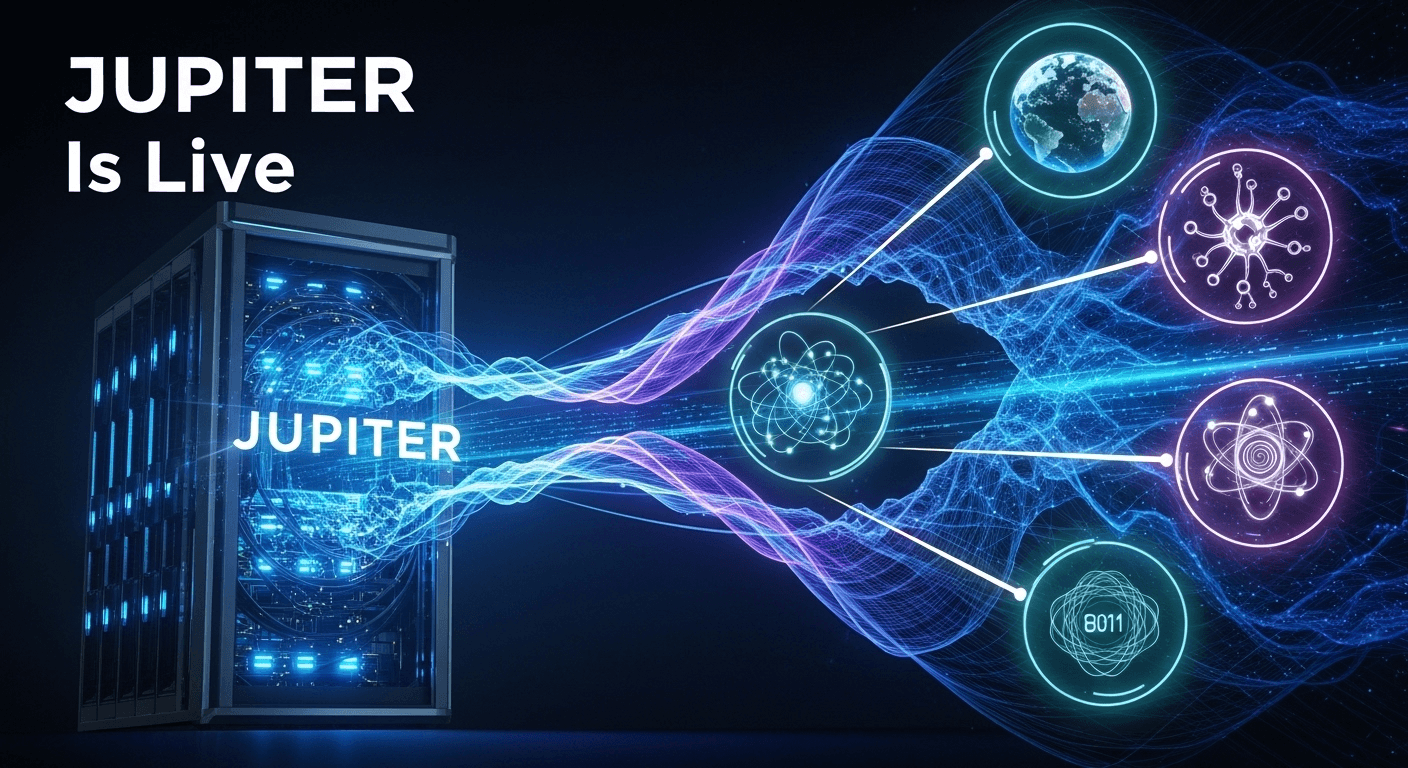
JUPITER Is Live: Europe’s First Exascale Supercomputer Revolutionizes Climate, Neuroscience, and Quantum Research
JUPITER Is Live: Europe’s First Exascale Supercomputer Revolutionizes Climate, Neuroscience, and Quantum Research
Europe has officially launched JUPITER, its first exascale supercomputer, marking a significant milestone in scientific and industrial advancement, as well as digital sovereignty. Located at the Forschungszentrum Juelich in Germany and funded by the EuroHPC Joint Undertaking, JUPITER delivers exascale-class performance for researchers focusing on critical challenges such as climate extremes, brain science, fusion energy, and quantum simulation. NVIDIA announced the launch of JUPITER, emphasizing its role in expanding the capabilities of AI and high-performance computing (HPC) in a single platform (NVIDIA).
Why JUPITER Matters
Exascale computing represents both a symbolic and practical leap forward: the ability to execute over a billion billion (10^18) calculations per second. This immense power is essential for simulating global storms at kilometer-scale resolution, modeling neuronal activity in the human brain, and researching new materials for sustainable energy solutions. For Europe, it enhances technological independence by bringing top-tier computing directly within its borders (EuroHPC JU).
JUPITER joins the broader EuroHPC initiative, alongside other flagship supercomputers like LUMI (Finland), Leonardo (Italy), and MareNostrum 5 (Spain). With the addition of JUPITER, Europe boosts its exascale capabilities, complementing advanced U.S. systems like Frontier at Oak Ridge National Laboratory and aligning with global objectives to address climate, healthcare, and industrial innovation challenges at an unmatched scale (TOP500).
What Is Exascale Computing?
Exascale computing refers to systems that can perform at least one exaflop, or one quintillion floating-point operations per second. This capacity is not just about sheer speed; it encompasses efficiency, memory bandwidth, interconnect technology, and a software ecosystem capable of managing thousands of nodes efficiently.
In practice, exascale systems accelerate two intertwined domains:
- HPC simulation and modeling at high precision across weather, climate, physics, chemistry, and engineering.
- AI at an expansive scale, including foundational models for scientific applications, digital twins, and AI-driven simulations.
Modern exascale architectures commonly integrate CPUs, GPUs, and high-speed interconnects, allowing researchers to run traditional HPC codes alongside AI training and inference workloads, or to blend them in hybrid workflows.
Inside JUPITER: Architecture and Partners
JUPITER is situated at the Juelich Supercomputing Centre (JSC) on the Forschungszentrum Juelich campus in Germany. It is procured by the EuroHPC Joint Undertaking and constructed by a consortium led by Eviden (an Atos business), alongside ParTec, utilizing a modular supercomputing design that facilitates the efficient collaboration of different computing modules (EuroHPC JU).
According to NVIDIA, JUPITER harnesses its accelerated computing technologies and high-speed networking, allowing for exascale-class performance across both HPC and AI requirements (NVIDIA). The system architecture incorporates CPU-GPU superchips, advanced interconnect technology, and hot-water cooling to maximize performance per watt and sustain continuous scientific operations (JSC).
Key elements
- Location and operator: Juelich Supercomputing Centre (JSC), Forschungszentrum Juelich, Germany.
- Program: EuroHPC Joint Undertaking.
- Prime contractor: Eviden, with ParTec as a key partner.
- Accelerated computing: NVIDIA platform for HPC and AI, featuring CPU-GPU superchips designed for high memory bandwidth and optimal CPU-GPU coupling (NVIDIA Grace Hopper).
- Networking: High-speed, low-latency fabrics ensure efficient data movement across the cluster. NVIDIA’s Quantum-2 InfiniBand exemplifies this category of interconnects tailored for large-scale AI and HPC (NVIDIA Quantum-2).
- Cooling: Innovative direct hot-water cooling for enhanced energy efficiency and potential heat reuse, a defining feature of JSC across multiple generations of systems (JSC energy efficiency).
JUPITER employs a modular supercomputing strategy pioneered at Juelich, pairing a booster module for massively parallel workloads with other modules fine-tuned for varied tasks. This design enhances overall throughput and enables users to select the appropriate computing resources for each component of a workflow (JSC Modular Supercomputing).
HPC Meets AI: One Platform, Multiple Workloads
Contemporary science does not strictly separate simulation from AI. JUPITER is designed to execute both, often in tandem:
- HPC simulation: Numerically intensive codes like climate models, computational fluid dynamics, materials science, and plasma physics.
- AI training and inference: Foundational models for weather and climate, extensive vision and language models for scientific data, and surrogate models that expedite simulations.
- Hybrid workflows: AI enhances simulations by comprehending unresolved physics, advising adaptive meshes, or predicting optimal starting points for solvers. Conversely, simulations generate synthetic data to enrich AI training.
This convergence is becoming the new standard. NVIDIA’s CUDA ecosystem and libraries support both domains, including scientific libraries for linear algebra and FFTs, domain packages for climate and materials, and frameworks for quantum simulations (NVIDIA cuQuantum).
Breakthrough Science Accelerated by JUPITER
1. Climate and Weather: Digital Twins of Earth
Addressing extreme climate events on human-relevant scales necessitates kilometer-scale models and data assimilation from satellites, sensors, and reanalyses. This is computationally intensive. JUPITER’s exascale-class performance is crucial for European climate initiatives, such as the EU’s Destination Earth program, which aims to develop high-fidelity digital twins of our planet (European Commission – Destination Earth).
Examples of how exascale computing assists these efforts include:
- Storm-resolving forecasts that more accurately capture local flooding, heatwaves, and wind extremes.
- Climate projections at kilometer-scale that enhance risk assessments for infrastructure, energy, and agriculture.
- AI-enhanced weather models that decrease computational costs while preserving accuracy, enabling rapid scenario testing.
Institutions like ECMWF and partners across EuroHPC have already demonstrated the scientific potential of higher resolution and AI augmentation. With JUPITER, Europe is positioned to amplify these efforts internally, fast-tracking both research and pre-operational workflows (ECMWF).
2. Neuroscience and Brain-Inspired Computing
Juelich houses one of Europe’s leading neuroscience computing hubs. Through EBRAINS, researchers run extensive brain simulations and analyze multimodal data at a continental scale. JUPITER amplifies this capacity for projects ranging from detailed neuron models to connectome-scale analysis, as well as AI systems inspired by the efficiency of the human brain (EBRAINS).
Capabilities enabled by JUPITER include:
- Accelerated, larger simulations of neural circuits to test theories regarding brain dynamics and diseases.
- High-throughput analysis of imaging and electrophysiology data across diverse cohorts.
- Investigating neuromorphic and brain-inspired algorithms that enhance AI energy efficiency.
3. Quantum Simulation and Hybrid Quantum-HPC
While quantum computers are on the rise, many beneficial algorithms still require classical supercomputers for simulations and hybrids. GPU-accelerated quantum circuit simulators, such as those utilizing NVIDIA’s cuQuantum SDK, enable researchers to emulate and debug quantum programs more efficiently than traditional CPU methods (NVIDIA cuQuantum).
With JUPITER, European teams can accomplish:
- Simulation of larger quantum circuits for chemistry, optimization, and materials research.
- Development of hybrid algorithms that distribute workloads between quantum processors and JUPITER’s classical GPU nodes.
- Validation of near-term quantum hardware and software against robust classical baselines.
4. Fusion Energy and Materials Discovery
From magnetic confinement fusion to advanced materials for energy solutions, exascale HPC reduces the timeline from concept to implementation. EUROfusion and its partners depend on large-scale simulation of plasma turbulence, magnetohydrodynamics, and reactor materials. GPU-accelerated codes can drive these developments more rapidly and at higher resolutions, helping Europe achieve its sustainable energy objectives (EUROfusion).
In materials research, exascale enables high-throughput density functional theory (DFT), molecular dynamics simulations, and AI-guided exploration across expansive chemical dimensions, from catalysts to semiconductors.
Energy Efficiency by Design
Supercomputers are defined by their efficiency as much as their peak performance. JUPITER’s hot-water cooling system allows for greater density, reduced fan power, and potential heat reclamation. This strategy aligns with EuroHPC’s sustainability goals (JSC energy efficiency).
On the computational side, close integration between CPUs and GPUs minimizes data movement, one of the primary energy drains in modern computing systems. High-bandwidth memory, fast interconnections, and optimized software architectures enable JUPITER to deliver more science per watt compared to older, CPU-only platforms.
Software and Developer Ecosystem
While hardware unlocks potential, software is essential for delivering it. JUPITER supports a mature developer ecosystem for both HPC and AI:
- CUDA and HPC libraries for linear algebra, FFTs, and solvers utilized across climate, CFD, and materials science applications.
- AI frameworks and optimized libraries for training and executing large models across thousands of GPUs.
- Domain-specific SDKs such as cuQuantum for quantum circuit simulation and tools aimed at digital twins.
- System software and resource schedulers tailored for modular supercomputing, allowing users to integrate diverse modules into a single workflow (JSC Modular Supercomputing).
Developers transitioning from CPU-centered clusters will find migration pathways via standard models (MPI, OpenMP, OpenACC) alongside a growing array of GPU-optimized containers maintained by the community and vendors.
How JUPITER Fits Into Europe’s HPC Landscape
EuroHPC orchestrates a suite of leading systems across member states. Existing supercomputers like LUMI, Leonardo, MareNostrum 5, and Deucalion serve significant research initiatives. JUPITER enhances this network with exascale-class performance and advanced AI capabilities, empowering pan-European projects that require both exceptional throughput and sophisticated AI (EuroHPC JU).
Anticipate JUPITER’s appearance in upcoming performance rankings as the system approaches full operational capacity. Beyond these rankings, the long-term implications of its deployment will be evident in scientific discoveries, industrial applications, and the expedited transition of ideas into validated findings.
Access and Who Can Use JUPITER
As a EuroHPC system, JUPITER facilitates access for European academia, public institutions, and industry through established allocation programs. These calls typically feature categories for extreme-scale science, industrial research and development, and small to medium-sized enterprise innovations. For information on applications, eligibility, and support programs for code adaptation and scalability, visit EuroHPC and JSC channels (EuroHPC Access) (JSC).
Training and community support are central to Juelich’s mission. Expect workshops, hackathons, and extensive documentation aimed at assisting teams in adopting GPU acceleration, scaling AI training, and developing hybrid AI-simulation workflows.
What Comes Next
The launch of JUPITER marks the beginning of an exciting era rather than a completion point. As additional modules come online and the software ecosystem evolves, researchers will be able to explore larger models, develop richer ensembles, and achieve faster discoveries. It will also serve as a testing ground for innovative concepts in energy reuse, hybrid quantum-HPC interactions, and AI agents collaborating with simulations in real time.
The overarching narrative is unmistakable: exascale computing is now a reality for Europe. With JUPITER, Europe is ready to enhance climate resilience, uncover biomedical insights, and bolster industrial competitiveness while training the next generation of scientists and engineers on a forward-thinking platform.
Frequently Asked Questions
Is JUPITER really Europe’s first exascale supercomputer?
Yes. JUPITER is recognized as the first exascale-class system deployed in Europe, operated by JSC and funded through the EuroHPC Joint Undertaking. NVIDIA has confirmed that the system is now operational (NVIDIA) (EuroHPC JU).
Where is JUPITER located, and who operates it?
JUPITER is located at the Juelich Supercomputing Centre on the Forschungszentrum Juelich campus in Germany. The system is operated by JSC on behalf of EuroHPC and its partners (JSC).
How does JUPITER differ from previous European systems?
JUPITER integrates exascale-class performance with significant AI acceleration in a modular supercomputing design. It leverages accelerated computing, high-speed interconnects, and hot-water cooling to offer superior performance and efficiency compared to traditional CPU-only clusters (EuroHPC JU).
What workloads will benefit the most?
Beneficial workloads include climate and weather modeling, neuroscience inquiries, quantum simulations, fusion energy studies, computational chemistry, and expansive AI training and inference. Many projects will integrate simulation and AI in hybrid workflows.
How can researchers or companies access JUPITER?
EuroHPC offers periodic calls for access, catering to academia, industry, and public sector users. JSC provides user support and training to facilitate the adaptation and scaling of applications (EuroHPC Access) (JSC).
Sources
- NVIDIA – Now Live: Europe’s First Exascale Supercomputer, JUPITER
- EuroHPC JU – JUPITER
- Juelich Supercomputing Centre – JUPITER System
- NVIDIA Grace Hopper Superchip
- NVIDIA Quantum-2 InfiniBand
- NVIDIA cuQuantum SDK
- European Commission – Destination Earth
- ECMWF – Destination Earth
- EUROfusion
- EuroHPC Joint Undertaking
- TOP500 List
- JSC – Energy Efficiency
- JSC – Modular Supercomputing Architecture
Thank You for Reading this Blog and See You Soon! 🙏 👋
Let's connect 🚀
Latest Insights
Deep dives into AI, Engineering, and the Future of Tech.
I Tried 5 AI Browsers So You Don’t Have To: Here’s What Actually Works in 2025
I explored 5 AI browsers—Chrome Gemini, Edge Copilot, ChatGPT Atlas, Comet, and Dia—to find out what works. Here are insights, advantages, and safety recommendations.
Read Article


