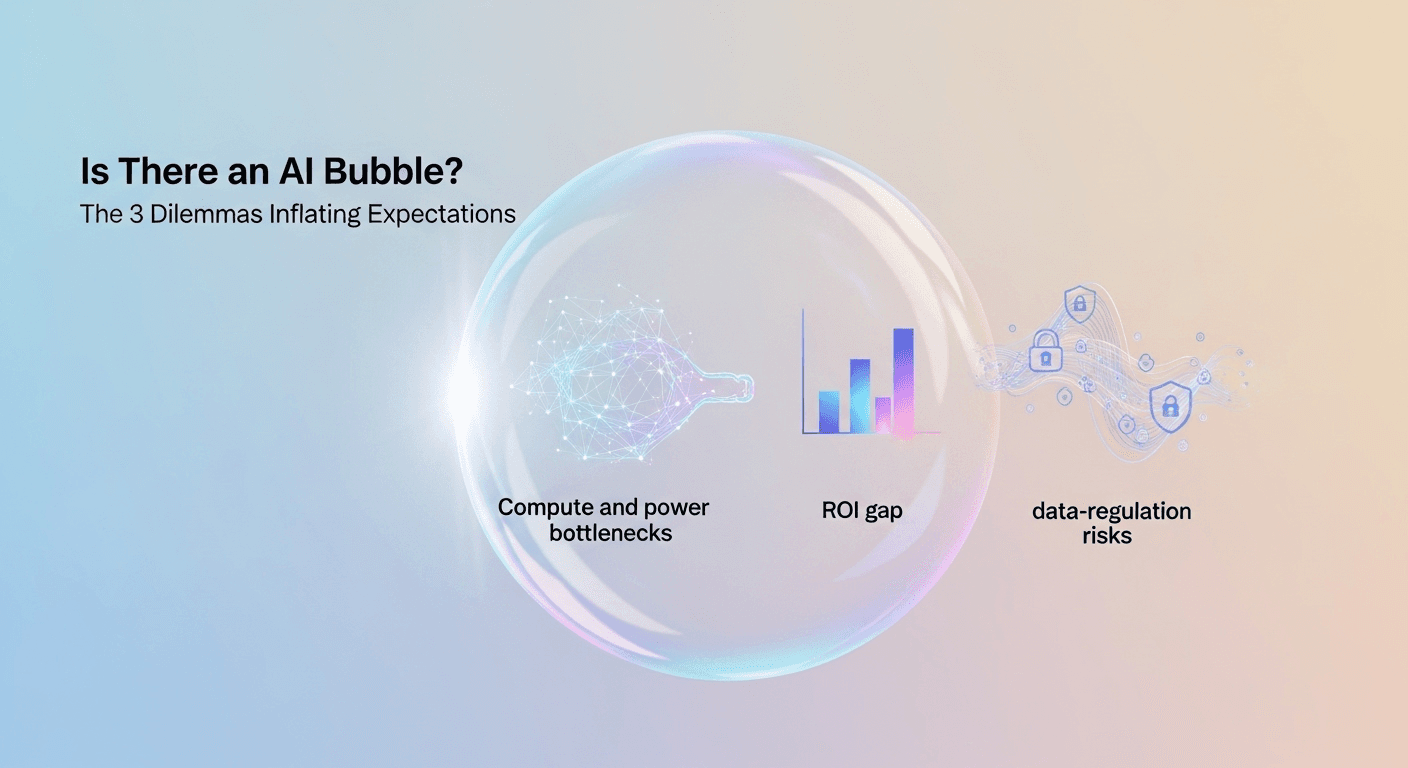
Is There an AI Bubble? The 3 Dilemmas Inflating Expectations
Is There an AI Bubble? The 3 Dilemmas Inflating Expectations
AI has taken center stage in the market, with significant investments flowing into chips, data centers, and software startups at a pace reminiscent of past bubbles. However, three persistent dilemmas may either further inflate expectations or deflate them. Here’s a comprehensive guide to the forces driving the current surge, the potential pitfalls, and key indicators to monitor moving forward.
Why AI Investment Has Taken Off
Several powerful factors have converged:
- Breakthroughs in generative AI and large language models have rapidly demonstrated consumer value.
- Advances in semiconductors have created significant computational gains, particularly in GPUs and high-bandwidth memory.
- Cloud service providers are committing to multi-year investments in AI infrastructure on a global scale.
- Early workplace applications have shown promising productivity gains in areas like coding, marketing, customer support, and analytics.
Hardware leaders are reaping the most benefits. Nvidia’s rapid growth and increasing valuation have become key indicators of AI enthusiasm, with related suppliers in memory, cooling, and servers also riding the wave (Reuters). Yet, the investment narrative now hinges on whether the economics of AI can keep up with the influx of capital.
The Trio of Dilemmas Shaping the AI Bubble Debate
Investors, business leaders, and policymakers are grappling with three interconnected dilemmas. Individually, these challenges may be manageable, but together they create uncertainty around how quickly AI expenditures will translate into sustainable profits.
Dilemma 1: The Compute and Power Bottleneck
Scaling AI relies heavily on two costly and limited resources: advanced chips and electricity. While supply is increasing, demand is outpacing it.
- Chips and Memory: Modern AI operations depend on GPUs and high-bandwidth memory (HBM). Suppliers like SK hynix, Samsung, and Micron are ramping up HBM production, but tight supply and prolonged lead times continue to pose risks throughout extensive upgrade cycles (Reuters) (Micron).
- Custom Silicon: Cloud providers are developing proprietary AI chips to lower costs and reduce dependency on single suppliers. Google has introduced iterations of TPU platforms, including TPU v5p for large-scale training (Google Cloud). Similarly, Amazon launched Trainium2 and Inferentia for various workloads (AWS), while Nvidia continues to advance its Blackwell platform (Nvidia).
- Electricity and Land: Data centers consume substantial power. The International Energy Agency projects that data centers, along with AI and cryptocurrency, could use between 620 to 1,050 TWh of electricity by 2026, a jump from about 460 TWh in 2022 (IEA). Securing grid connections and suitable sites is becoming more challenging as interconnection queues expand and local permitting tightens (Berkeley Lab) (NERC).
- Carbon and Water: Companies are increasingly facing sustainability challenges alongside capacity issues. Microsoft’s latest sustainability report indicates that total emissions rose compared to its 2020 baseline as its cloud infrastructure expanded, highlighting a short-term trade-off between capacity and climate objectives (Microsoft). Efficient cooling and water usage are now strategic considerations.
Why it matters: If compute and power resources remain constrained, timelines for model training will slip, inference costs will remain elevated, and AI product roadmaps will slow down. Conversely, if supply exceeds demand, hardware pricing and profit margins could decline more rapidly than anticipated. Both scenarios threaten valuations based on consistently smooth, multi-year growth.
Dilemma 2: The Monetization and ROI Gap
While AI garners attention swiftly, monetization often lags significantly. Many companies are still in the exploration phase, and the most prominent consumer AI solutions either remain free or are bundled with other services. This creates a disconnect between current infrastructure spending and future monetization.
- Revenue Contribution is Uneven: Cloud providers have noted that AI has boosted growth rates, but from a relatively modest base. Microsoft indicated that AI services recently added significant growth points to Azure, yet AI remains a fraction of overall cloud spending (CNBC).
- Unit Economics are Sensitive: Inference, rather than training, is likely to dominate long-term costs for many applications. Factors such as latency, model size, and context window selections can significantly affect serving costs. The Stanford AI Index emphasizes how these variables lead to cost variability (Stanford HAI).
- Productivity Gains are Context-Specific: Controlled studies suggest that developers can complete tasks more efficiently with AI coding support, though results vary based on task complexity and team experience. GitHub noted significant improvements in targeted programming tasks (GitHub). However, translating these findings into comprehensive ROI across the entire organization remains a challenge.
- Pricing Experiments are Ongoing: Vendors are exploring various pricing models, including per-seat, per-token, per-feature, and outcome-based pricing. Many customers are evaluating AI enhancements against budgets set before the surge in AI interest, which can extend decision-making timelines.
Why it matters: If customers struggle to quantify benefits or if serving expenses remain high, efforts may stall at the pilot phase rather than transitioning to full production. This could lengthen the repayment period for significant capital expenditures underway.
Dilemma 3: Data, Defensibility, and Regulations
As AI models improve, the barriers protecting their value can diminish. Access to quality data, transparency, and regulatory landscapes will significantly influence who captures value and how sustainable that value is.
- Quality Data is Limited: Analyses indicate that high-quality public text and code data could be depleted within a few years for advanced model training, prompting the industry to rely more on proprietary datasets, synthetic data, or new modalities such as video (Epoch AI).
- Open vs. Closed Models: Strong open-source models are closing the gap with proprietary alternatives, putting pressure on prices and accelerating commoditization for general capabilities. Meta’s Llama 3 demonstrates how quickly open models can advance and disperse (Meta).
- Regulation is Looming: The EU’s AI Act introduces layered obligations with additional requirements for powerful foundation models, model transparency, and risk management (European Parliament). In the US, recent executive orders and frameworks promote safety reporting, secure development practices, and standardized evaluation processes (White House) (NIST).
- Intellectual Property and Data Provenance: Ongoing lawsuits regarding training data, licensing, and ownership of AI outputs continue to evolve. Clarity around data provenance and opt-out mechanisms will become critical for corporate buyers.
Why it matters: Increased regulation could heighten compliance costs or slow down model deployment, potentially delaying revenue growth. If open-source options catch up swiftly, profit margins may compress quicker than investors anticipate. Additionally, if access to unique data becomes the key competitive advantage, value may shift towards those who control distribution and rights, rather than just the best model weights.
What Could Burst the Bubble, and What Could Sustain It
Not every surge in investment constitutes a bubble, and not all bubbles inevitably burst. Here are potential paths forward.
Bearish Scenario: Oversupply of Capital and Slower-than-Expected Monetization
- Data center expansions hit power and permitting constraints, delaying deployments by several quarters.
- Capacity in HBM and advanced packaging increases, alleviating shortages and compressing hardware margins sooner than predicted.
- Businesses find it challenging to transition from pilot projects to full-scale production, due to unclear ROI, extensive security reviews, and integration complexities, lengthening sales cycles.
- Open-source models commoditize general features, intensifying price competition while lowering Average Revenue Per User (ARPU) for AI options.
- Heightened regulatory requirements impose extra burdens for safety testing, documentation, watermarking, and incident response, consequently increasing costs for frontier deployments.
Bullish Scenario: A Self-Reinforcing Wave of Productivity
- Custom silicon and software improvements substantially decrease serving costs, enhancing unit economics for widely used workloads.
- Power availability improves through strategic utility partnerships, on-site generation, and increased operational efficiency in cooling and orchestration (IEA).
- Companies successfully transition effective pilot projects in customer support, coding tasks, analytics, and content generation into structured operations, accumulating modest gains that lead to significant operational leverage.
- Clearer regulations foster confidence by defining common evaluation and safety standards, streamlining procurement processes for risk-averse companies.
- Exclusive data partnerships yield robust advantages and distinct models in sectors like healthcare, finance, and industrial processes.
The most probable outcome is a middle ground: cycles of eager optimism contrasted with disillusionment as challenges are addressed and new ones arise. The next 12 to 24 months will likely depend on tangible evidence of scalable ROI.
Signals to Monitor in the Upcoming Year
- Hardware Pricing and Lead Times: Are GPU and HBM prices stabilizing or dropping more rapidly than expected as new capacities come online?
- Power Agreements and Grid Connections: Are operators entering into long-term power purchase agreements and securing sites more efficiently?
- Cost Per Inference Query: Are serving costs declining through smaller models, quantization, caching, and improved routing?
- Metrics for Enterprise Adoption: Are companies converting pilots into production at higher rates and shifting contracts from seat-based to outcome-based models?
- Regulatory Progress: Do new regulations clarify obligations and alleviate uncertainty, or do they add complications for deployment?
- Data Partnerships: Are model developers forming domain-specific data collaborations that establish competitive advantages?
Practical Takeaways for Builders and Investors
For Technology Leaders
- Treat compute and power as essential constraints. Ensure supply security, diversify vendor options, and invest in efficiency tools.
- Focus on unit economics. Select the smallest model that provides sufficient quality and speed, then continuously optimize.
- Measure ROI early and often. Establish clear baselines and experiments linking AI outputs to business performance. Discontinue stalled pilot projects.
- Strengthen governance. Align with emerging standards on model assessments, safety, and data provenance to simplify procurement.
- Invest in unique data. Domain-specific datasets will become increasingly vital alongside model size.
For Investors
- Assess based on various scenarios. Stress-test assumptions related to chip prices, power availability, serving costs, and regulatory requirements.
- Steer clear of pure volume investments. Favor companies with clear differentiation in data, distribution, or workflow integration, rather than merely model access.
- Monitor open-source developments. If open models rapidly catch up in capabilities, profit margins for general-purpose AI may shrink.
- Keep an eye on cost trends. The most significant value may stem from software that lowers inference costs and maximizes utilization.
Conclusion: A Powerful Trend with Significant Constraints
AI is not a passing trend. However, like any major platform evolution, it must tackle three fundamental questions: Can we sufficiently scale compute and power resources to meet demand at reasonable costs? Can customers realize value faster than providers can incur expenses? And can data strategies and regulations create sustainable advantages instead of introducing friction?
These dilemmas won’t eliminate AI’s potential; rather, they will determine winners and losers, the distribution of profits, and whether the current valuations are justified or premature. Focusing on unit economics, proven ROI, and meaningful differentiation is the best strategy to mitigate bubble risks.
FAQs
Is AI in a bubble?
Some segments may appear overvalued, especially where revenue trails behind spending. Yet strong demand, rapid cost reductions, and genuine productivity gains support a long-term positive trend. Expect volatility.
What could trigger an AI pullback?
Potential triggers include quicker-than-expected drops in hardware prices, power constraints causing deployment delays, sluggish enterprise adoption owing to ROI concerns, or new regulatory expenses that slow release cycles.
Where might profits be concentrated?
Profits could gravitate towards specialized datasets, domain-specific models, and workflow software that controls decision-making, rather than just generic AI model access.
Will open-source models harm margins?
Open-source models may compress margins for capabilities that are not differentiated. Vendors with unique data, distribution channels, or compliance features can still maintain healthy margins.
How should enterprises budget for AI?
Rapidly pilot projects while establishing clear success criteria, design for the smallest viable model, monitor serving costs, and link AI investments to quantifiable business outcomes.
Sources
- Reuters – Nvidia joins 3 trillion club
- Reuters – HBM and AI chip demand pressures
- Micron – HBM3E overview
- Google Cloud – Introducing Cloud TPU v5p
- AWS – Next-generation AWS-designed chipsets (Trainium2, Inferentia)
- Nvidia – Blackwell platform
- International Energy Agency – Electricity 2024 report
- Berkeley Lab – Interconnection queue assessment
- NERC – 2024 Long-Term Reliability Assessment
- Microsoft – 2024 Sustainability Report
- Stanford HAI – AI Index Report
- GitHub – Copilot productivity research
- Meta – Llama 3 announcement
- European Parliament – AI Act approved
- White House – AI Executive Order
- NIST – AI Risk Management Framework
- IEA – Data centers and data transmission networks
- Epoch AI – When will AI training data run out
- CNBC – Microsoft earnings commentary on AI
- Reuters Breakingviews – AI investment bubble inflated by trio of dilemmas
Thank You for Reading this Blog and See You Soon! 🙏 👋
Let's connect 🚀
Latest Insights
Deep dives into AI, Engineering, and the Future of Tech.
I Tried 5 AI Browsers So You Don’t Have To: Here’s What Actually Works in 2025
I explored 5 AI browsers—Chrome Gemini, Edge Copilot, ChatGPT Atlas, Comet, and Dia—to find out what works. Here are insights, advantages, and safety recommendations.
Read Article


