Inside OpenAI’s Code Red: Implications for ChatGPT, Google, and the Future of AI
Inside OpenAI’s Code Red: Implications for ChatGPT, Google, and the Future of AI
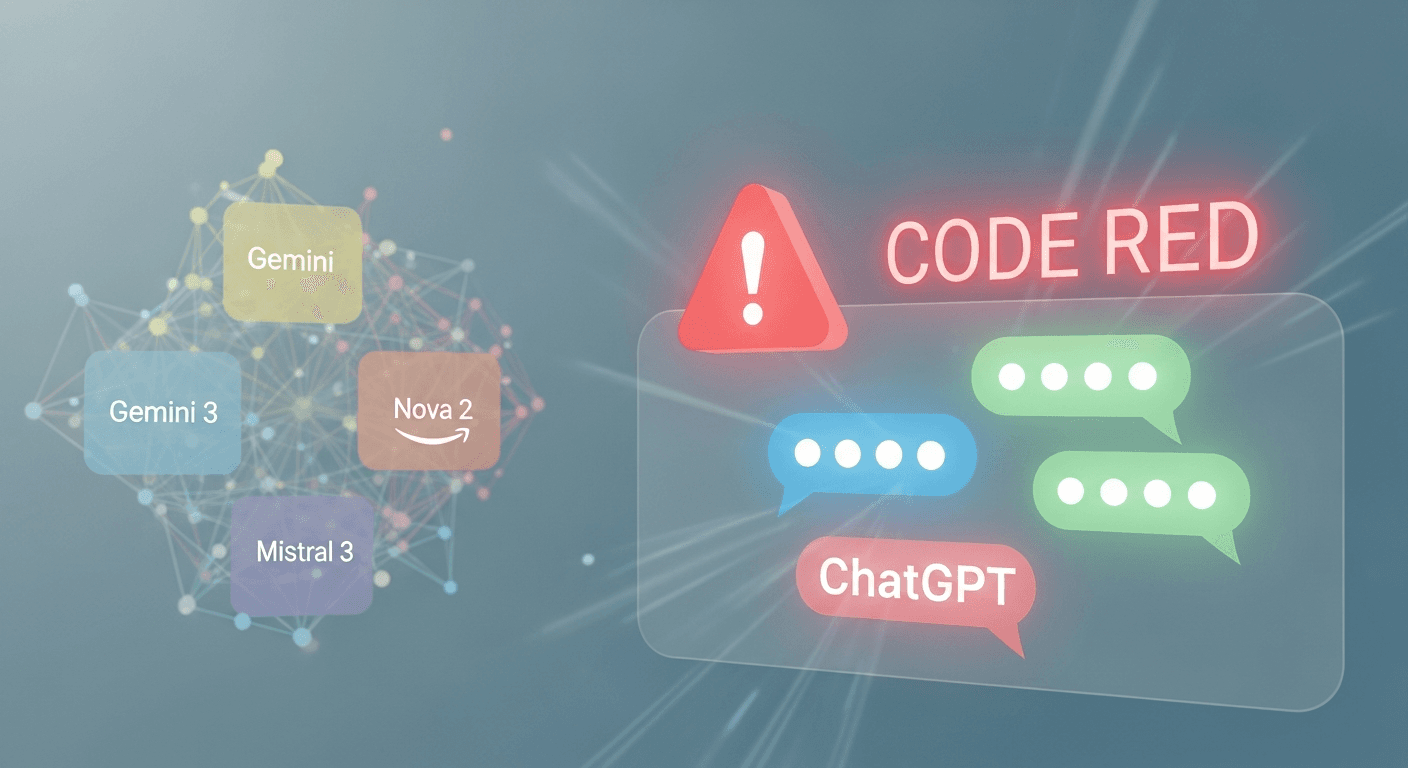
Three years ago, ChatGPT sent Google into an internal code red. This week, the situation reversed as OpenAI declared its own code red in response to Google’s new Gemini 3 models, which have captured significant attention and market share. For anyone involved with AI—whether you’re a developer or a daily user—this moment is critical. It will influence how we search, work, program, and create through 2026 and beyond.
In this article, we explore what sparked OpenAI’s urgency, the changes users and teams can expect, and how developments from Amazon and Mistral are redefining the competitive landscape.
The Catalyst: Gemini 3 and Changing Dynamics
Google’s Gemini 3 has made a notable impact with its impressive early performance in reasoning, coding, and multimodal tasks. Media coverage has highlighted its exceptional leaderboard rankings and practical usefulness. High-profile users, including Salesforce CEO Marc Benioff, have announced their switch from ChatGPT to Gemini 3, contributing to the growing perception that Google has gained a competitive edge.
Recognizing this shift, OpenAI’s leadership, including CEO Sam Altman, has responded decisively, emphasizing the urgency of enhancing ChatGPT. Altman indicated to employees that it is a crucial time for ChatGPT and called for a code red—an initiative aimed at boosting speed, reliability, and personalization by pausing less critical projects.
Changes Resulting from OpenAI’s Code Red
The code red directive prioritizes improving the everyday ChatGPT experience, deferring several initiatives to expedite core upgrades. Here’s what to expect:
- Product Focus: Streamlined efforts on faster and more reliable responses, along with improved personalization to enhance user relevance.
- Advertising Delayed: Plans for ad products in ChatGPT have been postponed as the team focuses on refining product quality.
- Deferred Concepts: Development on consumer agents for shopping and health, along with a rumored tool called Pulse, will be temporarily sidelined.
The urgency is clear. Despite ChatGPT’s substantial user base—approximately 800 million weekly users—OpenAI faces significant pressure to deliver a best-in-class experience as competitors swiftly enhance their offerings. With just a click, users can switch platforms; customer loyalty hinges on quality.
New Developments on the Horizon
Reports suggest OpenAI is accelerating new reasoning capabilities and developing a follow-up model for 2026, reportedly referred to as Garlic, aimed at addressing pre-training issues encountered in earlier versions. However, as OpenAI has yet to formally announce these codenames or timelines, treat them as tentative until official details are disclosed.
Key Insight: Anticipate more noticeable improvements in reasoning and personalization within ChatGPT soon, with a more substantial architectural update to come later—keeping in mind that plans may change as research and product insights evolve.
The Competitive Landscape: An AI Race Intensifies
OpenAI’s code red is part of a broader competitive surge characterized by three key trends:
- Google’s Momentum:
- Gemini 3’s strong reasoning benchmarks and practical utility have resonated well with the developer community, influencing adoption rates.
-
Public endorsements, like those from Benioff, contribute to changing perceptions, impacting enterprise pilots and vendor assessments.
-
Amazon’s Comprehensive Strategy:
- AWS recently introduced Nova 2 models (Lite, Pro, Sonic for voice, and Omni for multimodal uses) and Nova Forge, allowing custom domain-specific model development.
-
The announcement includes Trainium 3 hardware and innovative frontier agents capable of performing autonomously for extended periods, raising the stakes for all providers regarding model quality and operational efficiency.
-
Emergence of Open-Weight Challengers:
- Mistral launched Mistral Large 3 along with a new family of “Ministral 3” models under Apache 2.0 licensing, featuring multimodal support and high context capacity. These are becoming increasingly available on major platforms, expanding options for customization and deployment.
In interviews, Anthropic’s CEO noted a contrasting approach, humorously stating that they do not engage in “code reds.” Such statements might shape market perceptions concerning stability and long-term planning.
How Code Red Could Enhance ChatGPT for Users
If OpenAI follows through on its focus areas, users can expect the following enhancements:
- Faster and More Reliable Responses: Reduced latency and fewer errors, even in lengthy discussions.
- Enhanced Personalization: Improved memory adjustments based on user preferences for tone, structure, and recurring tasks, with clearer privacy controls.
- Smoother Multimodal Integration: Enhanced transitions between text, images, and documents, alongside improved image generation.
For teams, the most significant change may be the accelerated pace of product updates, fostering trust and increasing the return on investment in workflows that utilize ChatGPT.
Implications for Builders and Businesses
- Accelerated Iteration Cycles: Expect faster development and feedback as OpenAI prioritizes product refinement, leading to a more stable foundation for applications like retrieval-augmented generation and workflow automation.
- Cost-Quality Balance: With Amazon’s Nova 2 models and Trainium 3 solutions promising cost efficiencies, consider open-weight models like Mistral 3 for enhanced control and cost-effectiveness.
- Diversify Your Tech Stack: Position yourself with two to three robust model families to mitigate the risks of outages, pricing fluctuations, or service regressions. Many teams already categorize tasks by specific models’ strengths (e.g., coding, analysis, content generation).
Beyond Models: Leadership and Platform Shifts
Leadership changes will also impact the AI landscape. Apple recently appointed Amar Subramanya as the new VP of AI, indicating a renewed focus on core AI functionality and developer tools. Given Apple’s scale, advancements in personal assistants, privacy-centric personalization, and developer resources may have widespread implications.
OpenAI, despite its massive user base and substantial compute demands, faces a balancing act as it aims to sustain profitability, particularly as they have deferred advertising monetization. This highlights the importance of product focus, efficient performance, and strategic cloud partnerships in the current climate.
Practical Advice: Selecting the Right Model in an Evolving Market
If you’re planning to build or migrate workloads in early 2026, keep this checklist in mind:
- Define Specific Needs: Determine whether your tasks require long-context research, live coding assistance, structured data extraction, multimodal analysis, or autonomous agents.
- Assess True Cost of Outcomes: Look beyond token prices to consider latency, retries, safeguards, and manual oversight.
- Ensure Clear Safety and Controls: Choose providers offering transparent memory, policy, and evaluation tools.
- Consider Open-Weight Options: Look at Mistral’s offerings for licensing flexibility and broad deployment capabilities.
Key Upcoming Trends to Monitor
- ChatGPT Features: Look for immediate improvements in response speed, reliability, memory, and multimodal functionality as indicators of OpenAI’s initiatives.
- Model Rivalries: Expect ongoing competition among OpenAI, Google, Anthropic, and leaders in open-weight models to innovate regarding reasoning, tool usage, and accuracy.
- Enterprise Adoption: Watch for enterprises’ decisions on standardized stacks for automation, with AWS’s offerings being one potential avenue.
Conclusion
OpenAI’s code red symbolizes a focused commitment to enhancing the everyday ChatGPT experience used by millions. Simultaneously, advancements from Google’s Gemini 3, Amazon’s Nova 2 and Trainium 3, and Mistral’s open-weight models elevate expectations for quality, speed, and cost efficiencies. This competition benefits both users and builders. The best approach now is methodical evaluation, strategic hedging, and a readiness to adapt based on real-world outcomes rather than just hype.
FAQs
What does OpenAI’s code red entail?
This initiative is an internal push to enhance ChatGPT’s core user experience with a focus on speed, reliability, and personalization, while putting less critical projects on hold.
Is ChatGPT falling behind Gemini 3?
Not necessarily; however, momentum is important. Gemini 3’s strong benchmarks and endorsements have shifted perceptions, but OpenAI still holds a robust position.
Will ChatGPT incorporate ads?
Plans for ad products have been postponed during the code red period to prioritize core functionality, but monetization opportunities may be revisited later.
What is the rumored Garlic model from OpenAI?
This refers to an anticipated larger follow-up model slated for 2026, aimed at resolving previous training shortfalls. Treat all details regarding codenames and timelines as unofficial until confirmed.
Who else should I keep an eye on besides OpenAI and Google?
Watch for Amazon’s Nova 2 models and Trainium 3, alongside Mistral’s open-weight offerings, and Anthropic’s Claude series; each focuses on differing aspects of cost, performance, and enterprise capabilities.
Thank You for Reading this Blog and See You Soon! 🙏 👋
Let's connect 🚀
Latest Insights
Deep dives into AI, Engineering, and the Future of Tech.
I Tried 5 AI Browsers So You Don’t Have To: Here’s What Actually Works in 2025
I explored 5 AI browsers—Chrome Gemini, Edge Copilot, ChatGPT Atlas, Comet, and Dia—to find out what works. Here are insights, advantages, and safety recommendations.
Read Article


