Inside DeepMind’s New Science AI: Why a “General‑Purpose” Researcher Could Change Discovery
Google DeepMind has unveiled a “spectacular” general‑purpose science AI, according to reporting in Nature. If accurate, it signals a shift from single‑domain breakthroughs (like protein folding or materials discovery) toward a unified AI researcher that can read papers, plan experiments, and collaborate with lab robots across disciplines. Here’s what that means, why it matters, and what to watch next.
What did DeepMind announce?
Nature reports that DeepMind introduced a general‑purpose system designed to accelerate scientific discovery across fields such as biology, chemistry, materials science, and physics. Early demonstrations suggest it can synthesize literature, generate hypotheses, design experiments, and interface with automated laboratory equipment — a step toward an AI “co‑scientist.” Details are still emerging, but researchers quoted by Nature called the results “spectacular,” while also urging careful validation and safety guardrails (Nature coverage).
Why a general‑purpose science AI is a big deal
Until now, the most visible advances in AI‑for‑science have been domain‑specific systems. DeepMind’s own breakthroughs include:
- AlphaFold, which transformed structural biology by predicting the 3D structures of proteins and, more recently, biomolecular complexes with AlphaFold 3.
- GNoME, which helped uncover hundreds of thousands of candidate materials, greatly expanding the materials discovery landscape (DeepMind) and (Nature).
- GraphCast, a graph‑neural‑network weather model that achieves state‑of‑the‑art medium‑range forecasts with orders‑of‑magnitude efficiency gains (Science).
- FunSearch, which discovered new algorithms for challenging math problems by combining large language models with rigorous evaluation loops (Nature).
A “general‑purpose” system aims to weave these strengths together. Instead of building one expert model per field, the promise is a single AI that can:
- Absorb and reason over massive scientific literatures.
- Form hypotheses that cross domain boundaries (e.g., protein design informed by materials insights).
- Design, simulate, and interpret experiments end‑to‑end.
- Control or coordinate self‑driving labs for faster iteration cycles.
If it works, this could compress the time between idea and evidence — not just in one discipline, but across many.
What we know from DeepMind’s track record
DeepMind tends to pair fundamental AI innovations with scientific applications. Four recent lines of work hint at the building blocks likely involved in a general‑purpose science AI:
1) Multimodal scientific reasoning
AlphaFold 3 integrates sequence information, structural constraints, and interaction modeling to predict complexes involving proteins, DNA, RNA, ligands, and ions — a step toward unified molecular reasoning (DeepMind).
2) Search and generation across vast spaces
Materials discovery is a combinatorial challenge. GNoME scaled supervised learning and search to propose millions of stable crystal structures, many of which labs later synthesized, illustrating how AI can chart new scientific territories (Nature).
3) Models that plan and tool‑use
Systems like FunSearch point to architectures where language models generate candidates that are then filtered by strict evaluators. In science, those evaluators can be simulators, symbolic solvers, or real instruments. This “generate‑test‑refine” loop is central to autonomous discovery (Nature).
4) Interfaces to autonomous labs
Self‑driving labs combine robotics, high‑throughput experimentation, and closed‑loop optimization. Reviews in the literature outline how AI can select experiments, analyze results, and update models automatically — a key ingredient for any generalist science AI (Nature commentary) and (Nature review).
How a general‑purpose science AI might work
DeepMind hasn’t publicly released full technical details, but based on recent advances, a plausible stack looks like this:
- Retrieval‑augmented language models read and synthesize literature, extracting equations, methods, and datasets from millions of papers.
- Tool‑using agents call out to domain‑specific engines — from quantum chemistry packages and molecular docking tools to differential‑equation solvers and Bayesian optimizers.
- Planning modules decompose research goals into experiments and simulations, tracking assumptions and uncertainties.
- Closed‑loop lab integration runs experiments on automated platforms, feeds results back into models, and iterates.
- Safety and governance layers enforce domain rules (e.g., biosafety), provenance tracking, and human‑in‑the‑loop review.
Each component exists today in some form; what’s new is stitching them together into a robust, auditable system that works across domains.
What can it actually do right now?
Nature’s reporting suggests the system has shown strong early performance on literature analysis and hypothesis generation, with promising lab‑automation pilots (Nature). That aligns with where the field is: models can already propose promising molecules and materials, and self‑driving labs are increasingly common in chemistry and materials science (Nature).
However, claims of generality should be interpreted with care. Different sciences require different evidence standards, from statistical inference in social science to reproducible synthesis in materials to randomized controlled trials in biomedicine. An AI that is helpful across all of these will need careful domain adaptation, transparent uncertainty estimates, and rigorous evaluation.
Benefits — and the caveats
Potential benefits
- Speed: Close the loop between reading, reasoning, and experimenting.
- Breadth: Transfer insights across disciplines to spark unexpected ideas.
- Scale: Explore far larger design spaces than a human team could, as in materials and catalyst discovery.
- Accessibility: Package advanced methods into usable assistants for scientists and R&D teams.
Key caveats
- Verification: Generated hypotheses are only as good as the experiments that test them; rigorous validation, preregistration, and replication still matter.
- Hallucinations and bias: Language models can fabricate citations or overgeneralize from biased literature; retrieval and fact‑checking are essential.
- Reproducibility: Full provenance (data, parameters, tool versions) must be recorded so others can reproduce results.
- Safety: In fields like biology, AI planning must respect biosafety constraints. Prior work shows dual‑use risks are real — for example, AI models have been repurposed to generate toxic molecules in silico (Nature Machine Intelligence).
- Governance: Organizations should align deployments with recognized frameworks such as NIST’s AI Risk Management Framework (NIST AI RMF 1.0).
How this could change the research workflow
Think of a future project flow in materials discovery:
- The AI reviews thousands of papers and patents, mapping synthesis pathways and property trends.
- It proposes candidate compounds that balance stability, performance, and sustainability, using physics‑informed models.
- It designs a batch of experiments for a self‑driving lab, selecting conditions to maximize information gain.
- As results stream in, it updates its models, flags anomalies, and suggests follow‑ups.
- It generates a lab‑ready report with methods, data, and code — all with provenance for reproducibility.
Swap in protein design, battery electrolytes, or climate modeling, and the same pattern holds: read, plan, act, learn — with humans supervising critical decisions.
What to watch next
- Peer‑reviewed details: Look for technical papers, model cards, and benchmarks that clarify capabilities and limits.
- Independent replications: Third‑party labs reproducing results will be a key signal of robustness.
- Open tools: Even if the core model remains closed, usable interfaces, datasets, and evaluation suites can broaden community benefit.
- Safety features: Expect stronger biosecurity filters, audit trails, and human‑in‑the‑loop controls, especially in sensitive fields.
- Real‑world wins: Watch for concrete discoveries — new catalysts, materials, or biological designs validated in the lab.
Bottom line
DeepMind’s move from specialized tools to a general‑purpose science AI is a logical next step — and a meaningful one if the system proves reliable. The path forward is clear: pair ambitious AI with rigorous science. Transparent methods, cautious claims, and independent validation will determine whether this technology becomes a dependable co‑author of future discoveries.
FAQs
Is this an AGI for science?
No. “General‑purpose” here means versatile across scientific tasks, not human‑level intelligence. It likely integrates existing capabilities — literature retrieval, planning, simulation, and lab automation — rather than a single all‑powerful model.
How is this different from AlphaFold or GNoME?
AlphaFold and GNoME are domain‑specific systems (biology and materials). The new effort aims to coordinate many tools across domains, acting as an orchestrator and planner that can move from reading to experimentation.
Can it run experiments by itself?
It can likely interface with automated equipment in “self‑driving labs,” but responsible deployments keep a human in the loop, especially in safety‑critical domains like biology.
What about errors or hallucinations?
They remain a risk. Best practices include grounding outputs in retrieved sources, using tool‑based verification (e.g., simulators), and logging full provenance to enable replication.
When will scientists get access?
Access details weren’t public at the time of reporting. Watch for peer‑reviewed papers, APIs, or collaborations that open parts of the system to the community.
Sources
- Nature coverage of DeepMind’s announcement: “DeepMind unveils ‘spectacular’ general‑purpose science AI”.
- AlphaFold 3 overview: DeepMind.
- GNoME materials discovery: DeepMind and Nature.
- GraphCast weather forecasting: Science.
- FunSearch for mathematical discovery: Nature.
- Autonomous labs and AI‑driven discovery (overview): Nature and Nature review.
- Dual‑use risks in AI‑enabled molecule design: Nature Machine Intelligence.
- NIST AI Risk Management Framework 1.0: NIST.
Thank You for Reading this Blog and See You Soon! 🙏 👋
Let's connect 🚀
Latest Insights
Deep dives into AI, Engineering, and the Future of Tech.
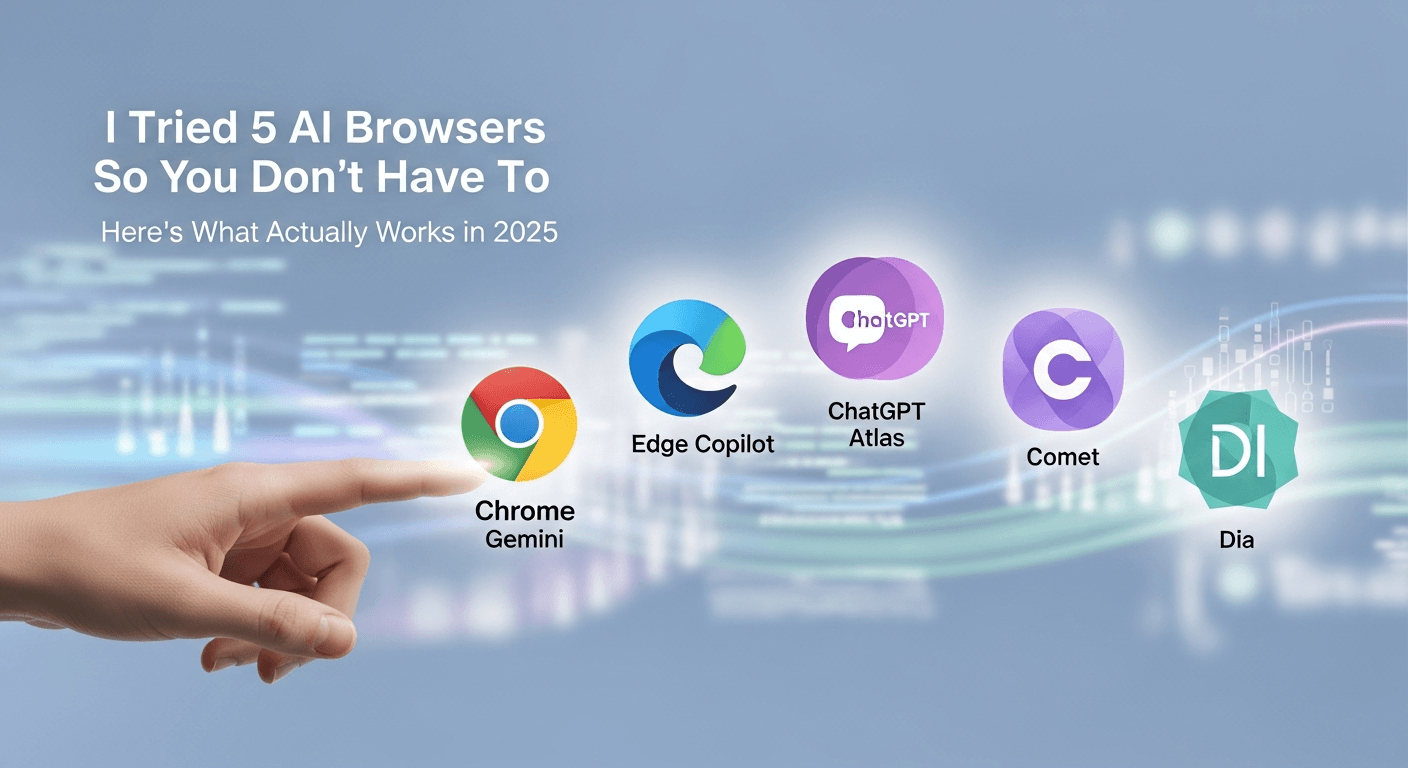
I Tried 5 AI Browsers So You Don’t Have To: Here’s What Actually Works in 2025
I explored 5 AI browsers—Chrome Gemini, Edge Copilot, ChatGPT Atlas, Comet, and Dia—to find out what works. Here are insights, advantages, and safety recommendations.
Read Article


