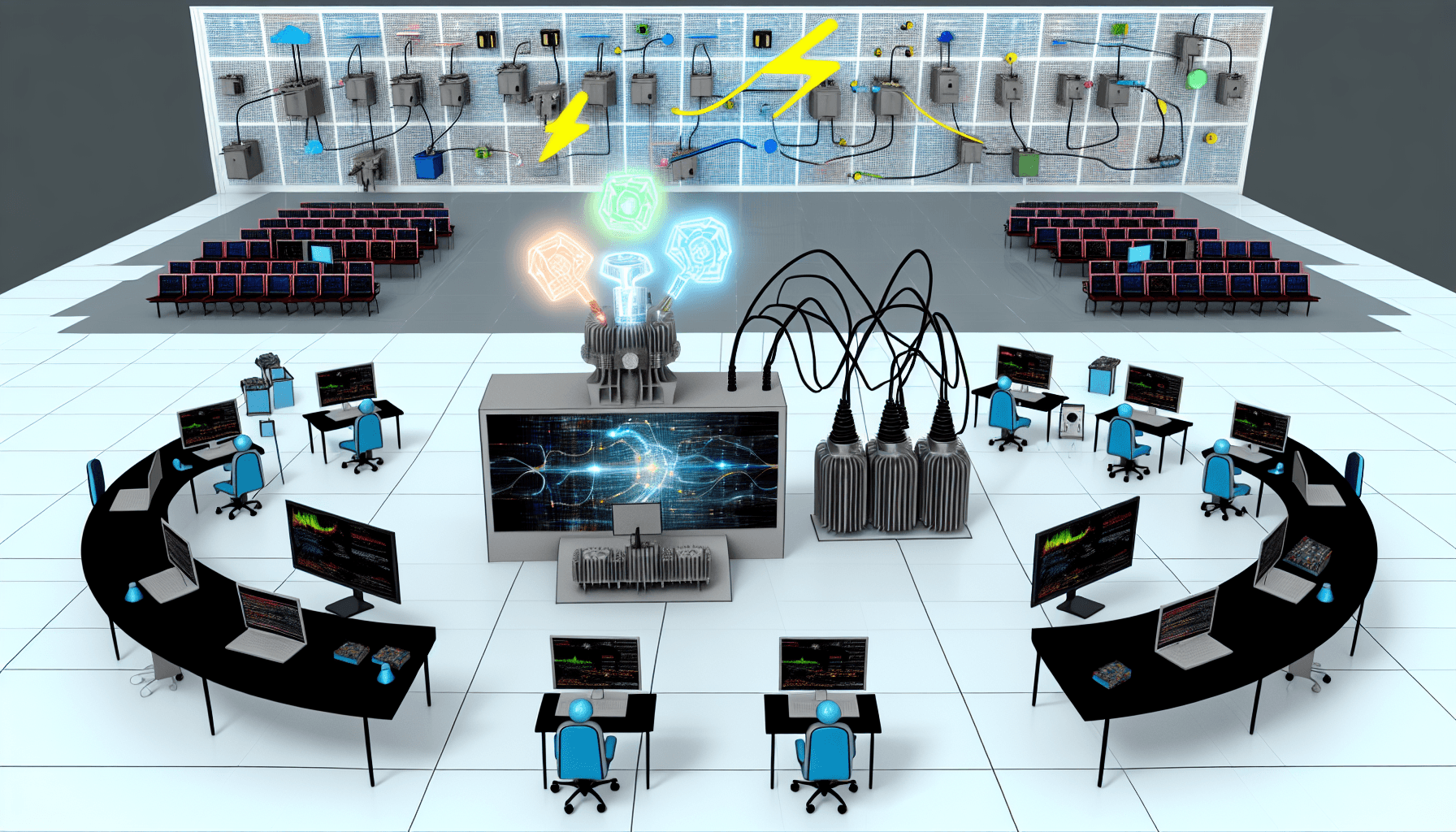
How Transformers Handle Long-Range Dependencies in Deep Learning
Introduction
Transformers have revolutionized the field of natural language processing (NLP) and beyond, due to their unique architecture that efficiently handles ‘long-range dependencies’. Long-range dependencies refer to the relationships between elements in a sequence that are separated by relatively large distances. In this blog, we delve into the mechanisms transformers use to manage these dependencies, enhancing their ability to process sequential data like text, and why this makes them exceptionally powerful in the AI field.
The Challenge of Long-Range Dependencies
In many NLP tasks, the meaning of a word in a sentence can depend heavily on other words that may not be immediately adjacent. Traditional models, such as recurrent neural networks (RNNs), struggle with these dependencies due to their sequential processing nature, which limits their memory and makes it difficult to maintain context over long distances. Transformers, introduced in the landmark paper ‘Attention is All You Need’ by Vaswani et al., overcome these limitations with their attention mechanism.
The Architecture of Transformers
The transformer model distinguishes itself with its reliance solely on attention mechanisms, discarding recurrence and convolutions entirely. This architecture consists of two main parts: the encoder and the decoder. Each of these parts is composed of layers that contain multi-head self-attention mechanisms and point-wise, fully connected layers. This design allows every position in the decoder to attend over all positions in the encoder, enabling the decoder to capture far-reaching contextual relationships more effectively than its predecessors.
Understanding the Self-Attention Mechanism
The self-attention mechanism is at the heart of the transformer’s ability to handle long-range dependencies. It works by allowing each position in the sequence to attend to all other positions in the same sequence. This means that dependencies can be directly computed between distant elements without needing to propagate information through a potentially deep series of computations, as in traditional RNNs. The self-attention mechanism computes three sets of values from its input: keys, queries, and values. The output is then obtained by scaling the dot products of the keys and queries, applying a softmax function to get weights on the values.
Advantages of Transformers Over Traditional Models
Transformers bring several advantages over traditional sequential models like RNNs and LSTMs. These include parallelization of computations, which significantly speeds up training, and more importantly, the ability to attend to any part of the input sequence, no matter how far apart the elements are. This makes transformers particularly powerful for tasks where understanding context and dependencies is crucial—for example, in document summarization, question answering, and language translation.
Case Studies of Transformer Effectiveness
To illustrate the effectiveness of transformers in handling long-range dependencies, let’s consider the task of language translation. Traditional sequence models often lose essential contextual cues as the input sequence length increases. Transformers maintain a global view of the entire sequence, enabling more accurate and contextually aware translations. For instance, the transformer-based models like BERT (Bidirectional Encoder Representations from Transformers) have achieved state-of-the-art results on a variety of NLP benchmarks and tasks.
Challenges and Future Directions
Despite their advantages, transformers also come with their own set of challenges. One of the primary concerns is their need for substantial computational resources, particularly in terms of memory when processing very long sequences. Researchers continue to innovate on this front, with recent advancements like the Reformer and the Longformer, which adapt the transformer architecture to handle even longer sequences more efficiently.
Conclusion
Transformers have become a core component of modern NLP solutions, offering an elegant and extremely effective methodology for handling long-range dependencies. As research continues and technology advances, it is likely that we will see even more sophisticated transformer models that carry less computational cost and are accessible for a broader range of applications.
Thank You for Reading this Blog and See You Soon! 🙏 👋
Let's connect 🚀
Latest Insights
Deep dives into AI, Engineering, and the Future of Tech.
I Tried 5 AI Browsers So You Don’t Have To: Here’s What Actually Works in 2025
I explored 5 AI browsers—Chrome Gemini, Edge Copilot, ChatGPT Atlas, Comet, and Dia—to find out what works. Here are insights, advantages, and safety recommendations.
Read Article


