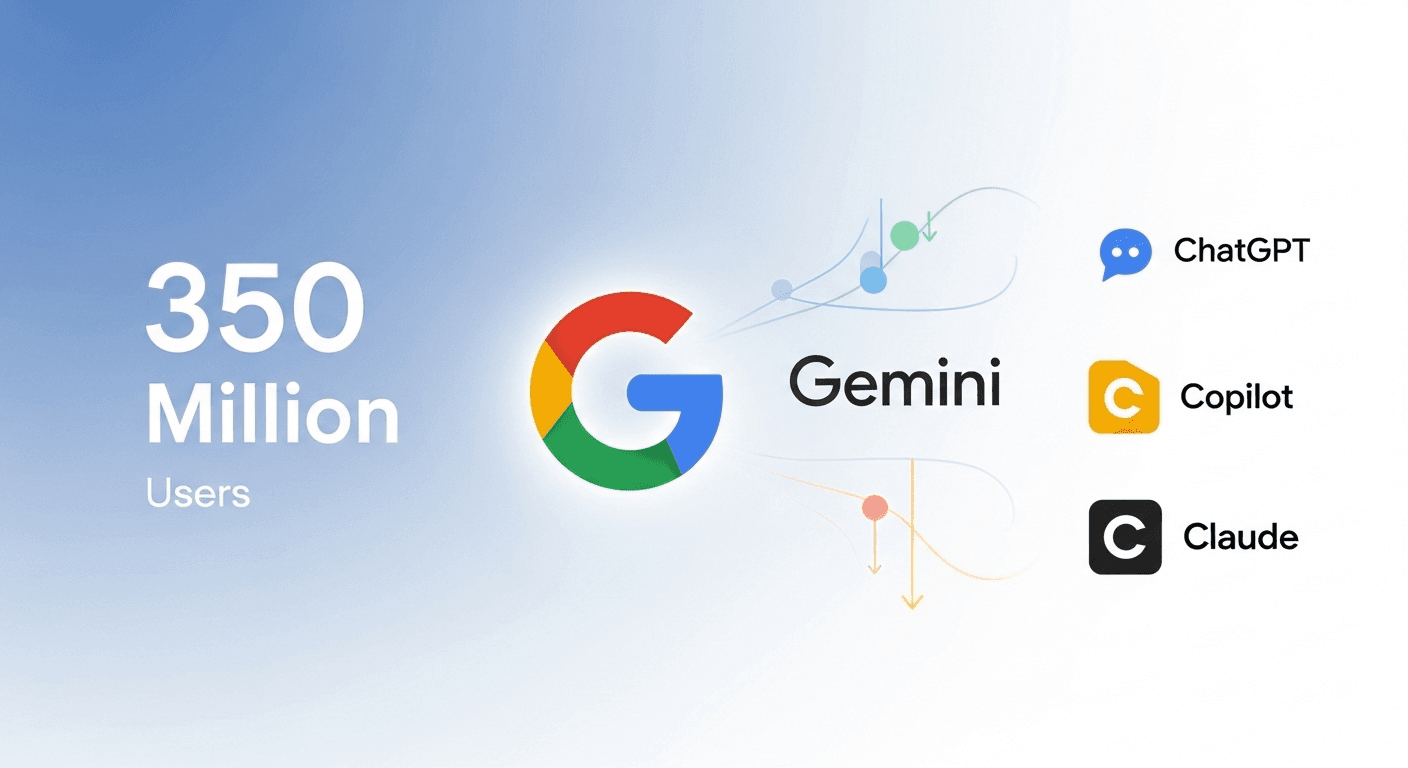
Google Gemini Reaches 350 Million Users: What It Means and Where It Lags Behind Competitors
Google Gemini Reaches 350 Million Users: What It Means and Where It Lags Behind Competitors
Google’s Gemini has reportedly achieved 350 million monthly active users, marking a significant milestone for an AI platform that integrates into Google Search, Android, and Workspace. However, user numbers alone don’t define success in the competitive landscape. Here’s what that figure includes, how it stacks up against OpenAI, Microsoft, and Anthropic, and why the underlying narrative is more complex than it appears.
Key Takeaways
- Gemini serves approximately 350 million monthly active users globally, according to a recent report from PYMNTS.
- This figure likely includes users of chat applications, AI features across Google products (such as Search, Android, YouTube, and Workspace), and cloud developers utilizing Gemini models.
- Despite its scale, Gemini still trails competitors in key areas like model rankings, developer engagement, and consumer usage metrics.
Why 350 Million Monthly Active Users Matters
In the consumer internet era, reaching 100 million monthly active users often indicates strong product-market fit. Achieving 350 million places Gemini among a select few for a platform that only launched in late 2023, suggesting Google’s approach of integrating generative AI into established workflows is effective. Features like AI Overviews in Search, “Help me write” in Gmail and Docs, and autocaptioning in YouTube are examples of this strategy.
Here’s why this user base is significant:
- Data Advantage: More interactions can enhance model quality through fine-tuning and evaluation, respecting privacy constraints.
- Distribution Moat: Few companies can deliver AI solutions across billions of devices and services as rapidly as Google can.
- Monetization Flexibility: AI embedded in revenue-generating platforms like Search and YouTube can translate usage directly into revenue faster than standalone chat applications.
Understanding What Counts as a Gemini User
Definitions of monthly active users (MAUs) can vary across companies. Google has not released a detailed breakdown, but the 350 million figure likely encompasses:
- Gemini Chat Users: Engaging through web and mobile applications.
- Search Users: Those experiencing AI Overviews or related results at least once a month. Google expanded AI Overviews internationally in 2024, modifying rollout based on early user feedback (The Verge).
- Workspace Users: Activating Gemini features in tools like Gmail, Docs, Sheets, or Slides. With over 3 billion Workspace users, even a modest adoption rate can result in significant MAU numbers.
- Android Features: Such as on-device summarization and smart replies driven by Gemini Nano.
- Developers and Enterprises: Utilizing Gemini models through Google Cloud’s Vertex AI or the Gemini API.
Ultimately, the MAU count reflects Google’s distribution capabilities rather than just a standalone chatbot.
How Gemini Compares to Competitors
OpenAI and ChatGPT
OpenAI’s ChatGPT remains the most recognizable consumer chatbot brand worldwide. Traffic analysis from Similarweb estimated ChatGPT’s site attracted over 2 billion visits during various months in 2024 and 2025, indicating widespread consumer engagement (Similarweb). OpenAI has consistently stated that ChatGPT has over 100 million weekly active users, a figure they’ve maintained since late 2023 (Reuters).
Regarding monetization, reports suggest that OpenAI’s revenue soared through 2024, with internal figures indicating an annual revenue surpassing $3.4 billion by late 2024, largely fueled by API usage and ChatGPT subscriptions (CNBC).
Microsoft and Copilot
Microsoft has integrated Copilot across Windows, Bing, Edge, GitHub, and Microsoft 365, establishing multiple access points for generative AI in work and everyday tasks. While Microsoft doesn’t disclose consumer MAUs for Copilot, they have reported strong enterprise adoption of Azure OpenAI Service and Copilot for Microsoft 365, with AI noticeably contributing to Azure’s growth in recent quarters (Microsoft IR). This enterprise focus enables a higher willingness to pay, even if straightforward MAU comparisons remain elusive.
Anthropic and Claude
Anthropic’s Claude models, particularly Claude 3.5 Sonnet, rank highly on independent leaderboards and are favored by developers and professionals. Public usage metrics are limited, but the model’s quality and steady enterprise adoption through cloud partners make Claude a formidable competitor to both OpenAI and Google (Anthropic).
Benchmarking and Quality Signals
Community rankings from resources like LMSYS’s Chatbot Arena currently list GPT-4o and Claude 3.5 Sonnet at or near the top, with Google’s recent Gemini models competitive but not consistently ranked first across all tasks (LMSYS Chatbot Arena). While rankings can shift rapidly as models are updated, the current standings illustrate why Gemini’s extensive reach does not necessarily indicate it leads in cutting-edge AI quality.
Gemini’s Strengths and Weaknesses
Strengths
- Broad Integration Across Google Products: Google offers unique access to AI features in Search, Android, YouTube, and Workspace, enhancing user exposure.
- Built-in Multimodal Capabilities: Gemini’s vision and text functionalities support diverse applications, from video summarizations to generating structured data.
- On-Device AI: Gemini Nano optimizes privacy, speed, and cost by running smaller models on devices, providing features without needing constant cloud access.
Weaknesses
- Perception of Quality: For more complex tasks like reasoning or coding, many users still prefer OpenAI or Anthropic, as reflected in developer surveys and leaderboard rankings (LMSYS).
- Developer Engagement: Even with improvement, Google’s AI tools and APIs face strong competition from the ecosystems built around OpenAI’s API and Microsoft’s Azure OpenAI Service.
- Revenue Signals: Microsoft has clearer indicators of turning AI usage into enterprise revenue. OpenAI’s subscription and API business also seem more advanced based on revenue reports (CNBC).
Challenges in MAU Comparisons
Comparing monthly active users across AI products isn’t straightforward. Here are three reasons for this:
- Definition Variability: One platform may consider any monthly interaction as a user, while another might require a sustained session.
- Bundled vs. Standalone Features: AI integrated into existing products (like Search or Docs) generally has a lower barrier to entry compared to standalone applications, which inflates MAU numbers while potentially indicating shallower engagement.
- Consumer vs. Enterprise Metrics: An enterprise seat can translate to thousands of daily users, but reporting may focus on licenses instead, complicating MAU comparisons with consumer products.
When encountering large AI user figures, it’s essential to analyze what user behaviors are being counted and how frequently they occur. Repeat usage and willingness to pay matter just as much as total reach.
What 350 Million Users Means for Google’s Business
Google’s AI strategy is tightly linked to two primary revenue streams: advertising and cloud services.
Search and Advertising
Enhancements like AI Overviews, Shopping Graph, and smarter advertising could boost relevance and user satisfaction, potentially improving ad performance. However, overly detailed AI responses might deter users from clicking through to external sites, which could lead to pushback from publishers and advertisers. Google is refining its design and coverage in light of earlier challenges with AI Overviews (The Verge).
Workspace Subscriptions
Gemini features for Workspace offer premium options like advanced writing tools, image generation, and data analysis for a monthly fee. Even modest conversion rates could accumulate significantly given Workspace’s large user base. While Google has not released paid subscriber numbers for Gemini Advanced, subscriptions represent a straightforward path to revenue from AI.
Google Cloud and Vertex AI
In the enterprise sector, Vertex AI competes for hosting models, fine-tuning tasks, and evaluation workloads. Microsoft’s Azure OpenAI Service currently leads the enterprise generative AI market, with Microsoft frequently noting AI’s impact on Azure’s growth in its financial results (Microsoft IR). Google is investing heavily to close the gap in terms of model variety, privacy capabilities, and cost management tools.
Signals to Monitor Going Forward
- Quality Improvements: Subsequent versions of Gemini that enhance reasoning, tool usage, and speed will affect adoption among developers and enterprises.
- Clear Metrics: More precise MAU figures across Search, Workspace, and the Gemini app, along with data on paid conversions, will help investors and customers gauge progress.
- Integration Success: Deeper integration within Android and Chrome could significantly encourage daily active usage.
- Cost Management: The expenses of running large models at web scale are substantial. Advancements in model efficiency, on-device capabilities, and inference chips will influence profitability.
Practical Insights for Teams Considering Gemini
- Integrate Where Users Are: If your organization utilizes Workspace, Gemini can streamline pilots and rollouts.
- Benchmark Against Specific Tasks: Evaluate Gemini’s performance side-by-side with your own tasks and documents, as community rankings may not reflect your specific needs.
- Plan for Iteration: Understand that model behaviors can evolve. Incorporate evaluation and necessary guidelines into your deployment strategy.
- Avoid Vendor Lock-in: Prioritize architectures that allow for model flexibility and independent retrieval layers.
Conclusion
Reaching 350 million monthly active users indicates that Gemini has moved beyond being a niche offering. Google’s broad distribution capabilities provide a significant advantage in introducing AI to hundreds of millions of users. However, leadership in the generative AI space will depend on quality, trust, and outcomes rather than just on user numbers. The competition among Google, OpenAI, Microsoft, and Anthropic remains fiercely contested.
FAQs
How many users does Google report for Gemini?
A recent report from PYMNTS cites that Gemini has 350 million monthly active users across its ecosystem, including features embedded in various Google products (PYMNTS).
Is Gemini larger than ChatGPT?
It depends on the metric used. ChatGPT’s website consistently ranks among the most visited worldwide, indicating considerable consumer engagement (Similarweb). Gemini’s reported 350 million MAUs likely includes users across integrated Google products, which are not directly comparable.
Which AI model is currently the best?
Independent leaderboards such as LMSYS’s Chatbot Arena typically place GPT-4o and Claude 3.5 Sonnet at or near the top, with Gemini models competitive in several areas but not consistently leading (LMSYS). The best choice often varies based on specific tasks, costs, latency, and privacy requirements.
How is Google monetizing Gemini?
Through enhanced advertising on Search, subscriptions for Workspace add-ons like Gemini Advanced, and enterprise services via Vertex AI. Detailed revenue contributions have not yet been publicly disclosed.
What should enterprises consider before committing to a single AI vendor?
Focus on evaluation frameworks, data governance, cost management, and maintaining flexibility in architecture to prevent vendor lock-in. Many organizations adopt a multi-model approach to balance quality, risk, and expenses.
Sources
- PYMNTS: Google’s Gemini Reaches 350 Million Monthly Active Users but Lags Rivals
- Similarweb: ChatGPT traffic analysis
- Reuters: OpenAI says ChatGPT has 100 million weekly active users
- CNBC: Reported OpenAI revenue run-rate tops 3.4 billion
- Microsoft Investor Relations: Earnings commentary on AI and Azure
- LMSYS Chatbot Arena leaderboard
- The Verge: Google addresses AI Overviews errors
- Anthropic: Claude 3.5 Sonnet
Thank You for Reading this Blog and See You Soon! 🙏 👋
Let's connect 🚀
Latest Insights
Deep dives into AI, Engineering, and the Future of Tech.
I Tried 5 AI Browsers So You Don’t Have To: Here’s What Actually Works in 2025
I explored 5 AI browsers—Chrome Gemini, Edge Copilot, ChatGPT Atlas, Comet, and Dia—to find out what works. Here are insights, advantages, and safety recommendations.
Read Article


