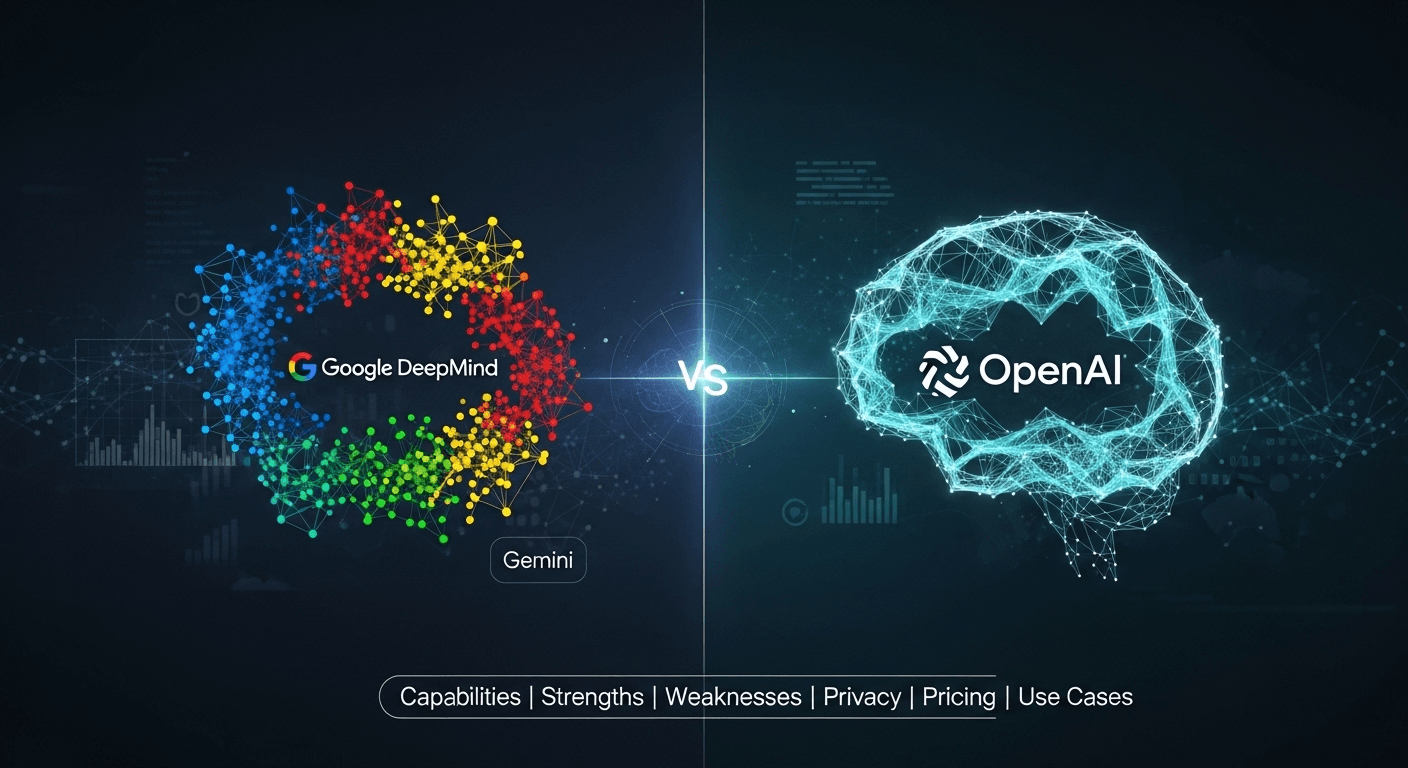
Google Deep Research vs OpenAI: Who Will Lead the AI Research Agent Race?
Google Deep Research vs OpenAI: Who Will Lead the AI Research Agent Race?
AI is evolving beyond simple chat interfaces into sophisticated research agents capable of planning, browsing, reading, and synthesizing information for you. Google is introducing Deep Research within Gemini Advanced, while OpenAI is enhancing capabilities with browsing, SearchGPT, and its own reasoning models. Let’s explore how Google Deep Research compares with OpenAI and what it means for readers, professionals, and teams alike.
Why This Matters Now
The digital landscape is inundated with information. Research agents aim to filter the noise, allowing you to delegate complex inquiries to an AI that can strategize on multi-step tasks, review web content, compare various sources, and deliver a concise, cited summary. This vision underpins Google Deep Research in Gemini, along with competing tools from OpenAI.
Two significant advancements make this possible: longer context windows that enable models to process more content at once, and improved planning and tool utilization that allow them to operate more independently. Google leverages Gemini 1.5 Pro’s extensive context capabilities and integration with the Google ecosystem, while OpenAI focuses on strong reasoning models, real-time multimodal functionalities, and a developer-centric approach.
What Is Google Deep Research in Gemini?
Deep Research is an advanced investigation mode available in Gemini Advanced. Users set a goal or a series of questions, and the AI formulates a strategy, visits sources, extracts and verifies information, and creates a structured synthesis with citations.
According to Google, Deep Research is tailored for multi-step inquiries over extended periods, prioritizing the comparison of multiple sources instead of just summarizing a single page. It utilizes Gemini 1.5 Pro’s long context window and can process text, images, and video as needed. Transparency regarding sources and citation is a key focus; for the latest updates and regional availability, check out Google’s product updates on Gemini here, and for an overview of the technology from Google DeepMind here.
Key Features of Deep Research
- Planning Before Execution: Instead of providing immediate answers, it outlines a reading plan to clarify its approach.
- Web Reading and Synthesis: The AI visits multiple URLs, extracts relevant facts, contrasts different perspectives, and compiles a cohesive summary.
- Long-Context Comprehension: Powered by Gemini 1.5 Pro’s expansive context, capable of handling up to 1 million tokens in specific modes, making it effective at digesting lengthy documents and multiple web pages (source).
- Transparency: Summaries include links to sources and notes on trade-offs or uncertainties.
- Integration: Works closely with Google services like Search, YouTube, and, for premium users, integrates with Workspace tools.
In practice, Deep Research is designed to conduct tasks such as market research, literature reviews, vendor evaluations, travel and budget planning, and executive summaries for decision-makers. While it should not replace expert judgment, it serves as a valuable resource for quickly obtaining well-cited starting points.
How OpenAI Competes
OpenAI tackles research agents through various strategies:
- Browsing and Web Reading: Available in ChatGPT for Plus, Team, and Enterprise users, featuring source citations where necessary.
- SearchGPT: An experimental web research interface introduced in 2024, focusing on real-time results, web reading, and citation-forward responses (OpenAI posts).
- Reasoning Models: The o1 series is designed to facilitate planning of intermediate tasks and solve more complex challenges compared to conventional chat models (OpenAI overview).
- Multimodal Model: GPT-4o combines voice, vision, and text for fast, interactive experiences (OpenAI posts).
- Custom GPTs: The OpenAI API ecosystem enables developers to create specialized research agents with retrieval capabilities, tools, and governance.
While Google Deep Research emphasizes long-context synthesis and expansive reading within Gemini, OpenAI focuses on advanced reasoning, conversational browsing, and a robust platform for developers to create custom agents.
Deep Research vs. OpenAI: Strengths and Tradeoffs
1) Planning and Reasoning
Both companies are investing in planning-first methodologies and chain-of-thought approaches. Deep Research explicitly lays out its plan before executing web reading. OpenAI’s o1 series aims to enhance step-by-step reasoning by allocating more computing power for thoughtful responses (OpenAI posts). In everyday use, Google’s research mode often presents a table of contents and reading strategy, while OpenAI’s browsing and SearchGPT concentrate on providing concise answers with citations that encourage exploration.
2) Web Browsing and Citations
Google integrates Deep Research with Search and its broader web index. Outputs typically consist of inline links with a comprehensive source list at the end. In contrast, OpenAI’s browsing features a smaller selection of curated fetches, highlighting citations within responses, while SearchGPT emphasizes sources by default (OpenAI posts). In both instances, it’s wise to verify claims by clicking through original sources when accuracy is critical.
3) Long Context Windows
The standout feature of Gemini 1.5 Pro is its extensive context window, which Google has emphasized can expand up to 1 million tokens in select configurations. This capability enables the AI to consider long PDFs, entire codebases, or multiple web pages in one session (Google DeepMind). OpenAI’s models are also improving context capabilities, and their reasoning models are designed to allocate additional compute resources to planning, even with shorter contexts. For research requiring the assimilation of numerous documents, Gemini’s long context is a significant advantage.
4) Multimodality and Real-Time Interaction
Both platforms boast strong multimodal features, albeit with different focal points. Google’s Gemini 1.5 family accommodates substantial video and document inputs within a single context (source). Conversely, OpenAI’s GPT-4o excels in rich and interactive voice and live conversation, providing an assistant-like experience for exploration and follow-up inquiries (OpenAI posts). While Gemini is well-suited for in-depth document analysis, GPT-4o stands out for fluid, voice-centric exploration.
5) Integrations and Ecosystems
Google’s Deep Research seamlessly integrates with its ecosystem: Search, YouTube, Chrome, and, for opted-in users, Workspace applications such as Docs, Sheets, Slides, and Gmail (Google product posts). In contrast, OpenAI offers native ChatGPT functionalities for Teams and Enterprise users, along with a versatile API and custom GPTs that enable businesses to create tailored research processes. If your operations already rely on Google Drive and Gmail, Deep Research feels native; however, if you are after a programmable platform, OpenAI’s ecosystem may be more suitable.
6) Data Privacy and Governance
Utilizing these tools in an enterprise setting necessitates robust data management controls. Both Google and OpenAI provide enterprise options that segregate user data from model training and offer administrative controls. For personal accounts, it’s essential to review each service’s data policies and privacy settings before enabling features like browsing or document access. Refer to Google’s product updates here and OpenAI’s product and policy statements here for official guidelines.
7) Pricing and Availability
As of this writing, Deep Research is available as part of Gemini Advanced, Google’s subscription tier, with features varying based on region. OpenAI provides browsing capabilities in ChatGPT Plus, Team, and Enterprise plans, and has been trialing SearchGPT as a separate experience. Always check each provider’s current pricing and feature offerings, as both frequently evolve (Google) (OpenAI).
What Deep Research Does Well
If you’re considering implementing Deep Research, focus on its core strengths:
- Long-Form Synthesis: Transforming broad inquiries—such as “How is the battery recycling market evolving in the EU and US?”—into structured, cited briefs.
- Source Triangulation: Reading multiple reports, articles, and videos, while highlighting consensus and discrepancies.
- Digesting Large Documents: Managing extensive research papers, regulatory filings, or hundreds of pages of PDFs in a single session.
- Executive Summaries: Extracting critical takeaways, risks, and action items for decision-makers.
- Preliminary Due Diligence: Summarizing vendor landscapes or new technologies, complete with links for deeper exploration.
These strengths stem from its long-context understanding, planning-first approach, and extensive web reading capabilities integrated with Google Search. If information overload is your bottleneck, Deep Research serves as a practical enhancement.
Where OpenAI May Excel for Your Workflow
OpenAI’s offering is particularly appealing if your work involves:
- Interactive Exploration: Engaging in voice and vision interactivity with GPT-4o.
- Complex Reasoning Tasks: Utilizing o1 models that allocate more compute power for planning.
- Developer-Led Automation: Using APIs and custom GPTs linked to internal databases.
- Team Collaboration: Leveraging ChatGPT features with administrative controls, shared workspaces, and audit capabilities.
If you’re looking for a customizable research agent, OpenAI’s platform may be more advantageous today. Conversely, if you prefer a fully integrated research mode within Google Search and its applications, Deep Research is highly attractive.
Benchmarks, Reliability, and Evaluation
While benchmarks can be useful, they often fail to represent the complete picture of research agents. Vendor claims typically reflect ideal scenarios. Community assessments, such as the LMSYS Chatbot Arena, offer crowdsourced comparisons across models and tasks (LMSYS). Furthermore, independent evaluations from academic and industry labs are continually evolving.
For your team, the optimal evaluation approach is to run pilot tests using real tasks. Define three to five typical research projects, establish quality criteria, and assess the savings in time, citation quality, and error rates. Document when the agent overlooks nuances or fails to substantiate claims, and then refine your prompts and guardrails accordingly.
Practical Tips for Better Results
Using Google Deep Research
- Define Scope and Constraints: “Analyze the past 12 months, prioritize regulatory sources, and include 6 to 10 citations.”
- Request a Plan: “Outline your research strategy and determine the types of sources you will check. Present this for approval before proceeding.”
- Structured Outputs: Ask for formats such as briefs, tables, timelines, or slide outlines.
- Require Citations: “Identify conflicting information and assess confidence levels for each claim.”
- Iterate: Approve, refine, and instruct the AI to delve deeper into vital sections.
Using OpenAI Browsing and SearchGPT
- Targeted Questions: Specify domains you trust and ask pointed questions.
- Request Comparisons: Ask for side-by-side evaluations and quoted sections from sources.
- Follow-Up Engagement: Use voice or text to explore assumptions and edge cases further.
- Complex Tasks: Combine a reasoning model (o1 series when available) with browsing to strategize and verify.
Always Verify
Regardless of the tool you choose, check sources, verify dates, and confirm claims. Treat AI research agents as smart, efficient assistants that still require human review, especially for high-stakes subjects such as legal, medical, or financial topics.
What to Watch in the Coming Year
- Increased Autonomy: Agents that run independently for extended periods, updating their plans and notifying you with final briefs.
- Actionable Tools: Direct integrations enabling agents to perform actions, such as booking or annotating within your apps, requiring human review.
- Knowledge Retrieval: Safe, auditable access across personal and team knowledge bases—including Drive, email, wikis, and tickets.
- Reduced Hallucinations: Improved citation-first design, checks for source overlap, and more accurate uncertainty measurements.
- Governance Enhancements: Clearer enterprise controls, default data retention settings, and evaluation frameworks for organizations.
Bottom Line
Google’s Deep Research in Gemini represents a timely, promising advancement in reliable web research agents. It capitalizes on Gemini’s strengths in long-context comprehension and its integration with Google apps. In contrast, OpenAI offers strong reasoning models, rapid multimodal interaction, and a flexible platform for developing custom agents. Your choice should reflect your specific needs: if you require comprehensive synthesis within the Google ecosystem, Deep Research is your best bet; if you seek a programmable research workflow or voice-centric exploration, OpenAI may fit better. In either case, research agents are becoming essential tools for knowledge acquisition, far surpassing their initial roles as mere chat companions.
FAQs
What Exactly Is Google Deep Research?
Deep Research is a capabilities feature in Gemini Advanced designed to plan multi-step inquiries, analyze numerous web sources, and generate cited syntheses. It is ideal for complex tasks such as market evaluations and literature reviews, rather than just summarizing single pages.
How Is Deep Research Different from Standard Gemini Prompts?
While standard prompts provide direct answers, Deep Research first plans its strategy and actively reviews multiple sources before composing its output. This typically results in more structured briefs, complete with citations and insights into trade-offs.
How Does OpenAI Compare?
OpenAI features browsing capabilities within ChatGPT, an experimental SearchGPT interface, and reasoning-centric models like the o1 series. GPT-4o excels in responsive voice interactions and multimodal responses, making it ideal for environments requiring developer control and customized research workflows.
Is This Safe for Enterprise Use?
Both Google and OpenAI provide enterprise solutions with data management controls and administrative features. Before enabling browsing or repository access, review each provider’s documentation and agreements, particularly regarding data handling and retention.
How Should I Evaluate These Tools?
Conduct a 2 to 4 week pilot integrating real tasks, evaluating metrics such as time efficiency, citation quality, error rates, and overall user satisfaction. Ensure that human oversight remains in place for crucial decisions.
Sources
Thank You for Reading this Blog and See You Soon! 🙏 👋
Let's connect 🚀
Latest Insights
Deep dives into AI, Engineering, and the Future of Tech.
I Tried 5 AI Browsers So You Don’t Have To: Here’s What Actually Works in 2025
I explored 5 AI browsers—Chrome Gemini, Edge Copilot, ChatGPT Atlas, Comet, and Dia—to find out what works. Here are insights, advantages, and safety recommendations.
Read Article


