Generative AI Explained: What ChatGPT and DALL-E Are, How They Work, and Why They Matter
Introduction: Why Everyone Is Talking About Generative AI
Generative AI has transitioned from research labs to everyday life at an astonishing pace. Tools like ChatGPT and DALL-E can draft emails, summarize reports, generate code, and create images from simple prompts. Beyond the hype, a practical question arises for both curious readers and professionals: What exactly are these systems, how do they work, and where are they truly beneficial?
This explainer draws on trusted sources to help you grasp ChatGPT, DALL-E, and the broader landscape of generative AI. We’ll balance opportunities with clear guidance on the associated risks, governance, and how to get started responsibly.
What Is Generative AI?
Generative AI refers to models that can create new content based on patterns learned from large datasets. This content could be text, images, audio, code, video, or even structured data. The technology gained mainstream attention with the public releases of OpenAI’s ChatGPT in late 2022 and diffusion-based image models like DALL-E 2, Stable Diffusion, and Midjourney in 2022 and 2023 (see: OpenAI, OpenAI, Stability AI).
While the core ideas have been developing for decades within machine learning research, advancements in computing, transformer architectures, and access to abundant data have accelerated progress. Analysts estimate that generative AI could deliver trillions in annual economic value by enhancing knowledge work across various fields—from marketing and customer service to software development and R&D (see: McKinsey).
How Does Generative AI Work?
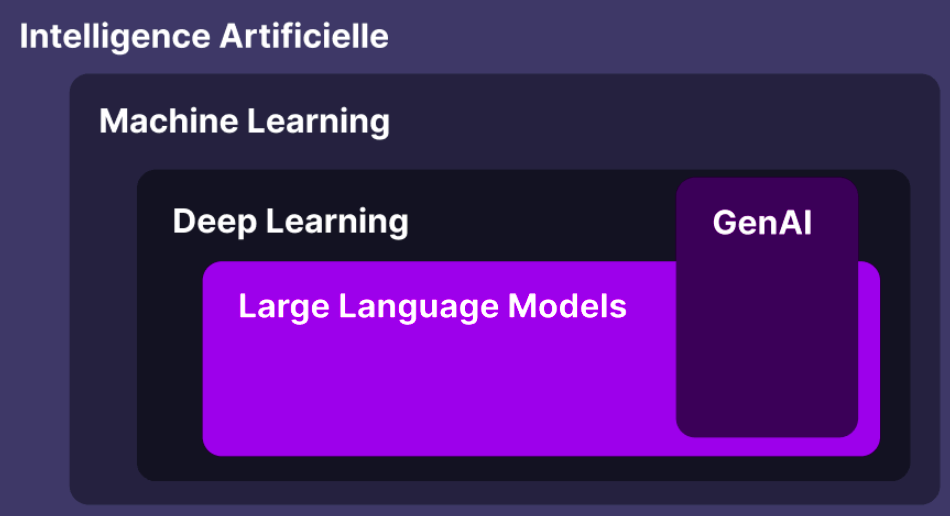
Large Language Models (LLMs)
Text-focused systems like ChatGPT rely on large language models. LLMs are trained to predict the next token (a piece of text) based on the preceding ones. With billions of parameters and training on a diverse range of text corpus, they learn statistical patterns of language, logic, and general knowledge about the world. Modern LLMs use transformer architectures to efficiently focus on long sequences and are often refined with techniques like instruction tuning and reinforcement learning from human feedback (RLHF), enhancing their helpfulness and safety (see: OpenAI GPT-4).
Image Generation with Diffusion Models
Image generators such as DALL-E 2 typically employ diffusion models. During training, these models learn to denoise images step by step, reconstructing structure from noise. At inference time, they reverse this process, starting from noise and gradually refining it into an image that matches the prompt. Many state-of-the-art systems operate within a compressed latent space to enhance both speed and quality (see: OpenAI DALL-E 2, Latent Diffusion Models).
Multimodal Models
Emerging systems can manage multiple modalities at once, such as interpreting images while generating text or creating images from textual descriptions. This allows for tasks like describing charts, drafting alt text, or brainstorming visuals from a brief.
Data, Fine-Tuning, and Retrieval
Base models are typically trained on a wide array of publicly available data and licensed sources. Organizations frequently customize them further with domain-specific data, safety policies, and retrieval-augmented generation (RAG), a method that grounds outputs in a reliable knowledge base to improve accuracy and reduce hallucinations (see: RAG paper).
What Is ChatGPT?
ChatGPT serves as a conversational interface allowing users to engage with LLMs through natural language. It can answer questions, summarize information, suggest ideas, draft documents, and even write code. Underlying versions of ChatGPT have operated on models like GPT-3.5 and GPT-4, with expanding features such as browsing, function calling, and multimodal input in more recent releases (see: OpenAI, OpenAI GPT-4).
Strengths
- Swift drafting and summarization for emails, memos, briefs, and reports.
- Structured outputs, such as tables and JSON, for data tasks.
- Programming assistance: boilerplate code, tests, refactoring, and documentation.
- Brainstorming and outlining help to combat creative blocks.
Limitations
- Hallucinations: plausible yet incorrect statements.
- Outdated information if not connected to current data.
- Sensitivity to prompt wording and a lack of definitive guarantees.
- Potential biases reflecting patterns in training data.
Mitigation strategies include grounding with RAG, incorporating human review for high-stakes tasks, and model choice based on quality and safety needs (see: GPT-4 system card, NIST AI RMF).
What Is DALL-E?
DALL-E and its successors are designed to generate images from text prompts. You can describe a scene, style, or concept, and the model synthesizes a new picture that aligns with your description. These systems can also edit images by adding, removing, or altering elements while maintaining consistent lighting and perspective (see: OpenAI DALL-E 2).
Where Image Generators Shine
- Quick concept art, mood boards, and storyboards.
- Marketing mockups and visual content to experiment with ideas.
- Design exploration across various styles and constraints.
- Education and accessibility, such as illustrating complex ideas.
Alternatives include Stable Diffusion (open source) and Midjourney (a closed model with a strong aesthetic). Each offers different levels of control, licensing, and ecosystem trade-offs (see: Stability AI).
Practical Applications Across Functions
Generative AI isn’t a silver bullet, but it can deliver significant improvements when applied to specific workflows. Common uses include:
- Customer Service – draft responses, propose solutions, and summarize tickets for human agents.
- Marketing – create variations of copy, landing page sections, and creative briefs.
- Sales – conduct account research, personalize outreach, and summarize calls.
- Software Development – generate tests, refactor legacy code, and aid in documentation.
- Operations – extract data from documents and automate routine summaries.
- R&D – assist with literature reviews, idea generation, and experiment planning.
When used responsibly, these tools can help teams accelerate their work and focus on higher-value tasks. Industry analyses indicate that meaningful productivity gains and cost savings can occur when paired with process redesign and change management (see: McKinsey, Stanford AI Index).
Risks, Governance, and Responsible Use
Generative AI can lead to misunderstandings if implemented without proper safeguards. An effective approach combines technical mitigations with appropriate policy, training, and oversight.
Key Risks to Manage
- Accuracy and Hallucinations – always verify outputs, especially in regulated or safety-sensitive environments.
- Bias and Fairness – assess for disparate impact and mitigate with diverse data and evaluation methods.
- Security and Privacy – avoid revealing sensitive information in prompts and implement data retention controls.
- Intellectual Property – verify licensing and rights for training data, outputs, and copyrights for commercial use.
- Regulatory Compliance – stay updated on evolving regulations, including the EU AI Act and sector-specific guidelines.
Frameworks such as the NIST AI Risk Management Framework provide practical guidance for mapping, measuring, and mitigating these risks throughout the AI lifecycle (see: NIST AI RMF 1.0). The EU AI Act sets obligations based on risk categories and transparency, with specific provisions for general-purpose models (see: EU AI Act).
How to Get Started in Your Organization
Success with generative AI arises from aligning its capabilities with real-world problems, not merely chasing novelty. A straightforward playbook to start looks like this:
- Identify high-impact, low-risk workflows—summarization, drafting, and classification are promising initial candidates.
- Select the appropriate model—balance quality, cost, latency, modality, and deployment constraints.
- Connect with your data—utilize RAG to tie the model to accurate, up-to-date knowledge sources.
- Design prompts and establish guardrails—standardize prompts, apply filters for input/output, and define escalation procedures.
- Continually evaluate—measure accuracy, latency, cost, and user satisfaction; conduct A/B tests.
- Maintain a human in the loop—require review and approval where the stakes are high.
- Plan for governance—align with security, legal, procurement, and compliance considerations from the outset.
A Quick Note on Skills and Change
Generative AI enhances, not replaces, expert judgment. Teach teams about prompt design, verification practices, and privacy-safe methods. Pair training with clearly defined use policies and establish a feedback loop so that tools evolve to meet real-world needs.
Conclusion
ChatGPT and DALL-E showcase the potential of generative AI: transforming simple language into working drafts, insights, and visuals in mere seconds. The technology proves most valuable when grounded in reliable data, designed with proper safeguards, and supplemented with human expertise. Start with focused use cases, build a responsible framework, and iterate. The goal is not just novelty but sustained productivity and improved outcomes.
FAQs
Is ChatGPT the Same as GPT-4?
ChatGPT is a product interface. Under the hood, it can run on different models such as GPT-3.5 or GPT-4, depending on the plan and features. GPT-4 is a specific large language model with more robust capabilities and safety measures compared to its predecessors (see: OpenAI GPT-4).
How Accurate Are Generative AI Models?
Generative AI models are impressive yet imperfect. They can sometimes hallucinate facts or misinterpret ambiguous prompts. For critical tasks, it’s important to ground the model with RAG, verify sources, and involve human review (see: RAG, NIST AI RMF).
Can I Use AI-Generated Images and Text Commercially?
Generally, yes, depending on the model’s license and applicable laws. Some platforms provide broad rights to outputs, while others impose restrictions. Copyright laws are changing, especially regarding training data and authorship of AI-generated works. It’s advisable to consult legal counsel and review the terms before any commercial use (see: U.S. Copyright Office).
What Data Is Used to Train These Models?
Models are trained on a mix of publicly available text and images, licensed data, and content produced by human contractors. Enterprise implementations often add private datasets and retrieval methods to tailor models for specific domains (see: OpenAI GPT-4).
Will Generative AI Replace Jobs?
It’s more likely to transform tasks within jobs rather than eliminate entire roles. Early evidence suggests productivity improvements for many knowledge work tasks, particularly when humans oversee and refine the outputs (see: McKinsey, Stanford AI Index).
Sources
- McKinsey – What Is Generative AI?
- McKinsey – The Economic Potential of Generative AI
- OpenAI – Introducing ChatGPT
- OpenAI – GPT-4 Research and System Card
- OpenAI – DALL-E 2
- Stability AI – Stable Diffusion Public Release
- High-Resolution Image Synthesis with Latent Diffusion Models
- Retrieval-Augmented Generation for Knowledge-Intensive NLP
- NIST – AI Risk Management Framework 1.0
- European Parliament – EU AI Act Adoption
- Stanford – AI Index Report
- U.S. Copyright Office – Artificial Intelligence
Thank You for Reading this Blog and See You Soon! 🙏 👋
Let's connect 🚀
Latest Insights
Deep dives into AI, Engineering, and the Future of Tech.
I Tried 5 AI Browsers So You Don’t Have To: Here’s What Actually Works in 2025
I explored 5 AI browsers—Chrome Gemini, Edge Copilot, ChatGPT Atlas, Comet, and Dia—to find out what works. Here are insights, advantages, and safety recommendations.
Read Article


