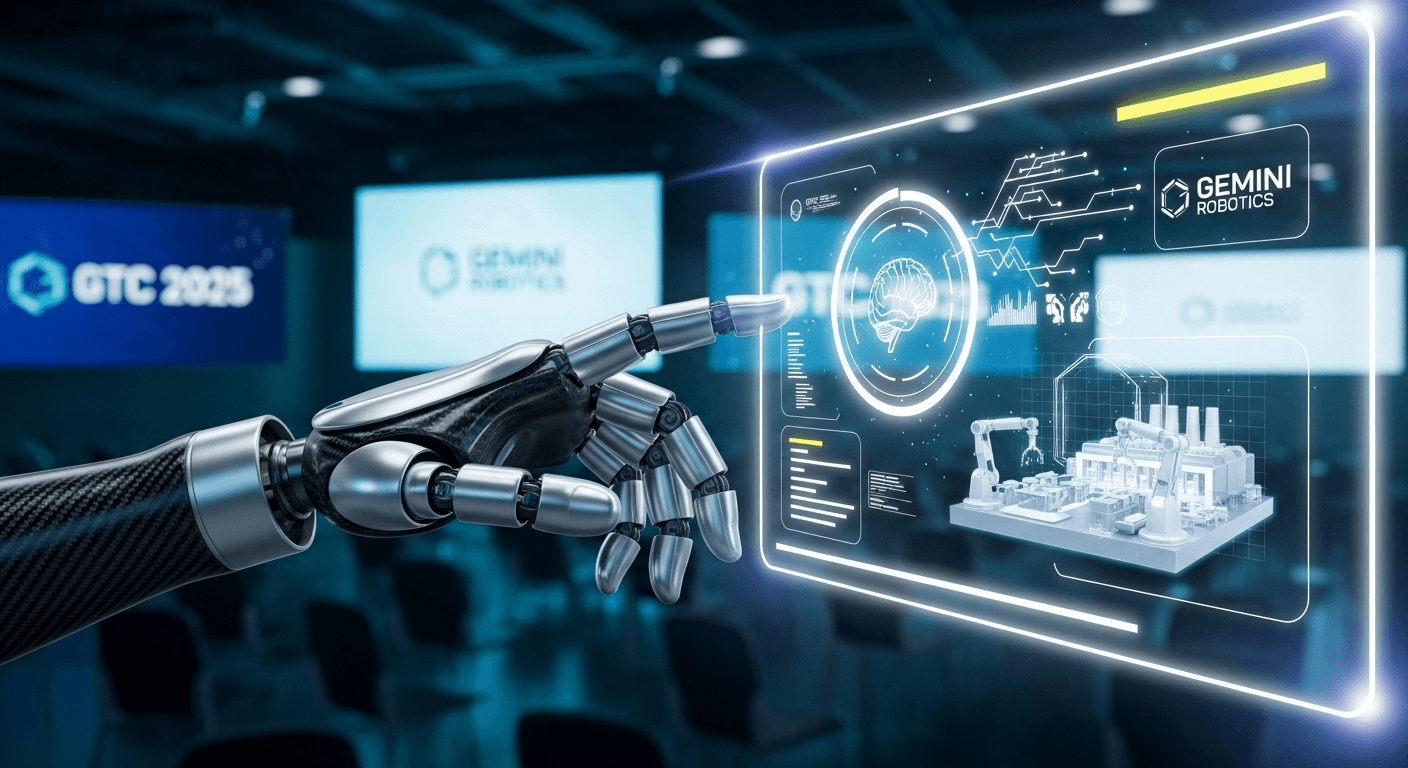
Gemini Robotics, GTC 2025, and Cheaper LLMs: How AI is Transitioning from Screens to Real-World Robots
Gemini Robotics, GTC 2025, and Cheaper LLMs: How AI is Transitioning from Screens to Real-World Robots
This week in AI engineering news highlights significant shifts, from Google DeepMind’s advances in multimodal AI models for robotics to NVIDIA’s GTC 2025 updates and rapidly decreasing costs of large language models (LLMs). One clear trend emerges: AI is making its move from chat interfaces to tangible robotic applications.
Why This Matters Now
Robots equipped with visual, auditory, and operational capabilities are evolving from scripted demonstrations to versatile skillsets. The recent surge in vision-language-action models and long-context reasoning allows robots to more effectively follow natural language commands, adapt to various environments, and learn new abilities without extensive fine-tuning. On the infrastructure side, innovations in GPUs, simulation technologies, and robotics toolchains are drastically reducing the time and cost needed to transition from ideas to functioning systems.
Gemini Robotics: The Intersection of Google AI and Robotics
Google and Google DeepMind are merging two significant research areas: powerful multimodal models like Gemini and foundational robotics models trained on extensive demonstration datasets. The underlying principle is straightforward yet impactful: if a model can link language with perception and action, a robot can receive instructions in everyday language, grounded in its observations, and generate a series of actions to reach a specified objective.
This builds on years of research. In 2023, Google introduced RT-2, a vision-language-action model capable of transferring knowledge from extensive web-based training to real robots, enabling them to execute tasks dictated in natural language—such as recognizing objects based on descriptions or adapting to new tool uses. This work demonstrated that a unified model can directly map text and image inputs to robotic movements, bridging the gap between language comprehension and robotic control (Google AI Blog) and (arXiv).
To enhance scalability beyond single lab environments, Google and its partners issued the Open X-Embodiment dataset and the RT-X series, which incorporate data from various robotic platforms to enhance generalization across tasks and robot types previously considered impractical (Google AI Blog) and (arXiv).
Complementary research like AutoRT explores how large models can autonomously plan data collection and assist with robotic task planning, indicating a future where AI agents not only act but also build their own training datasets over time (arXiv).
When discussing “Gemini Robotics” today, many refer to this integration: employing Gemini-type multimodal models as the decision-making and instruction-following layer atop robotics foundation models for operational control. In practical terms, this involves:
- Perception: Multi-camera or RGB-D inputs are integrated with language to create a shared scene representation.
- Planning: The model breaks down a natural language goal into actionable steps, often utilizing closed-loop feedback for refinement.
- Control: A lower-level policy converts the planned steps into motor commands, sometimes supported by task-specific affordance maps.
- Self-improvement: Models aid in data labeling, curriculum proposals, and synthesizing variations in simulations before applying them to physical hardware.
Recent demonstrations throughout the field highlight the capabilities unlocked by these advancements, such as organizing tables, manipulating flexible items like fabric, or directing mobile manipulators to locate and retrieve objects based on verbal cues. While challenges regarding reliability and safety persist, particularly under distribution shifts, the trajectory for the industry is clear.
Behind the Scenes: The Architecture Powering AI in Robotics
Simulation-First Development
Developers are increasingly utilizing high-fidelity simulations to refine their designs before committing to costly hardware. NVIDIA’s Isaac Sim and the Omniverse suite have become essential for generating synthetic data, photorealistic rendering, sensor modeling, and domain randomization – all crucial for successful sim-to-real transitions (NVIDIA Isaac).
Foundation Models for Control
Rather than crafting unique controllers for each task, teams are now training a single policy capable of generalizing across various tasks and robots. This is often achieved through imitation learning using large datasets, occasionally enhanced with reinforcement learning fine-tuning. The vision-language-action framework serves to unify perception, language, and control within a single model.
Long-Context Reasoning
Models with long-context capabilities can retain more observations and instructions over extended periods, which is crucial in robotics where tasks can unfold over several minutes and involve multiple steps. Google has showcased long-context functionalities in the Gemini models, including video comprehension and memory across extended sequences (Google DeepMind).
Safety and Verification
Prioritizing safety is essential: developers employ constraint-based planners, safety monitors, and fallback policies to regulate system behavior. As these technologies integrate into warehouses, hospitals, and homes, human oversight, capability gating, and robust failure management become imperative. The broader AI safety community is investigating multimodal testing, red-teaming, and alignment techniques applicable to embodied systems (NIST AI RMF).
NVIDIA GTC 2025: Key Announcements for AI and Robotics
NVIDIA’s annual GTC conference serves as a platform for unveiling tools that drive modern AI endeavors. While each year brings numerous announcements, three main themes stand out for robotics and AI engineers:
1) Scalable Inference and Microservices
NVIDIA is streamlining inference through NIM, a suite of microservices and optimized runtimes that encompass model serving, safety measures, and hardware acceleration. The aim is to simplify time-to-production and reduce operational complexity for teams implementing multimodal models on edge servers and in data centers (GTC overview).
2) Robotics Simulation and Digital Twins
Expect ongoing enhancements to Isaac Sim, Omniverse, and robotics toolchains, making it easier to create, evaluate, and authenticate robot behaviors before deploying them on actual hardware. NVIDIA also introduced initiatives such as Project GR00T for embodied AI and Jetson-class platforms for onboard computing, emphasizing a comprehensive approach from training to deployment (NVIDIA Isaac) and (NVIDIA Newsroom).
3) Higher Throughput Training
On the infrastructure front, advancements in GPUs, interconnects, and networking continue to boost training throughput and memory bandwidth, thereby shortening the iteration time for large multimodal models and robotic policies. While specifics vary by generation, the trajectory is clear: increased compute efficiency per watt and improved interconnects to support data-intensive models (NVIDIA Newsroom).
For robotics developers, the key takeaway is the accelerating speed and standardization of simulation-to-deployment pipelines, making it feasible for smaller teams to build sophisticated embodied AI systems without a custom architecture.
Baidu ERNIE 4.5: The Race Toward Affordable LLMs
Another hot topic in the news is the decreasing costs associated with large language models. Reports and pricing information from Chinese providers reveal significant reductions in model usage, positioning local models as competitive alternatives to leading options from Western laboratories. Baidu’s ERNIE series has undergone several rounds of price cuts and performance updates since 2023, with versions like ERNIE 4.x aimed at enterprise applications in search, virtual assistants, and coding (Reuters) and (Baidu Cloud).
ERNIE 4.5 is being hailed for its notable affordability compared to competing models, showcasing a broader trend among providers to lower per-token costs and expand free usage tiers to encourage adoption. Although pricing varies by region, tier, and quotas, the direction is clear: lower costs can redesign the framework for developing features like long-context reasoning, retrieval-augmented generation (RAG) with extended context windows, and multimodal functionalities.
Two important considerations include:
- Price isn’t the only factor to weigh. Latency, reliability, and the quality of specific tasks can significantly influence overall costs.
- Benchmarking may lag behind real-world performance. Always validate results on your own datasets.
Other Key Developments Linking AI and Robotics
- Industry demonstrations are increasingly showcasing the potential of language models as cognitive engines for general-purpose robots. For instance, Figure AI presented a humanoid robot capable of understanding and executing tasks, including tool use and real-time dialogue, leveraging a large multimodal model. Though these remain controlled demos, they indicate steady advances in coordination between perception and action (The Verge).
- Open datasets and benchmarks are expanding within the community. In addition to the Open X-Embodiment, researchers are organizing challenge tasks that require long-term planning and effective manipulation in unstructured environments, aiding the field in assessing generalization and reliability (Open X-Embodiment).
- Tools for embodied evaluation are maturing. Simulated environments like homes, warehouses, and labs equipped with standardized sensors and physics are facilitating more accurate comparisons and reproducibility (NVIDIA Isaac).
What This Means for Developers and Teams
For those working in this domain, here are some actionable steps to consider:
- Utilize a simulator-first approach for prototyping. Leverage Isaac Sim or similar tools to test perception and control loops early in the development process.
- Implement a layered architecture. Allow a multifaceted multimodal model to handle instruction-following and planning, while maintaining separate safety-focused policies for low-level control.
- Aggressively gather and curate high-quality task data. Even small, high-quality demonstration datasets can significantly enhance performance when paired with large pretrained models.
- Benchmark comprehensively. Evaluate not just success rates but also recovery behavior, latency, and user satisfaction.
- Plan operational details from the outset. Address monitoring, remote assistance, update mechanisms, and safe failure modes as integral engineering challenges.
Conclusion
AI is breaking free from theoretical confines. By merging multimodal understanding, scalable simulations, and improved hardware, the field is effectively bridging the gap between language and actionable capabilities. Whether referred to as Gemini Robotics, embodied AI, or vision-language-action control, the momentum is palpable. The upcoming wave of product experiences will shift focus from what models can express to what they can reliably execute.
FAQs
What is Gemini Robotics in simple terms?
It refers to utilizing Google’s Gemini-style multimodal models as the reasoning framework for robots, combined with foundational robotics models that turn plans into actions, enabling systems to understand language, interpret their surroundings, and take action.
How close are we to functional home robots?
Fundamental abilities such as picking, placing, and navigating are progressing rapidly, yet ensuring reliability and safety in unmanaged home environments remains a challenge. Expect preliminary implementations in controlled settings like logistics and manufacturing prior to widespread consumer availability.
Should I switch providers to take advantage of cheaper LLMs?
Not necessarily. Assess models based on your specific tasks, keeping latency and uptime in mind, and conduct small A/B tests. While pricing is important, total cost of ownership and user experience are even more crucial.
What impact did NVIDIA GTC 2025 have for robotics developers?
GTC reaffirmed trends toward standardized simulation, increased training and inference speeds, and microservices that simplify deployment. The practical result is a more streamlined path from research to production.
How can I start developing a VLA-controlled robot?
Start with simulation, gather a modest dataset of task demonstrations, refine a control policy, and incorporate a multimodal model for planning and instruction-following. Always include safety measures and fallbacks from day one.
Sources
- RT-2 – Google AI Blog
- RT-2: Vision-Language-Action Models Transfer Web Knowledge to Robotic Control – arXiv
- Open X-Embodiment and RT-X – Google AI Blog
- Open X-Embodiment – arXiv
- AutoRT: Embodied Foundation Models – arXiv
- NVIDIA Isaac robotics platform
- NVIDIA GTC overview
- NVIDIA Newsroom
- Gemini long-context updates – Google DeepMind
- Baidu pricing cuts for AI model services – Reuters
- Baidu ERNIE – Wenxin Yiyan product page
- Figure AI and large model robot demo – The Verge
Thank You for Reading this Blog and See You Soon! 🙏 👋
Let's connect 🚀
Latest Insights
Deep dives into AI, Engineering, and the Future of Tech.
I Tried 5 AI Browsers So You Don’t Have To: Here’s What Actually Works in 2025
I explored 5 AI browsers—Chrome Gemini, Edge Copilot, ChatGPT Atlas, Comet, and Dia—to find out what works. Here are insights, advantages, and safety recommendations.
Read Article


