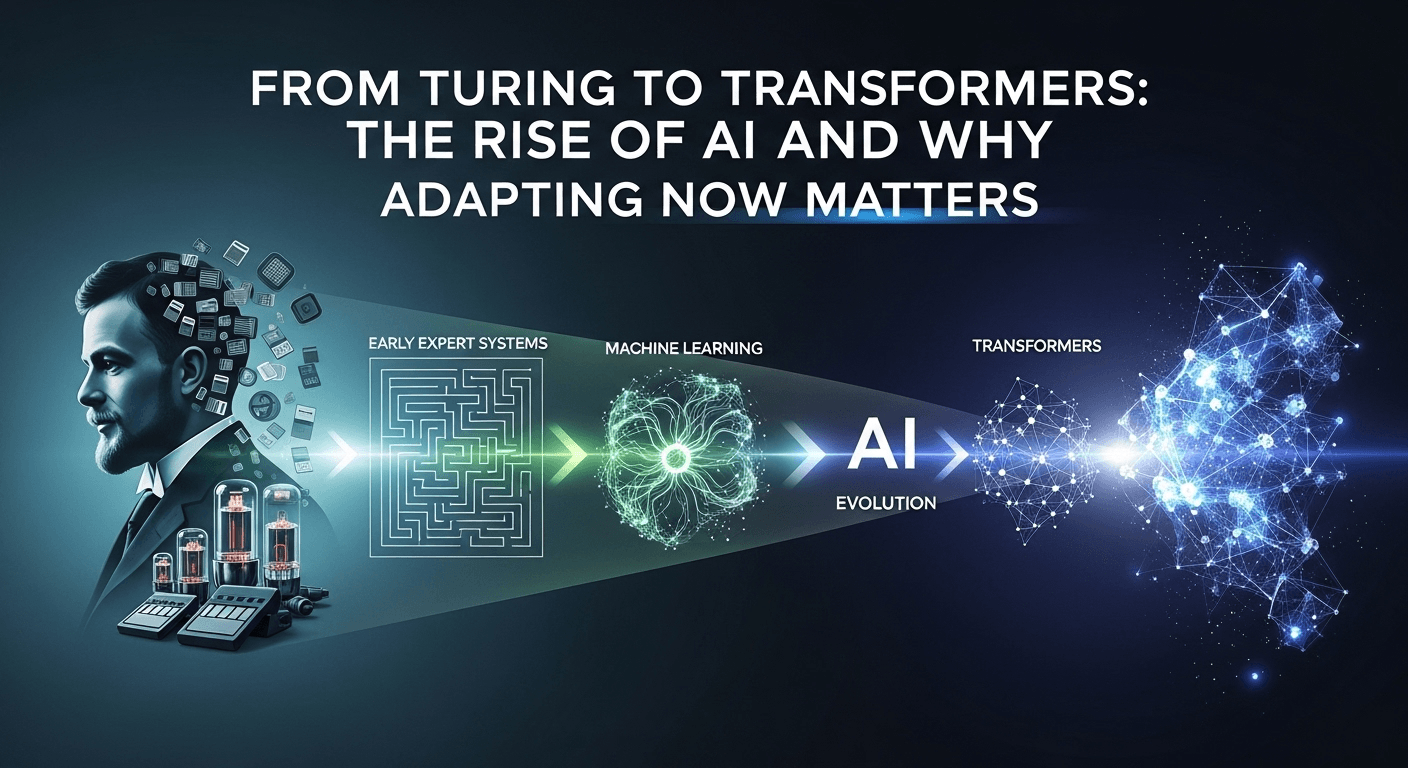
From Turing to Transformers: The Rise of AI and Why Adapting Now Matters
Artificial intelligence was once merely a thought experiment. Today, it can write, draw, code, and analyze data on demand. Whether you’re a curious reader, a professional, or someone who wants to remain relevant, understanding the journey from Alan Turing’s test of machine intelligence to modern transformer models is key to adapting with confidence. This article explores the evolution from pioneering concepts to today’s breakthroughs, discusses the transformative impact of transformers, and provides practical steps you can take to work smarter with AI.
The Long Arc of AI Progress
Turing and the Birth of the Idea
In 1950, Alan Turing posed a deceptively simple question: Can machines think? He proposed the “imitation game” as a practical test of intelligence, wherein a machine aims to convince a human evaluator that it is human through conversation. Turing’s seminal paper, “Computing Machinery and Intelligence,” shaped the discourse on machine intelligence for decades to follow (Turing 1950).
Early Optimism, Then Hard Lessons
By 1956, a group of researchers, including John McCarthy, Marvin Minsky, and Claude Shannon, gathered at the Dartmouth Workshop—an event often recognized as the founding moment of AI. Their enthusiastic proposal suggested that a summer of dedicated research could lead to significant advancements toward human-level intelligence (Dartmouth proposal).
Initial excitement stemmed from early systems, such as simple neural models like perceptrons (Rosenblatt 1958). However, limitations emerged quickly. Minsky and Papert famously demonstrated that single-layer perceptrons could not solve fundamental problems like XOR, leading to disillusionment and marking the onset of the first “AI winter” characterized by reduced funding and stagnation in progress (Minsky & Papert 1969; Britannica on AI winter).
In the 1980s, rule-based expert systems began to gain traction in areas like diagnostics and finance, proving useful though often fragile, requiring painstaking updates and struggling with uncertainty (Expert systems overview).
Learning to Learn: Backpropagation and Data
1986 saw the popularization of backpropagation, a technique that allowed multi-layer neural networks to adjust internal weights based on error minimization, enabling them to learn complex patterns directly from data (Rumelhart, Hinton & Williams 1986). Progress continued through the 1990s and 2000s, with neural networks achieving steady advancements: convolutional networks excelled at recognizing digits and images (LeCun et al. 1998), while deep belief networks promised the potential of deeper architectures (Hinton et al. 2006).
The pivotal moment came with ImageNet. In 2012, a deep convolutional network known as AlexNet shattered multiple image recognition benchmarks, dramatically reducing error rates and demonstrating that with sufficient data, computational power, and improved architectures, neural networks could outpace established methods (Krizhevsky, Sutskever & Hinton 2012).
Why Transformers Changed the Game
The monumental advancements in AI’s language capabilities and multimodal functionalities stem primarily from a singular architectural innovation: attention. In 2017, researchers unveiled the transformer model, utilizing attention mechanisms to evaluate relationships among words (or tokens) in parallel rather than sequentially. This innovation enabled efficient training on a massive scale and significantly enhanced performance in language tasks (Vaswani et al. 2017).
Attention, Explained Simply
Imagine reading a paragraph and instantly cross-referencing each word with all other words to grasp context. This is the function of self-attention: instead of processing text in a linear manner, transformers assess the entire sequence simultaneously, efficiently capturing long-range dependencies. This structure scales effectively across different data and hardware, crucial for training on internet-scale text and beyond.
Scale, Data, and the Tipping Point
Transformers demonstrate marked improvements as the quantity of data and computing power increases, a trend articulated by scaling laws. As the size of both models and datasets grows, the resulting reduction in loss tends to be predictable, encouraging the development of increasingly larger models (Kaplan et al. 2020). Pretraining on diverse datasets, followed by fine-tuning and reinforcement learning from human feedback (RLHF), have helped align models to respond to instructions and enhance their helpfulness (Ouyang et al. 2022).
The result has been models like BERT for text comprehension (Devlin et al. 2018), GPT-style models for text generation and reasoning (Brown et al. 2020; OpenAI 2023), and multimodal systems capable of seeing, reading, and writing.
What AI Can Do Now (and Where It Shines)
While capabilities are expanding rapidly, several areas have already proven reliable and beneficial:
- Language and Reasoning: Large language models can summarize, translate, extract key points, draft documents, and simplify complex topics. They also excel in academic and professional benchmarks such as the Massive Multitask Language Understanding (MMLU) test for broad knowledge tasks (Hendrycks et al. 2020).
- Vision and Perception: Models accurately classify, detect, and describe images, leveraging progress made since ImageNet. Multimodal models can analyze charts, screenshots, or documents that combine text and images.
- Scientific Discovery: AI has significantly impacted fields like biology and drug discovery, as seen with AlphaFold’s role in protein structure prediction (Jumper et al. 2021). Systems like AlphaGo also exhibited superhuman abilities in complex strategy games, showing the powerful synergy of learning and search (Silver et al. 2016).
- Software and Data: Coding assistants expedite the drafting process and help identify bugs, with early research indicating significant productivity improvements for developers (GitHub 2023 study; DeepMind AlphaCode 2022).
- Knowledge Work Augmentation: Controlled studies have shown that generative AI can enhance both throughput and quality in writing and analytical tasks, particularly for less experienced workers (NBER 2023).
What AI Still Struggles With
Even the most advanced systems come with notable limitations that you should be aware of:
- Hallucinations: AI models can confidently produce incorrect information or fabrications, especially when operating outside of their training data or when presented with ambiguous prompts. This remains an active area of research (Ji et al. 2023 survey).
- Bias and Fairness: Since training data often reflect human biases, models can inadvertently amplify these disparities if not carefully evaluated and managed.
- Privacy and Security: Sensitive information may inadvertently be disclosed through prompts or logs, necessitating strong data management protocols and clear organizational policies (NIST AI RMF 1.0).
- Attribution and Intellectual Property: Tracing the origins of knowledge in large models can be challenging, complicating rights management and compliance.
- Compute and Energy Usage: Training cutting-edge models requires substantial computational resources. Ongoing efforts aim to enhance training efficiency while managing trade-offs (AI Index 2024; Strubell et al. 2019).
Why You Must Adapt: The Economic Signal is Loud
For both individuals and organizations, the message is clear: AI enhances capabilities and efficiency. Recent analyses indicate that thoughtful adoption could lead to significant productivity and economic benefits. McKinsey estimates that generative AI could contribute trillions of dollars annually across various sectors by automating aspects of sales, marketing, software engineering, and customer operations (McKinsey 2023). Additionally, the World Economic Forum anticipates considerable job evolution, with increasing demand for analytical, creative, and technology-driven roles, while some routine tasks diminish (WEF 2023).
How to Adapt, Step by Step
Adapting to AI doesn’t necessitate training as a machine learning engineer; it’s about learning to collaborate effectively with AI and rethinking existing workflows. Here’s a playbook to get you started:
For Individuals
- Master the Basics: Familiarize yourself with fundamental concepts like tokens, prompts, context windows, and retrieval. This vocabulary will enhance your learning and troubleshooting abilities.
- Prompt Like a Pro: Clearly outline your goals, audience, constraints, and desired formats. Provide examples and ask the model to think step-by-step before verifying outputs. Treat your prompts as evolving tools that can improve over time.
- Combine Tools: Integrate AI with existing systems like spreadsheets, notebooks, and databases. For instance, use AI to draft code or perform analysis, and then validate the results against real data.
- Maintain a Human Presence: Use checklists for factual tasks and let AI assist with first drafts and outlines in creative processes—ensuring your judgment and voice remain integral.
- Enhance Data Literacy: Basic knowledge in statistics, visualization, and data hygiene can significantly amplify the effectiveness of AI while minimizing errors.
- Be Mindful of Ethics and IP: Understand your organization’s policies regarding data handling. Avoid inputting sensitive or proprietary information into AI systems without appropriate safeguards.
For Teams and Leaders
- Focus on High-ROI Use Cases: Identify text-heavy, repetitive tasks that could benefit from automation, such as drafting proposals, summarizing calls, generating support replies, managing ticket triage, or conducting initial data analysis.
- Select the Right Architecture: Many tasks are best served by a retrieval-augmented generation (RAG) model, which grounds responses using your own documents. This approach reduces hallucinations and enhances relevance.
- Establish Responsible AI Governance: Define protocols for data access, red-teaming, model evaluation, and approval processes. Consider frameworks like the NIST AI Risk Management Framework and OECD AI Principles (NIST; OECD).
- Measure What Matters: Track metrics like accuracy, latency, costs, and user satisfaction. Establish acceptance criteria for individual tasks rather than relying solely on aggregate scores.
- Upskill Continuously: Provide practical training sessions and schedule office hours. Encourage the development of communities of practice where teams share prompts, patterns, and lessons learned.
Governance and the Rules of the Road
Regulators are rapidly establishing guardrails. The EU’s AI Act delineates risk-based obligations for high-risk applications, mandates transparency for general-purpose models, and prohibits certain uses (EU AI Act 2024). Other regions are also issuing guidance on transparency, risk assessment, and accountability. Adopting a robust governance framework can cultivate trust and mitigate operational risks before any legal requirements arise.
Looking Ahead: What to Expect in the Coming Years
- Multimodal by Default: Models capable of seamlessly processing text, images, audio, and video will become essential tools across many workflows.
- Agentic Workflows: AI will increasingly manage multi-step tasks across various applications with human oversight, enhancing automation in routine knowledge work.
- Domain-Specialized Models: Anticipate the emergence of smaller, fine-tuned models based on proprietary data, coexisting with expansive frontier models to balance cost, latency, and control.
- Improved Reasoning and Tools: Advances in tool utilization, planning, and retrieval will further minimize hallucinations and create more trustworthy decision-making support.
- More Efficient Compute: Innovations in model architectures, distillation processes, and hardware will lower costs and energy consumption per task while enhancing accessibility (AI Index 2024).
Getting Started: A Practical Starter Toolkit
- Learn the Fundamentals: Short courses in machine learning and AI literacy can expedite your understanding. Numerous universities and organizations offer high-quality, free introductions.
- Pick a Pilot: Choose a single workflow you interact with regularly. Define a success metric, assemble a small team, experiment with various tools, and iterate swiftly.
- Establish a Feedback Loop: Gather examples of success and failure. Transform the most effective prompts and patterns into internal playbooks, templates, or scripts.
- Invest in Data Hygiene: Ensuring your data is organized, accessible, and governed is the most sustainable competitive advantage you can develop for AI.
Conclusion: The Case for Proactive Adaptation
From Turing’s thought-provoking question to today’s transformers, the narrative of AI is characterized by groundbreaking ideas, practical innovation, and cumulative progress. The systems we have today are far from omniscient, but they serve as potent collaborators. The best way to prepare is to explore, learn about their limitations, and establish dependable workflows where human judgment combines with AI’s scalable capabilities. By adapting now, you won’t just keep pace with change; you’ll play a pivotal role in shaping it.
FAQs
What is a transformer model, in plain language?
A transformer is a type of neural network architecture that utilizes attention mechanisms to assess the importance of different segments of input simultaneously. This parallel processing allows for efficient training on large datasets, which is why transformers are foundational to current language and multimodal systems.
How should I assess AI’s impact on jobs?
AI is transforming individual tasks more rapidly than entire job roles. Work will shift toward analysis, problem-solving, and creativity, while routine writing and summarization tasks may become increasingly automated. Upskilling in data literacy, effective prompting, and domain knowledge will help maintain your value in the job market.
How can I minimize hallucinations in practice?
Be explicit in your prompts, provide context and examples, and consider using retrieval-augmented generation to ground the model’s responses in your own documents. Implement safeguards like checklists, validation scripts, and human review for high-stakes outputs.
Is bigger always better for models?
Not necessarily. While larger models can demonstrate greater capabilities, smaller, fine-tuned models can be cost-effective, faster, and sufficiently accurate for specific tasks, particularly when supplemented by retrieval mechanisms or tools.
What governance frameworks should I be aware of?
Start with NIST’s AI Risk Management Framework for organizational guidelines and the OECD AI Principles for high-level principles. If you operate within the EU, it’s crucial to stay informed about obligations under the AI Act.
Sources
- Turing, A. M. (1950). Computing Machinery and Intelligence.
- Dartmouth Summer Research Project on Artificial Intelligence (1956) proposal.
- Rosenblatt, F. (1958). The Perceptron.
- Minsky, M., & Papert, S. (1969). Perceptrons.
- Encyclopaedia Britannica: AI Winter.
- Encyclopaedia Britannica: Expert Systems.
- Rumelhart, Hinton, & Williams (1986). Learning representations by back-propagating errors.
- LeCun et al. (1998). Gradient-based learning applied to document recognition.
- Hinton, Osindero, & Teh (2006). A fast learning algorithm for deep belief nets.
- Krizhevsky, Sutskever, & Hinton (2012). ImageNet classification with deep convolutional neural networks.
- Vaswani et al. (2017). Attention Is All You Need.
- Devlin et al. (2018). BERT: Pre-training of Deep Bidirectional Transformers for Language Understanding.
- Brown et al. (2020). Language Models are Few-Shot Learners.
- OpenAI (2023). GPT-4 Technical Report.
- Silver et al. (2016). Mastering the game of Go with deep neural networks and tree search.
- Jumper et al. (2021). Highly accurate protein structure prediction with AlphaFold.
- Li et al. (2022). Competition-level code generation with AlphaCode.
- NBER Working Paper (2023). Generative AI at work: Evidence from professional writing.
- McKinsey (2023). The economic potential of generative AI.
- World Economic Forum (2023). Future of Jobs Report.
- NIST AI Risk Management Framework 1.0 (2023).
- OECD AI Principles.
- EU Artificial Intelligence Act (2024) – Council press release.
- Ji et al. (2023). A Survey on Hallucination in Large Language Models.
- Stanford AI Index Report (2024).
- Strubell et al. (2019). Energy and Policy Considerations for Deep Learning in NLP.
- Kaplan et al. (2020). Scaling Laws for Neural Language Models.
- Ouyang et al. (2022). Training language models to follow instructions with human feedback.
- Hendrycks et al. (2020). Measuring Massive Multitask Language Understanding.
Thank You for Reading this Blog and See You Soon! 🙏 👋
Let's connect 🚀
Latest Insights
Deep dives into AI, Engineering, and the Future of Tech.
I Tried 5 AI Browsers So You Don’t Have To: Here’s What Actually Works in 2025
I explored 5 AI browsers—Chrome Gemini, Edge Copilot, ChatGPT Atlas, Comet, and Dia—to find out what works. Here are insights, advantages, and safety recommendations.
Read Article


