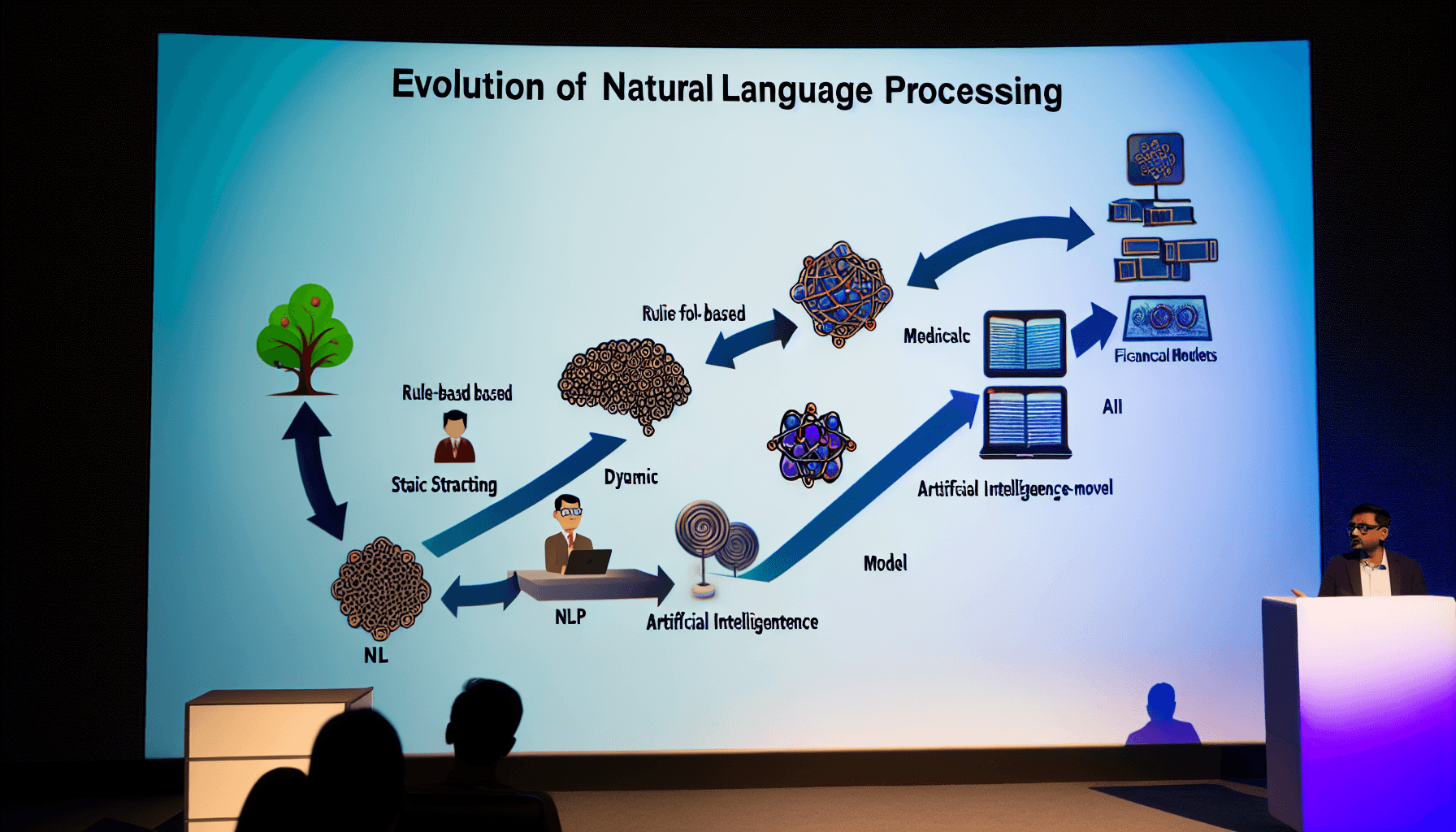
From Static Rules to Dynamic Models: The Evolution of NLP
The Early Days: Static Rule-Based Systems
Historically, natural language processing (NLP) relied heavily on static, rule-based systems. These initial attempts to structure and understand language depended on manually created rules and logic to process text. Such systems were both labor-intensive and rigid, lacking the ability to adapt to new, unscripted changes in language use, which is naturally dynamic and constantly evolving.
Limitations of Rule-Based NLP
Rule-based systems, while foundational, were limited in their capacity. They could only interpret language within the confines of their pre-defined rules, making them inefficient at understanding context, irony, or slang, which are deeply embedded in human communication. This limitation was particularly evident in areas like sentiment analysis and machine translation, where nuance and context play crucial roles.
Breakthrough: Statistical NLP
The emergence of statistical methods in NLP marked a significant shift from rule-based to more dynamic models. Leveraging large amounts of data and statistical techniques, these models could learn language patterns and make predictions about text. Techniques such as latent semantic analysis (LSA) allowed for a better grasp of contextual meaning, significantly improving machine comprehension.
Deep Learning: A Game-Changer in NLP
With the advent of deep learning techniques and neural networks, NLP witnessed another revolution. Deep learning models, capable of understanding complex patterns in large datasets, significantly advanced the field. Models like Long Short-Term Memory (LSTM) and the Transformer have been essential in developing applications that require understanding of context and sequence in text, such as automated translation services and voice-activated assistants.
The Rise of Pre-trained Models
One of the most groundbreaking advances in recent NLP history is the development of pre-trained models like BERT (Bidirectional Encoder Representations from Transformers) and GPT (Generative Pre-trained Transformer). These models are trained on vast amounts of text and then fine-tuned for specific tasks, offering unprecedented accuracy and flexibility. They have transformed tasks such as text classification, sentiment analysis, and even the generation of human-like text.
Real-World Applications: NLP in Action
Today, dynamic NLP models are being employed across various sectors, reshaping industries such as healthcare, finance, and customer service. In healthcare, NLP helps in parsing and understanding clinical notes, significantly aiding in patient management and predictive analytics. In finance, NLP techniques are used for sentiment analysis to gauge market sentiment and make investment decisions. Customer service has seen a revolution with chatbots that can understand and respond to customer queries effectively and contextually.
The Future: Ethical Considerations and Beyond
As NLP continues to evolve, it also brings forth ethical considerations, including concerns about privacy, data security, and the potential for bias in AI-generated language. Moving forward, addressing these challenges while continuing to innovate will be crucial for the sustainable development of NLP technologies.
The ongoing NLP revolution is not just about technology. It reflects a broader shift towards more intelligent, adaptive systems that can understand and interact with humans on an unprecedented level. As we stand on the brink of what might be the next big leap in NLP, the focus is on creating models that are not only technically robust but also ethically sound and socially beneficial.
Thank You for Reading this Blog and See You Soon! 🙏 👋
Let's connect 🚀
Latest Insights
Deep dives into AI, Engineering, and the Future of Tech.
I Tried 5 AI Browsers So You Don’t Have To: Here’s What Actually Works in 2025
I explored 5 AI browsers—Chrome Gemini, Edge Copilot, ChatGPT Atlas, Comet, and Dia—to find out what works. Here are insights, advantages, and safety recommendations.
Read Article


