From Lab to Profit Engine: What DeepMind’s Turn to Profit Means for Google—and Everyone Else
AI labs are famous for breathtaking research—and breathtaking costs. That’s why news that DeepMind has turned profitable is more than a financial milestone. It’s a signal that advanced AI can move from moonshots to money-makers, and it shows how tightly Google is weaving AI into every corner of its business.
Below, we unpack what changed at DeepMind, how the money is actually made, what it means for entrepreneurs and operators, and the signals to watch next.
Why DeepMind’s profitability matters now
For years, DeepMind was the poster child of frontier AI research: AlphaGo, AlphaFold, and a steady stream of breakthroughs. But research alone doesn’t pay the bills at the scale required to train and deploy cutting-edge models. Profitability—reported in UK filings and covered by outlets such as the Financial Times—suggests Google is monetizing DeepMind’s work more effectively across Search, Ads, Cloud, and YouTube, turning research into revenue across its product portfolio (Financial Times; see also the UK Companies House filings).
At a moment when inference costs are high, data center capex is soaring, and competitors are racing to ship their own AI copilots, one of the world’s most ambitious AI labs shifting to profit is a strategic message: the AI flywheel is starting to spin inside Google.
What changed: From research silo to Google’s AI backbone
A unified AI org
In 2023, Google merged DeepMind with Google Brain into a single team—Google DeepMind—to accelerate productization and reduce duplication (Google DeepMind announcement). This wasn’t just a rebrand; it was a shift in operating model aimed at putting cutting-edge research directly behind Google’s most used products.
AI across Google’s core businesses
- Search: Google began rolling out AI Overviews, powered by Gemini models, to help users get synthesized answers faster (CNBC coverage of I/O announcements).
- Ads: Google Ads now leans on Gemini to generate creatives and improve campaign performance, including in Performance Max and conversational campaign setup (Google Ads blog).
- Cloud: Gemini models are available through Google Cloud’s Vertex AI, enabling enterprises to fine-tune and deploy generative apps in production—another path to monetization via usage-based cloud revenue (Google Ads blog; see also Alphabet earnings commentary in CNBC).
- YouTube: AI features like assistive tools for creators and viewers are gradually being infused into the platform, with Google repeatedly highlighting AI’s role on earnings calls (CNBC).
The result: DeepMind’s work no longer lives in research papers alone—it’s embedded in revenue-generating products.
So how does DeepMind actually make money?
DeepMind’s profitability does not come from a standalone consumer app. It’s a story of internal and platform monetization.
1) Internal chargebacks to Google’s products
DeepMind’s UK entity reports revenue largely from services to other Alphabet entities. As Gemini and other DeepMind advances power features in Search, Ads, and YouTube, internal accounting recognizes that value as revenue for DeepMind’s unit. That’s how a research lab becomes a profit center inside a giant platform (Companies House filings).
2) Cloud distribution through Vertex AI
Enterprises pay Google Cloud for compute, storage, and managed AI services. When customers build with Gemini (and surrounding tooling) on Vertex AI, they’re indirectly monetizing DeepMind’s models at cloud scale. Alphabet has emphasized AI as a key growth driver for Cloud on recent earnings (CNBC).
3) Scientific breakthroughs that unlock downstream value
AlphaFold changed structural biology, and AlphaFold 3 expanded capabilities to protein complexes, nucleic acids, and ligands (Google DeepMind blog). While AlphaFold’s core tools are broadly available to researchers, the underlying capabilities and know-how strengthen Alphabet’s position in life sciences through sister companies.
Case in point: Isomorphic Labs—an Alphabet company leveraging AI for drug discovery—signed multi-year collaborations with pharma leaders Eli Lilly and Novartis, with deal terms that underscore the commercial potential of AI-led R&D (Isomorphic Labs announcement).
Monetization is not just about selling a chatbot. It’s about infusing AI into revenue engines you already own—search, ads, cloud, and enterprise workflows.
Is the profit sustainable?
Short answer: It depends on execution and economics.
The cost curve is the boss
Training and serving frontier models is expensive. Alphabet’s capital expenditures have been rising with investments in AI infrastructure—data centers, networking, and custom TPUs. Management has been explicit that elevated capex will continue to support AI demand (CNBC).
For profitability to persist, Google needs to keep pushing down unit costs (via better model architectures, efficient serving, distillation, caching, and hardware optimization) while scaling usage in high-margin products.
Value capture must outpace value creation
- Search and Ads: AI Overviews must enhance user satisfaction without cannibalizing ad revenue. Google has said it’s designing the experience with ads in mind and continues to report healthy ad momentum, but the long-term balance bears watching (CNBC).
- Cloud AI: Success hinges on enterprise adoption of Gemini and Vertex AI. Here, competition from Microsoft/OpenAI and other model providers is intense.
- Developer ecosystem: The easier it is to build AI into apps (tooling, guardrails, cost transparency), the faster an ecosystem forms around Google’s stack—and the more sustainable DeepMind’s revenue streams become.
Strategic implications: Lessons for founders and operators
1) Ship research through existing profit centers
DeepMind’s turn to profit highlights a universal playbook: plug frontier tech into the products customers already use and pay for. That’s often faster and cheaper than creating new products from scratch.
2) Distribution beats differentiation—at first
Even if your model is state-of-the-art, distribution is the moat. Google’s advantage is billions of users and trusted enterprise relationships. Startups can mimic this by integrating into existing workflows via APIs, partnerships, and marketplaces.
3) Watch unit economics like a hawk
Profit requires ruthless focus on inference costs and pricing. Techniques like model distillation, retrieval augmentation, selective caching, and tiered quality levels can make your gross margins viable.
4) Open the door to platforms
Offer your AI through cloud platforms your customers already use. Whether that’s Google Cloud, AWS, or Azure, meeting customers where they are can accelerate adoption. For a practitioner-friendly primer on building with modern LLMs, see this practical guide on AI product strategy at AI Developer Code.
DeepMind’s evolving role inside Google
With the unified Google DeepMind organization, three themes stand out:
- Shared roadmaps: Research agendas tightly coupled with product timelines, especially for Gemini releases.
- Platform-first mindset: Developer tooling, evals, and safety checks are being productized to make Gemini usable at scale, not just impressive in demos.
- Horizontal deployment: The same model families show up in Search, Ads, YouTube, Workspace, and Cloud—compounding impact across the portfolio.
Risks, regulations, and responsibilities
Regulatory momentum is real
Governments are moving quickly. The EU’s AI Act establishes obligations for general-purpose and high-risk AI systems, including transparency and safety requirements (European Parliament). In the U.S., the White House’s Executive Order on AI outlines reporting, safety testing, and cybersecurity expectations for advanced models (Executive Order 14110).
Reputation is everything
AI errors can be costly—in user trust and regulatory scrutiny. Google has already faced scrutiny over AI Overviews accuracy; the ability to rapidly improve quality while maintaining transparency will be critical. Expect ongoing investment in evaluation frameworks, safety mitigations, and clear UX affordances.
Competition won’t wait
Microsoft and OpenAI are bundling copilots into Office and Azure; Anthropic, Meta, and others are moving fast. In this environment, speed, reliability, and developer experience will shape who captures value—regardless of who has the biggest model.
What to watch next
- Model efficiency: Smaller, specialized models running on optimized hardware could shift the cost curve—and margins.
- Cloud AI adoption: Are enterprises standardizing on Gemini via Vertex AI? Watch case studies and workload share.
- Search + Ads balance: Can AI Overviews boost satisfaction and engagement without dampening ad yield?
- Healthcare and life sciences: Follow-through from AlphaFold 3 and Isomorphic Labs collaborations could unlock new revenue streams in pharma R&D.
- Capex signals: Continued high capex is a vote of confidence—but keep an eye on returns, utilization, and energy efficiency.
The bottom line
DeepMind’s shift to profitability is a milestone for Google and a message to the market: advanced AI doesn’t have to be a perpetual cost center. When research is tightly coupled with distribution—Search, Ads, Cloud, YouTube—AI can be both transformative and economically viable.
For builders, the lesson is clear. Put AI where it earns: in products with distribution, in workflows people already use, and in platforms that scale. Keep your eye on unit economics, ship responsibly, and design for reliability from day one. The AI era favors those who can connect breakthrough science to everyday value.
FAQs
Did DeepMind really become profitable?
Yes. Media coverage based on UK filings reports that DeepMind moved into profit, reflecting deeper integration of its AI into Google products and services (Financial Times; Companies House).
Where does the money come from if DeepMind doesn’t sell a consumer app?
Primarily from internal chargebacks to other Alphabet units (Search, Ads, YouTube), plus monetization through Google Cloud’s Vertex AI. Scientific advances like AlphaFold also strengthen Alphabet’s broader healthcare initiatives.
Is this profitability mostly accounting, or real?
It’s both a financial and strategic shift. Internal revenue recognition reflects the real commercial value created when DeepMind’s models power revenue-generating products. The sustainability hinges on economics—unit costs versus product value—and continued adoption.
What should startups learn from this?
Monetize through existing workflows, obsess over inference costs, and leverage distribution channels (cloud marketplaces, SaaS ecosystems) rather than only chasing net-new products.
How does regulation affect DeepMind and Google’s AI plans?
The EU AI Act and U.S. policy frameworks are setting guardrails around transparency, safety, and reporting. Compliance will shape product design, deployment velocity, and go-to-market strategies.
Sources
- TechTalks via Google News: DeepMind becomes profitable
- UK Companies House: DeepMind Technologies Limited filing history
- Google (Official): Bringing together our AI teams: Google DeepMind
- CNBC: Alphabet earnings and AI commentary
- Google Ads Blog: Harnessing the power of Gemini in Google Ads
- Google DeepMind Blog: AlphaFold 3
- Isomorphic Labs: Collaborations with Novartis and Eli Lilly
- European Parliament: AI Act adopted
- White House: Executive Order 14110 on AI
Thank You for Reading this Blog and See You Soon! 🙏 👋
Let's connect 🚀
Latest Insights
Deep dives into AI, Engineering, and the Future of Tech.
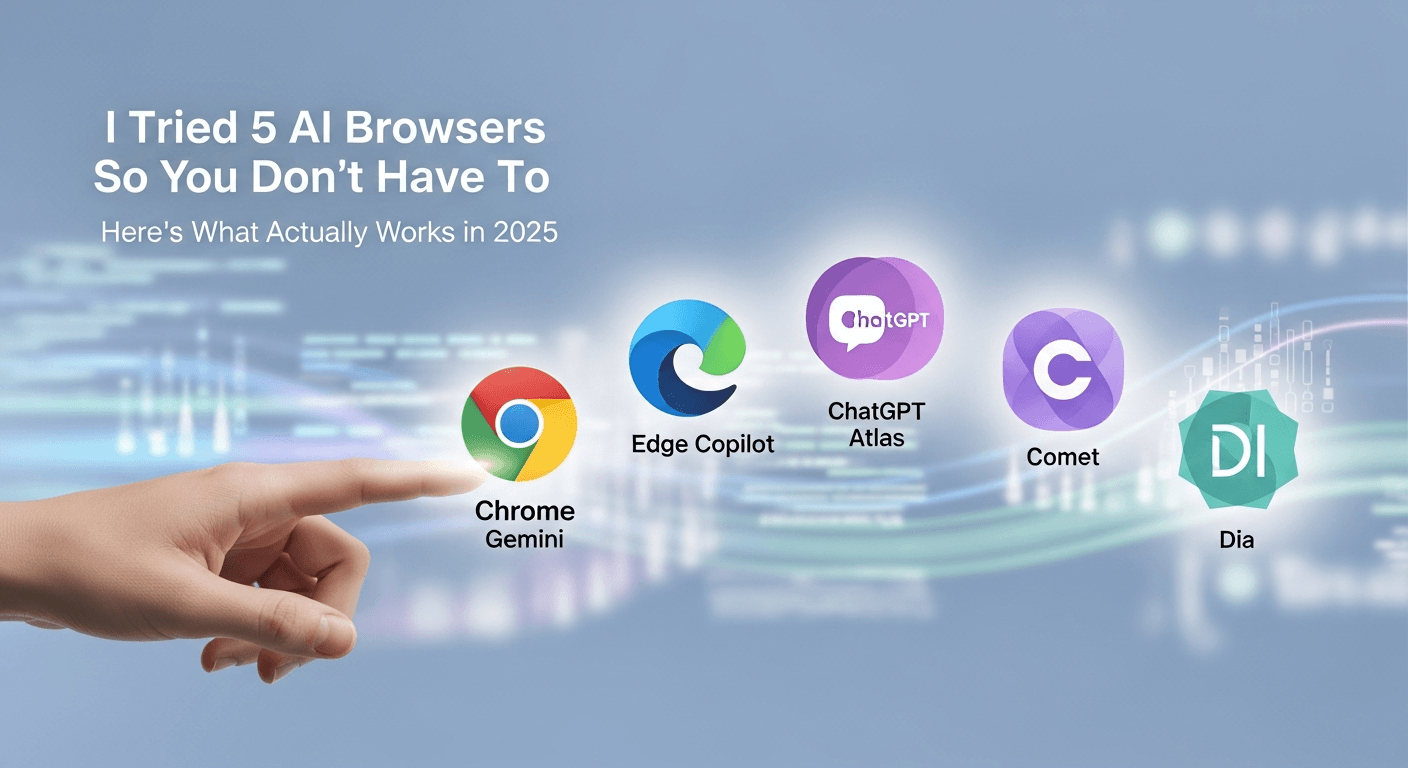
I Tried 5 AI Browsers So You Don’t Have To: Here’s What Actually Works in 2025
I explored 5 AI browsers—Chrome Gemini, Edge Copilot, ChatGPT Atlas, Comet, and Dia—to find out what works. Here are insights, advantages, and safety recommendations.
Read Article


