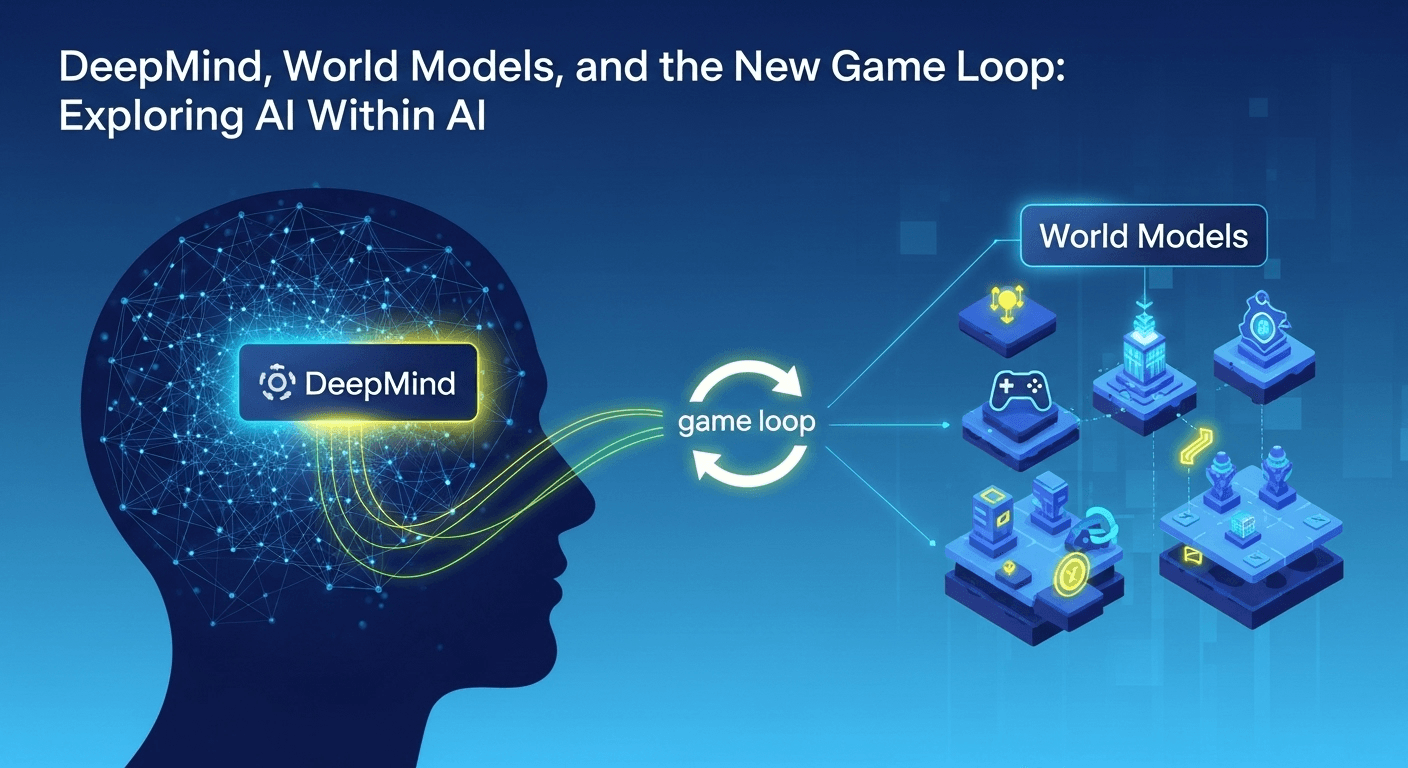
DeepMind, World Models, and the New Game Loop: Exploring AI Within AI
DeepMind, World Models, and the New Game Loop: Exploring AI Within AI
Google DeepMind’s CEO, Demis Hassabis, recently presented a captivating concept: “you’ve got basically one AI playing in the mind of another AI.” This description effectively illustrates the trajectory of artificial intelligence and highlights the renewed significance of gaming in its development. This article delves into the implications of this idea, the evolution leading up to it, and how the next wave of AI innovation may emerge from simulated environments.
Why Gaming Continues to Inspire AI
The most significant advancements in AI are deeply rooted in games. Traditional board and video games provide clear objectives, rapid feedback, and complex strategic possibilities, making them ideal environments for training and assessing algorithms. DeepMind’s journey exemplifies this partnership:
- AlphaGo: Demonstrated that deep learning combined with search algorithms could triumph over top human Go players, marking a historic achievement in AI by employing policy/value networks with Monte Carlo Tree Search (Nature, 2016).
- AlphaZero: Expanded this approach to chess, shogi, and Go through self-play, utilizing only its own experiences without relying on human data (arXiv, 2017).
- AlphaStar: Achieved Grandmaster status in StarCraft II, navigating a complex real-time strategy environment (Nature, 2019).
- MuZero: Developed its internal model to understand and predict the world’s dynamics without predefined rules (Nature, 2020).
In tandem with DeepMind, OpenAI showcased the potential of self-play on a grand scale with OpenAI Five in Dota 2 (OpenAI, 2019). Meanwhile, DeepMind explored boundless learning through XLand, where agents hone transferable skills by tackling a variety of procedurally generated tasks (DeepMind, 2021).
Gaming is not only proving grounds but also an arena for practical AI applications: enhanced non-player characters (NPCs), dynamic environments, automated quality assurance, and design tools are solidifying the connection between research and real-world implementation.
Understanding “One AI Playing in the Mind of Another AI”
The phrase coined by Hassabis encapsulates a key concept in model-based reinforcement learning and planning. Here’s a simplified breakdown:
- World Model (the mind): An AI constructs a predictive model of its environment, allowing it to foresee potential outcomes based on different actions.
- Planner (the player): A distinct decision-making process that utilizes the learned world model to simulate various strategies, evaluate resulting scenarios, and select the optimal course before taking real action.
This concept isn’t entirely new; traditional AI often leveraged search in programmed simulators. However, the innovation lies in the ability to learn the simulator from data, enabling generalization. Agents like MuZero cultivate a compact internal model to plan effectively within that learned framework (Nature, 2020). The broader research community has further investigated these ideas with world models and imagination-based planning, where agents envision potential futures internally before executing actions (Ha & Schmidhuber, 2018), (Racaniere et al., 2017), (Hafner et al., 2023).
In essence, the planner tests strategies within the cognitive framework of the world model. By the time the agent performs an action—whether it’s moving a piece, issuing commands, or interacting with an NPC—it has already thoroughly explored and optimized a tree of possibilities offline.
From Board Games to Dynamic Worlds
Why is this development significant now? Today’s games resemble intricate universes rather than simple puzzles. They feature long-term objectives, complex physics, social dynamics, and open-ended challenges. To navigate effectively in these environments, an agent must excel in three areas:
- Predict how its decisions will impact the world.
- Plan several steps ahead.
- Adapt when its predictions prove incorrect.
Learned world models are instrumental in all three aspects. They offer agents a virtual playground for testing strategies efficiently and safely, allowing simulations to occur faster than real-time, which leads to quicker iterations and safer executions. This principle has enabled AlphaGo and AlphaZero to uncover superhuman strategies by examining expansive search trees, a method now applicable to complex 3D environments, language-driven tasks, and multi-agent scenarios.
DeepMind’s Latest Innovations: From Alpha to SIMA
DeepMind continues to integrate learning, planning, and generalization across various fields. Here are some notable milestones:
- AlphaGo/AlphaZero: Merged learning with search to excel beyond human champions in abstract games (Nature, 2016), (arXiv, 2017).
- AlphaStar: Confronted real-time strategy challenges involving imperfect information and multi-agent interactions (Nature, 2019).
- MuZero: Developed an internal model for planning without relying on predefined rules (Nature, 2020).
- XLand: Demonstrated that a wide range of procedurally generated tasks could produce generally capable agents (DeepMind, 2021).
- SIMA: A versatile agent trained across various commercial 3D games to execute natural language instructions and acquire transferable skills (DeepMind, 2024).
Particularly, SIMA hints at a future where agents can interpret verbal commands like “build a shelter” or “find the exit while avoiding enemies” and translate them into structured action plans across diverse game environments. Internally, agents increasingly rely on their simulators to foresee outcomes and interlink subgoals—effectively showcasing the concept of “one AI playing in the mind of another AI.”
Implications for Players and Developers
Model-based agents and learned world models are not merely theoretical; they are transforming game design, testing, and playing.
Enhanced and More Realistic NPCs
With the aid of world models, NPCs can anticipate the consequences of actions instead of merely reacting. When combined with large language models, this allows characters to understand context, recall player interactions, and plan complex behaviors. Several industry initiatives highlight this trend:
- NVIDIA ACE for Games: A toolkit designed to create conversational, expressive NPCs backed by developer-controlled safety measures (NVIDIA).
- Ubisoft’s Neo NPCs: A research prototype investigating generative NPCs with persistent memory and goals assisted by writers (Inworld, 2024).
- Microsoft and Inworld AI: A partnership aimed at providing AI-driven character and narrative tools for Xbox developers (Microsoft, 2023).
Improved Automated Testing and Balancing
AI agents that can conceive multiple potential outcomes serve as excellent testers. They can investigate edge cases, replicate difficult-to-reach bugs, and stress-test systems on a large scale. Planners capable of simulating projected outcomes also facilitate the adjustment of gameplay difficulties and economic balance by running extensive “what-if” scenarios overnight.
Procedural Content Creation with Guardrails
World models, familiar with a game’s physics, narrative, and artistic style, can autonomously generate new levels, quests, or enemy behaviors that align with the game’s essence. Because the generation occurs within a sound simulator, developers can enforce strict limits and verify content before it reaches players.
Why Now? Three Converging Trends
The dynamic of “AI within AI” is gaining momentum due to three elements that were scarce just five years ago:
- Enhanced World Models: Breakthroughs in representation learning and sequence modeling enable compact predictive models that account for long-range dependencies and uncertainties. Innovations like MuZero and DreamerV3 allow agents to devise strategies using their learned physics and dynamics (Hafner et al., 2023).
- Language as an Interface: Large language models (LLMs) provide a versatile means for agents to articulate goals, summarize envisioned rollouts, and break tasks into manageable components. Research such as Voyager illustrates how LLM-driven agents can navigate and learn in open-ended games like Minecraft while amassing a library of skills over time (Wang et al., 2023).
- Computational Power and Tools: Modern GPUs and orchestration frameworks enable the simultaneous execution of thousands of simulated futures. Developer-friendly software development kits (SDKs) now make it feasible to seamlessly integrate planning agents into NPCs, bots, and quality assurance systems.
How the AI Pairing Process Functions
At its core, the architecture typically resembles this:
- Perception: The agent processes pixels, text, or structured information from the game.
- Latent State: A neural network generates a simplified, predictive representation of the ongoing situation.
- World Model: A learned dynamics module forecasts how the latent state will respond to various actions, often accounting for uncertainty.
- Imagination Rollouts: The planner executes numerous short simulations within the world model to assess possible action sequences (using methods like tree search or model predictive control).
- Policy Selection: The most favorable plan is enacted in the actual game, potentially refined by estimates of value and safety checks.
- Learning Loop: The agent updates both the world model and policies based on real-world outcomes, gradually aligning its constructed scenarios with reality.
This pipeline synthesizes concepts from classical control theory, deep learning, and search algorithms. Importantly, it distinguishes between fast, low-risk imagination and slower, high-stakes real-world interactions. This separation facilitates the process of “one AI” effectively engaging in the mind of “another AI” on a grand scale.
Case Studies: The Benefits of Imagining First
Uncovering Unstated Rules
MuZero excelled in mastering Atari, chess, shogi, and Go without specific rules. Instead, it identified the game’s underlying dynamics and strategically planned within that learned framework, achieving strong performance (Nature, 2020). This exemplifies the “think-before-you-act” mentality fostered by world models.
Open-Ended Skill Acquisition
DeepMind’s XLand illustrated that agents can develop broadly applicable skills by engaging with a diverse curriculum of games. The internal model of the agent enables it to adjust swiftly to new objectives by reapplying learned dynamics and strategies (DeepMind, 2021).
Exploration Guided by Language
Systems like Voyager integrate LLMs with embodied agents that navigate, strategize, and build a repertoire of reusable skills in Minecraft. The LLM suggests goals, critiques mistakes, and refines the agent’s toolkit over time, essentially serving as a high-level planner for a learned world model (Wang et al., 2023).
Translating Game Insights to the Real World
The same planning techniques have already yielded practical rewards. DeepMind’s AlphaDev framed low-level programming as a game, leading to the discovery of faster sorting algorithms that have since been incorporated into widely utilized libraries (DeepMind, 2023). This underscores the potential of training agents to engage in planning within learned simulators to facilitate breakthroughs that extend beyond the gaming realm.
Limitations and Risks: Navigating Potential Pitfalls
Entrusting an AI with overseeing another AI’s imagination is both powerful and fraught with complexity. The following challenges merit consideration:
- Model Bias: If the learned world model contains subtle inaccuracies, the planner may choose strategies that only succeed in hypothetical scenarios but fail in actual gameplay (often referred to as the “sim-to-real gap”). Although techniques like uncertainty estimation and model refinement help, they cannot completely eliminate this risk (Hafner et al., 2023).
- Reward Hacking: Agents may exploit loopholes in objectives to achieve high scores without genuinely solving the assigned tasks, presenting a known AI safety concern seen frequently in game-like environments (Amodei et al., 2016), (DeepMind, 2020).
- Unintended Social Behaviors: In multi-agent settings, planners might learn to collaborate, disrupt, or create unexpected behaviors. Careful evaluation and robust policy constraints are crucial, particularly in live service games.
- Content and Conduct: LLM-powered NPCs need to remain grounded in game lore and require moderation to prevent inappropriate or misleading content. Industry toolkits are increasingly integrating guardrails, retrieval grounding, and safety filters (NVIDIA ACE).
While these challenges are manageable through transparent design, thorough testing, and ongoing monitoring, they do require careful attention. As planners become more capable, their internal models must be diligently audited and aligned with the developers’ intent.
Design Principles for Creating Safe, Effective AI in Games
Teams implementing world-model planning can mitigate risk and enhance outcomes by utilizing several practical strategies:
- Sandboxes for Initial Deployment: Test new behaviors in isolated settings where agents can learn effectively without impacting live players.
- Structured Curriculum and Goals: Guide learning through clear subgoals and a progressive curriculum, transitioning from simple tasks to more complex challenges to minimize degenerate shortcuts.
- Grounded Content Generation: Ensure NPC dialogue and content are based on a verified knowledge base and implement retrieval methods to reduce inaccuracies.
- Human Oversight Tools: Provide designers, writers, and QA teams with controls to review imagined rollouts, approve strategies, and set boundaries.
- Monitoring and Red-Teaming: Continuously track real-time behavior, investigate potential exploits, and refine both the world model and policy to seal any gaps.
Envisioning the Future: Games as Engines of General Intelligence
Hassabis has long suggested that games serve as microcosms of intelligence, condensing essential challenges—perception, prediction, planning, adaptation, and collaboration—into controlled settings. The fundamental shift now is that the simulators are not only pre-programmed but learned and adaptable. This capability allows for training agents in rich, varied realms, which can then be adapted to novel domains where labeled data is sparse and experimentation costly.
In other words, the evolution of AI is returning to gaming, not as a detour but as a launchpad. While the previous decade focused on teaching AI to operate within predefined structures, the coming decade will center on training AI to think within environments it generates for itself.
Key Takeaways
- World models enable agents to simulate scenarios before acting—this captures the essence of “one AI playing in another AI’s mind.”
- DeepMind’s journey from AlphaGo to MuZero and SIMA illustrates how learning integrated with planning is transitioning from board games to expansive, open, multi-agent environments.
- Developers can currently leverage these innovations for more intelligent NPCs, streamlined testing, and controlled procedural content generation.
- The primary challenges—model bias, reward hacking, and content reliability—present real risks, but they can be effectively managed through thoughtful design and robust safety measures.
Conclusion: The Future Lies Within the Mind
AI systems capable of imagination and planning are transitioning from research labs into player experiences. The near future of game AI promises to resemble less a script-driven setup and more a collection of adaptive learners: a predictor that simulates, a planner that evaluates, and a policy that acts. As Hassabis articulated, the real action is increasingly about one AI engaging within the mind of another AI. Drawing from past experiences, it’s likely that concepts proving effective in gaming won’t remain confined to that space for long.
FAQs
What is a world model in AI?
A world model is a learned simulator that predicts how an environment will evolve in response to various actions. Agents leverage world models to envision potential futures and strategize before making decisions. Systems like MuZero and DreamerV3 utilize world models to excel across diverse tasks.
How does this differ from traditional game AI?
Traditional game AI typically employs fixed scripts, behavior trees, or manually-tuned utility functions. Conversely, world-model agents learn from data and plan in a learned simulator, enabling them to generalize, reason over extended timeframes, and adapt in ways that manually crafted systems struggle to achieve.
Can large language models truly assist in games?
Absolutely. LLMs offer a flexible means to articulate goals, maintain context, and engage in high-level planning. They can decompose tasks, summarize predictive scenarios, and facilitate natural interactions for NPCs. The key is to ground these models in the game’s state and lore while enforcing safety and style guidelines.
Are there examples of this approach being successful beyond gaming?
Yes. DeepMind’s AlphaDev employed reinforcement learning framed as a game to discover faster sorting algorithms, and similar planning strategies have found applications in robotics, operational research, and code optimization.
What are the primary risks to be cautious of?
Key risks include model bias (leading to sim-to-real gaps), reward hacking (where agents exploit objectives), and ungrounded NPC dialogues. Preventive measures encompass uncertainty assessment, red-teaming practices, human oversight, and grounding methodologies like retrieval-augmented generation.
Sources
- Silver et al., Mastering the game of Go with deep neural networks and tree search (Nature, 2016)
- Silver et al., A general reinforcement learning algorithm that masters chess, shogi, and Go through self-play (arXiv, 2017)
- Vinyals et al., Grandmaster level in StarCraft II (Nature, 2019)
- Schrittwieser et al., Mastering Atari, Go, chess and shogi by planning with a learned model (MuZero) (Nature, 2020)
- DeepMind, Open-ended learning leads to generally capable agents (XLand, 2021)
- Ha & Schmidhuber, World Models (arXiv, 2018)
- Racaniere et al., Imagination-augmented agents (arXiv, 2017)
- Hafner et al., Mastering Diverse Domains with World Models (DreamerV3, 2023)
- OpenAI Five (OpenAI, 2019)
- DeepMind, SIMA: a generalist agent for 3D virtual environments (2024)
- DeepMind, AlphaDev discovers faster sorting algorithms (2023)
- NVIDIA ACE for Games
- Inworld AI, Ubisoft’s Neo NPCs (2024)
- Microsoft, Empowering game developers with AI tools from Xbox, Microsoft Research, and Inworld AI (2023)
- Amodei et al., Concrete Problems in AI Safety (arXiv, 2016)
- DeepMind, Specification gaming: the flip side of AI ingenuity (2020)
- Wang et al., Voyager: An open-ended embodied agent with LLMs (arXiv, 2023)
Thank You for Reading this Blog and See You Soon! 🙏 👋
Let's connect 🚀
Latest Insights
Deep dives into AI, Engineering, and the Future of Tech.
I Tried 5 AI Browsers So You Don’t Have To: Here’s What Actually Works in 2025
I explored 5 AI browsers—Chrome Gemini, Edge Copilot, ChatGPT Atlas, Comet, and Dia—to find out what works. Here are insights, advantages, and safety recommendations.
Read Article


