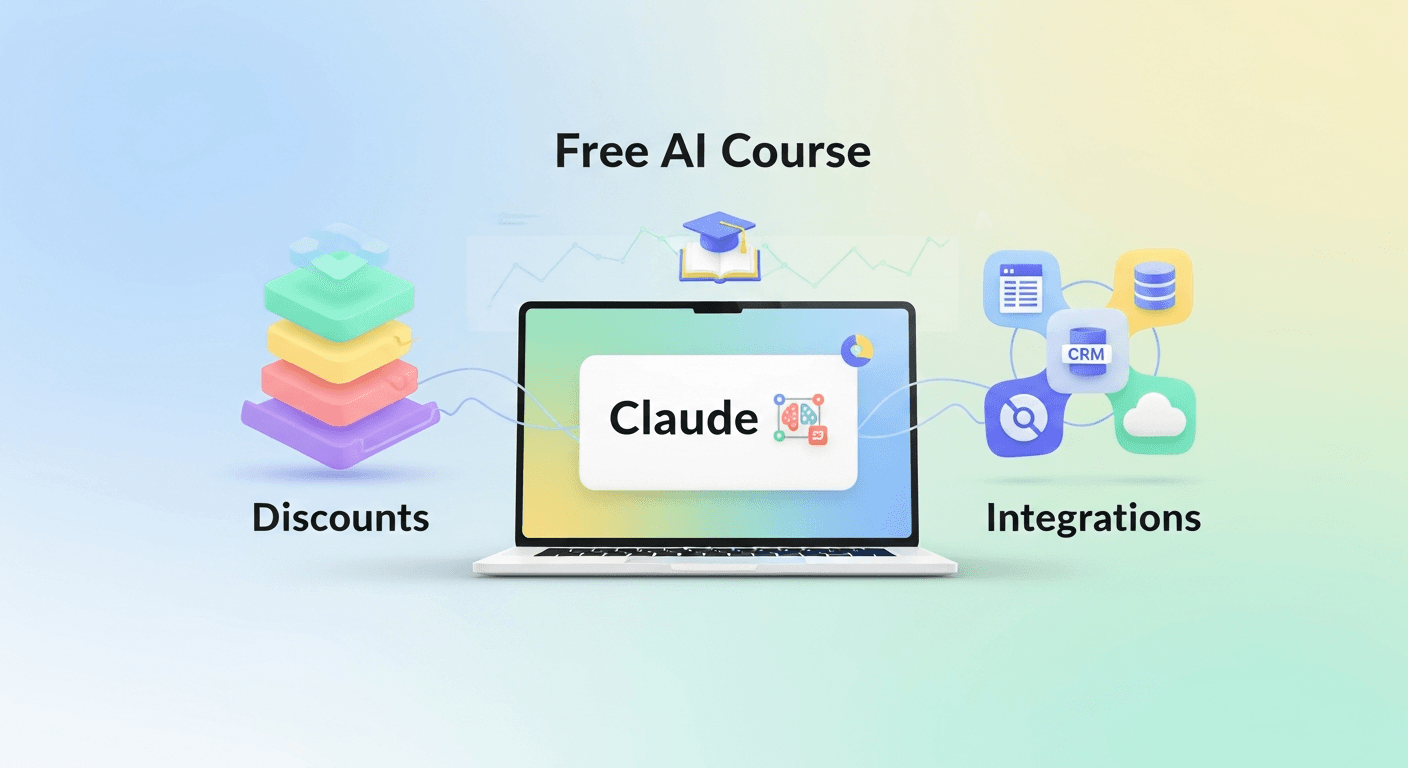
Claude for Nonprofits: Discounts, Integrations, and a Free AI Course for Mission Growth
Why Nonprofits Are Embracing AI Now
Nonprofits face significant challenges, often operating with tight budgets and staffing while managing heightened expectations for their impact. This makes the role of practical and reliable AI indispensable. On December 2, 2025, Anthropic launched Claude for Nonprofits, a program designed to deliver substantial discounts, seamless integrations with popular nonprofit tools, and a complimentary AI fluency course to ensure organizations can adopt AI responsibly and effectively.
In this guide, we’ll delve into what Claude for Nonprofits offers, how it operates, and actionable steps any nonprofit can take to harness its potential to save time, secure funding, and expand their reach.
What Is Claude for Nonprofits?
Claude for Nonprofits is a tailored initiative by Anthropic that aims to help mission-driven organizations leverage AI in accessible and responsible ways. The program has three key components:
- Discounts of up to 75% on Claude Team and Enterprise plans.
- Open-source connectors for popular nonprofit platforms, starting with Benevity, Blackbaud, and Candid, along with existing integrations to tools that many teams already utilize.
- A free course called AI Fluency for Nonprofits to enhance staff skills and confidence in using AI.
Together, these components reduce costs, simplify adoption, and offer teams a secure path to implement AI in their daily nonprofit workflows.
Discounts: Up to 75% Off
Eligible nonprofits can enjoy discounts of up to 75% on Claude Team and Enterprise plans. The Team plan is designed for smaller organizations focused on collaborative efforts, while the Enterprise plan includes enhanced security, governance, and admin controls tailored for larger agencies.
Anthropic informs us that Sonnet 4.5 and Haiku 4.5 are incorporated into these discounted rates, with Opus 4.5 available upon request for Enterprise customers.
When choosing a model:
- Haiku 4.5 is optimized for speed and cost, making it ideal for high-volume tasks such as drafting, summarizing, and data transformations.
- Sonnet 4.5 excels in complex reasoning, analysis, program design, and grant strategy.
- Opus 4.5, accessible upon request for Enterprise, is tailored for the most demanding workloads.
Tip: Consider starting with a small pilot project using the Team plan. As you refine governance and see the value, transition to Enterprise for features like SSO and advanced security.
Connectors Designed for Nonprofits
Claude connects seamlessly to the tools many teams rely on, including Microsoft 365, Google Workspace, Asana, Slack, and Box. Anthropic has also introduced three tailored open-source connectors:
- Benevity: Gain access to a validated global database of nonprofits to enhance donation discovery, corporate volunteering, and cause insights within Claude. Benevity boasts over two million validated nonprofits in its database and has initiated an MCP integration with Claude for Nonprofits.
- Blackbaud: Integrate your CRM and fundraising data to aid in donor research, campaign planning, and stewardship workflows directly from Claude.
- Candid: Access trusted data on nonprofits, foundations, and grants to support your prospecting and due diligence efforts. Candid provides sector metrics, including 1.9 million organization profiles and $180 billion in annual grant dollars. A free Candid account is needed to activate the connector.
Practical Applications:
– Fundraising teams can leverage Candid’s connector to identify relevant funders and analyze past giving patterns, enabling them to craft tailored outreach in mere minutes.
– Corporate partnership teams can utilize Benevity data to align campaigns with causes in specific company regions, ensuring that organizations are validated.
– Advancement and development teams can pull donor histories or segmentation insights via Blackbaud and request Claude to generate segment-specific appeals or stewardship plans.
Since connectors are open-source and utilize the Model Context Protocol, your team or vendor can adapt them as your needs change. Expect new integrations to follow over time.
Free Training: AI Fluency for Nonprofits
Technology is only effective when people know how to use it. To enhance staff skills, Anthropic, in collaboration with GivingTuesday, has created a free course called AI Fluency for Nonprofits, available through Anthropic Academy. This course introduces a practical 4D framework—Delegation, Description, Discernment, and Diligence—for working with AI, covering areas such as research, writing, data analysis, and privacy considerations with hands-on examples for chatbot applications.
Course Highlights:
– The 4D framework and its application to common tasks such as grant writing and impact reporting.
– The description-discernment loop: How to provide AI with clearer instructions and assess its outputs.
– Responsible use: Understanding privacy, consent, and management of sensitive data.
– Practical modules for research, writing, data analysis, and integrating AI into workflows.
Action Step: Encourage enrollment among staff in various departments so your entire team shares a unified understanding and set of guidelines for AI collaboration.
Early Impact: Nonprofits Already Leveraging Claude
Anthropic’s announcement showcases several organizations that have successfully integrated Claude:
– Epilepsy Foundation: Developed a multilingual AI companion offering 24/7 expert-vetted support to 3.4 million Americans with epilepsy.
– International Rescue Committee: Uses Claude to communicate effectively with local partners and quickly analyze field data in humanitarian settings.
– IDinsight: Reports achieving survey instrument readiness up to 16 times faster, creating dashboards in mere hours rather than weeks.
Pilot programs with Constellation Fund, Robin Hood, and Tipping Point Community are focused on optimizing grant proposals, measuring program impact, and creating board materials across more than 60 grantee organizations.
Insights from These Examples:
- Streamlining knowledge tasks can improve speed and consistency when standardized prompts and templates are used.
- AI can make data-heavy workflows accessible to non-technical staff, handling initial analysis and visualization.
- AI assistants can enhance support for beneficiaries without increasing staffing, provided they are designed with strong editorial oversight and safety checks.
Practical Ways to Use Claude in Your Nonprofit Now
Here are some immediate, low-risk use cases. Each example provides a suggestion for the Haiku model when speed is essential, and a Sonnet-driven version for more in-depth analysis:
- Grant Research and Qualification
- Haiku: Paste a funder’s 990 summary or profile and request Claude to extract focus areas, eligibility criteria, deadlines, and a fit rationale in bullet list format.
-
Sonnet: Provide multiple RFPs for Claude to compare requirements, estimate effort, highlight risks, and propose a go/no-go decision with justifications.
-
Case Statements and Proposals
- Haiku: Transform an existing program description into a concise one-page support case featuring a hook, outcomes, and budget overview.
-
Sonnet: Synthesize the theory of change, logic model, and evaluation plan tailored to specific funder priorities, detailing measurable outputs and indicators.
-
Donor Stewardship and Campaigns
- Haiku: Draft segmented email copy for first-time, monthly, and lapsed donors, including A/B subject lines for testing.
-
Sonnet: Analyze donor histories to recommend a 90-day stewardship approach with touchpoints across email, SMS, events, and calls, along with sample messages.
-
Program Design and Evaluation
- Haiku: Summarize survey responses into themes, providing counts and representative quotes for board updates.
-
Sonnet: Generate an evaluation framework linking outcomes to indicators, data sources, collection schedules, and responsibilities, then propose a dashboard design.
-
Volunteer Management
- Haiku: Create role descriptions, onboarding checklists, and 30-60-90 day plans for new volunteers.
-
Sonnet: Predict volunteer demand for upcoming program cycles, suggesting recruitment and retention strategies based on past participation data.
-
Accessibility and Language Access
- Haiku: Translate a beneficiary FAQ into Spanish, Arabic, or French and rewrite it at an 8th-grade reading level.
-
Sonnet: Develop a plain-language, culturally responsive communications guide for program staff with examples and tone guidelines.
-
Data Operations and Reporting
- Haiku: Clean messy CSV headers, normalize values, and map fields to your CRM.
-
Sonnet: Outline a data lifecycle policy for your organization, detailing retention windows, consent language, and anonymization strategies, then draft a summary for your privacy notice.
-
Internal Knowledge Base
- Haiku: Summarize successful grant proposals into a library of reusable paragraphs and supporting points.
- Sonnet: Propose an information architecture for a program wiki, including folder structures, naming conventions, and editorial workflows.
Responsible Adoption: Governance, Privacy, and Change Management
AI can significantly enhance your organization’s impact, but it requires a thoughtful introduction. Here are some guardrails to consider:
- Establish a clear use policy: Define acceptable use, prohibited data types, review processes, and escalation paths. Tailor policy elements to Team or Enterprise features as needed.
- Data classification: Keep personally identifiable information and sensitive data (health, immigration, financial) out of general prompts. Use anonymized or aggregated data for analysis.
- Human oversight: Implement a process for human approval before any AI-generated content is shared with donors, partners, or beneficiaries.
- Document prompts: Treat effective prompts as templates, ensuring owners and version control are established.
- Measure results: Track time savings, funds raised, quality improvements, and beneficiary feedback to foster ongoing adoption and secure funding.
Coordinate with your CRM and data governance teams when using connectors to guarantee permissions, audit trails, and record management are properly maintained.
How to Get Started in 30 Days
Week 1: Align and Select Use Cases
– Identify 2-3 workflows where AI can drive time savings over four weeks (like grant qualification, report drafting, or donor segmentation).
– Determine owners, success metrics, and constraints. Make sure to plan for data anonymization if handling sensitive information.
Week 2: Access and Training
– Apply for Claude for Nonprofits and select the appropriate tier. Enroll staff in the free AI Fluency course to build shared knowledge.
– Install relevant connectors, like Candid for funder research or Blackbaud for donor insights.
Week 3: Build and Pilot
– Develop standard prompts, inputs, and outputs for each workflow. Use Haiku for speed tests and Sonnet for deeper tasks.
– Create a review checklist focusing on accuracy, tone, inclusivity, accessibility, and compliance.
Week 4: Launch and Evaluate
– Implement the workflows with actual tasks for 1-2 weeks. Document time saved, quality gains, and any identified risks.
– Review findings and decide whether to scale, adapt, or discontinue each pilot.
Example Prompts Your Team Can Reuse
- Grant Fit Summary: Paste a funder profile and ask Claude:
- What is the funder’s focus?
- What are the eligibility rules?
- What is the timeline?
- Why is our program an appropriate fit?
- What evidence would strengthen the pitch?
- Program Evaluation Plan: Provide objectives, outputs, outcomes, and data sources. Ask Claude to produce a logic model, indicators, collection cadence, and a draft dashboard schema.
- Donation Appeal Generator: Provide audience segments and previous gift histories. Request three appeal variations per segment with distinct hooks and calls to action, plus a follow-up stewardship sequence.
- Data Cleaning: Paste a sample CSV header row and field notes. Ask for a normalized header mapping and a brief script or steps to transform the dataset.
The Future of Claude for Nonprofits
By combining substantial discounts with sector-specific connectors and free training, Claude for Nonprofits seeks to accelerate AI adoption while addressing the unique challenges faced by nonprofits such as privacy, compliance, and resource limitations. Early results from organizations in health, humanitarian assistance, and education indicate significant time savings and improved outcomes when teams implement clear guidelines and start with appropriate use cases.
As connector partners like Benevity and Candid expand their features through the Model Context Protocol, expect enhanced discovery, due diligence, and donor stewardship all within the same AI workspace where analysis and drafting occur.
FAQs
Q1: What is included in Claude for Nonprofits?
A: The program offers up to 75% discounts on Team and Enterprise plans, open-source connectors for Benevity, Blackbaud, and Candid, a free AI Fluency for Nonprofits course, and support for tools like Microsoft 365 and Google Workspace.
Q2: Which Claude model should my team use?
A: Utilize Haiku 4.5 for rapid tasks and Sonnet 4.5 for tasks requiring complex reasoning. Enterprise teams may request access to Opus 4.5 for extensive workloads.
Q3: How do the nonprofit connectors assist with fundraising?
A: The Candid connector facilitates access to reliable funder and nonprofit data, speeding up prospecting and due diligence. Benevity’s database helps align campaigns with validated causes, while Blackbaud connectivity offers donor and campaign context within Claude for tailored outreach.
Q4: Are technical skills required to use Claude for Nonprofits?
A: No, the program is designed for non-technical staff. The free AI Fluency course provides foundational skills, and connectors simplify setup.
Q5: What is the recommended approach for privacy and safety?
A: Start with a clear internal policy, classify sensitive data, and maintain human oversight before sharing anything externally. Employ Enterprise controls where suitable, and limit prompts to de-identified or consented data. The AI Fluency course includes vital modules on privacy and data handling.
Conclusion
Claude for Nonprofits is more than just a tool; it’s a comprehensive approach that meets organizations where they are—offering reduced costs, seamless integrations with existing systems, and essential training that acknowledges limited resources. If your organization is ready to explore the advantages of AI, begin with manageable projects, establish guidelines, and monitor your results. With the right strategies in place, AI can help propel your mission forward without compromising trust.
Thank You for Reading this Blog and See You Soon! 🙏 👋
Let's connect 🚀
Latest Insights
Deep dives into AI, Engineering, and the Future of Tech.
I Tried 5 AI Browsers So You Don’t Have To: Here’s What Actually Works in 2025
I explored 5 AI browsers—Chrome Gemini, Edge Copilot, ChatGPT Atlas, Comet, and Dia—to find out what works. Here are insights, advantages, and safety recommendations.
Read Article


