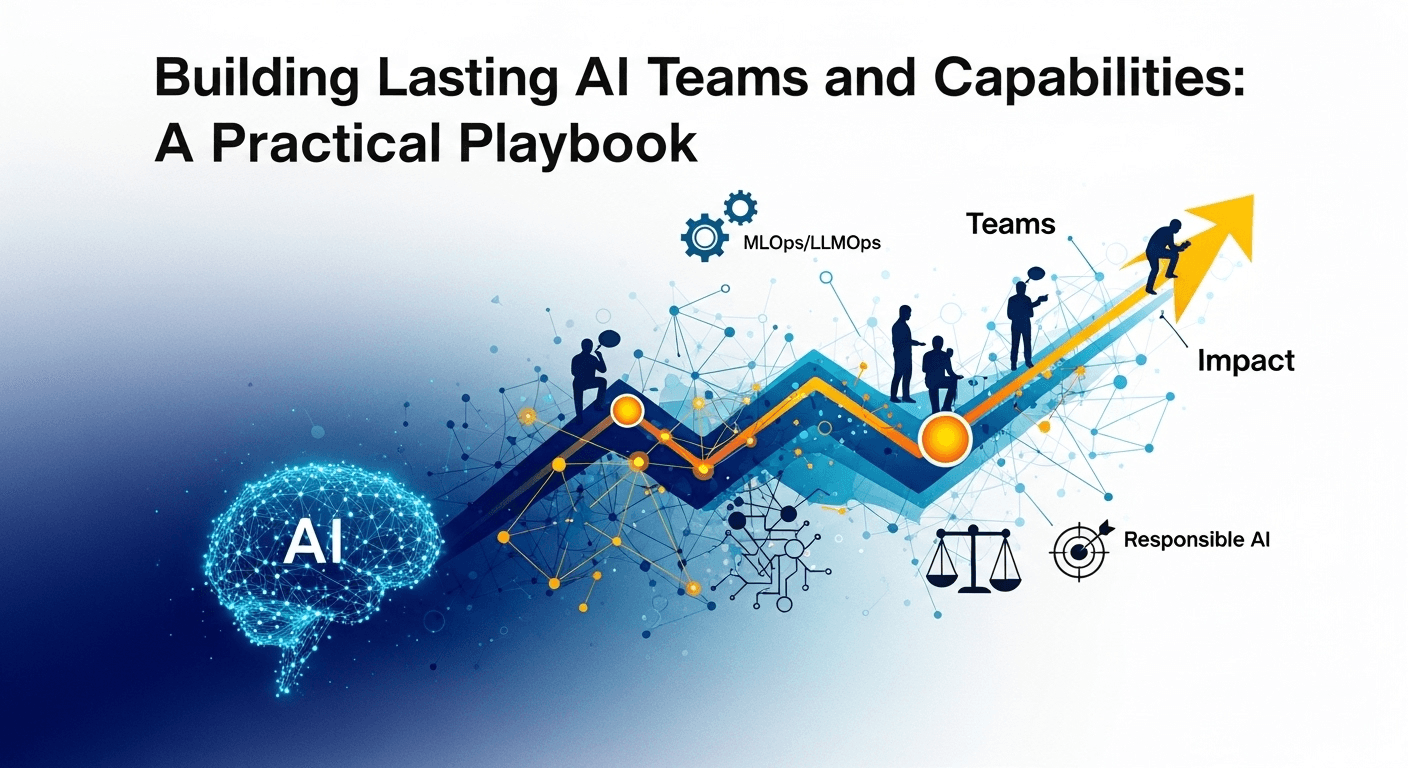
Building Lasting AI Teams and Capabilities: A Practical Playbook
AI has transitioned from experimentation to practical application. Leaders now face a critical question: how can they build teams and capabilities that yield reliable outcomes while minimizing risks? This practical playbook offers insights into the operating models, roles, processes, and governance necessary to transform AI concepts into sustainable results.
Why Build AI Capabilities Now
Economic, technical, and regulatory factors are converging. McKinsey estimates that generative AI could contribute between $2.6 and $4.4 trillion annually across various industries, with the most substantial gains anticipated in sales, marketing, software engineering, and customer operations (source). Developers utilizing AI coding assistance have demonstrated the ability to complete tasks up to 55% faster, indicating significant productivity gains when implemented effectively (source).
Simultaneously, the AI landscape is rapidly evolving. The Stanford AI Index highlights significant growth in model capabilities, industry investment, and enterprise adoption, coupled with increasing concerns about safety and evaluation quality (source). Regulations are also advancing, with the EU AI Act introducing a risk-based framework that will begin implementation in 2025-2026, influencing how organizations manage, test, and oversee AI systems within the EU and beyond (source).
To thrive in this environment, organizations require more than just tools; they need a clear operational model, the appropriate roles and skills, effective MLOps and LLMOps, and pragmatic governance strategies that mitigate risks without stifling innovation.
Select an Operating Model
Your AI operating model shapes how ideas become tangible products. Most organizations follow one of three evolutionary patterns.
1) Centralized Center of Excellence (CoE)
A dedicated team develops platforms, standards, and initial use cases across the organization.
- Strengths: Rapid standardization, shared resources, consistent governance, focused talent acquisition.
- Risks: Potential bottlenecks, limited domain understanding, perception of a centralized gatekeeper.
- Best when: You’re in the early stages, need robust foundations, or face strict risk and compliance requirements.
2) Hub-and-Spoke Model
A central platform and governance team (hub) supports AI practitioners embedded within different business units (spokes).
- Strengths: Combines speed and consistency; domain context resides with product teams; shared tools minimize duplication.
- Risks: Requires mature product management and clear interfaces; can lose coherence without common standards.
- Best when: You have multiple AI initiatives across departments and can staff local teams effectively.
3) Federated Model
Individual business units manage their own AI projects with minimal shared principles and optional tools.
- Strengths: Maximizes autonomy and speed for high-capacity teams.
- Risks: Potential duplication of efforts, inconsistent risk management, and challenges in knowledge sharing.
- Best when: Teams possess robust engineering skills and distinct requirements.
Whichever model you choose, clearly define handoffs: who prioritizes use cases, who makes risk decisions, how platform teams coordinate with product teams, and what support is available at each stage. Aligning team structures with overarching system goals is crucial, following the principles established in Conway’s Law and modern software organizational design.
Core Roles and Skills
High-performing AI teams integrate expertise from product management, data science, engineering, and risk assessment. While job titles may differ, the necessary competencies remain consistent.
- AI Product Manager: Defines problems, establishes success metrics, facilitates delivery, and ensures solutions are viable, feasible, and desirable.
- Data Scientist: Analyzes data, constructs and evaluates models, designs experiments, and collaborates on feature engineering and metrics.
- ML Engineer: Deploys models, develops training and inference pipelines, optimizes performance, and integrates with services.
- Data Engineer/Analytics Engineer: Provides high-quality, well-structured data through efficient pipelines; oversees data integrity and lineage.
- Platform/Infra Engineer: Supplies shared tools, computing resources, observability, and CI/CD for data and model workflows.
- AI Evaluation Engineer: Creates evaluation frameworks, offline and online metrics, and validation tests for robustness, fairness, and safety.
- Responsible AI/AI Risk Lead: Translates policy into actionable controls, coordinates risk assessments, and ensures appropriate human oversight.
- Domain Expert and UX Researcher: Provides real-world insights and user feedback; essential for workflow integration and adoption.
- Applied Research Scientist (optional): Investigates innovative techniques when off-the-shelf solutions are inadequate or when differentiation relies on model innovation.
For generative AI specifically, include:
- Prompt/Retrieval Engineer: Crafts prompts and retrieval-augmented generation (RAG) pipelines; optimizes context windows and grounding.
- Safety/Guardrails Engineer: Implements content filters, policy enforcement measures, and conducts red-teaming exercises.
Start with Problems, Not Models
Ground every AI initiative in a business challenge with measurable value and a designated owner. A straightforward checklist can help prevent wasted efforts:
- User and Workflow: Who will utilize this solution? How will their roles change?
- Value: Which metric improves (revenue, costs, risk, experience) and by what extent?
- Data: What data is available, accessible, and compliant for use? What is the baseline quality?
- Feasibility: Is there a clear path using available models, fine-tuning, or RAG?
- Risk: What are the potential pitfalls, and how will you monitor and mitigate them?
- Change: What training and process adjustments are necessary for successful adoption?
Prioritize a portfolio of use cases that balances quick wins with foundational initiatives. Implement a lightweight stage-gate process (discovery, pilot, scale) with clear exit criteria to enhance learning and minimize risks early.
Data Foundations and Governance
The quality of AI is intrinsically linked to data quality. Invest in data practices that accelerate cycles and reduce rework.
- Data Contracts and Lineage: Clearly outline producers and consumers; track lineage to identify drift and disruptions.
- Data Quality: Monitor freshness, completeness, accuracy, and uniqueness. Address quality issues as you would production incidents.
- Feature Stores: Reuse and govern features across models, speeding up experimentation and enhancing reproducibility.
- Labeling: Devise a labeling strategy with definitive guidelines and quality assurance. For generative AI, establish curated evaluation datasets.
- Privacy and Security: Implement data minimization, purpose limitation, access controls, and encryption. Map data to applicable policies and jurisdictions.
Consider utilizing standardized documentation like Datasheets for Datasets and Model Cards to clarify assumptions, limits, and intended applications (Datasheets, Model Cards). These artifacts facilitate audits and transitions.
MLOps and LLMOps: The Delivery Engine
Embrace an end-to-end lifecycle that merges established data science workflows with contemporary software delivery methods. While the CRISP-DM model remains relevant, operational success hinges on automation, observability, and rapid feedback loops (source).
Lifecycle Overview
- Plan: Define problems, success metrics, and risk assessments.
- Build: Prepare data, select models, engineer features, and track experiments.
- Evaluate: Assess offline metrics, conduct stratified tests, analyze bias/variance, and perform safety checks.
- Ship: Implement CI/CD/CT for data and models; utilize canary and A/B testing; maintain versioned artifacts.
- Operate: Monitor quality, drift, costs, latency, and user feedback; automate retraining and rollout.
Key Practices
- Experiment Tracking: Log code, data versions, parameters, and metrics for reproducibility.
- Continuous Testing: Include unit tests for data and features, fairness assessments on relevant cohorts, and security/privacy checks in CI/CD.
- Data and Model Versioning: Preserve immutable artifacts for auditing and rollback purposes.
- Monitoring: Track performance and drift with alerts. Incorporate user-centric metrics like satisfaction and time-to-completion.
- Cost Governance: Monitor training and inference costs; establish budgetary limits to ensure ROI.
LLMOps Specifics
- Prompt Management: Version prompts, templates, and policies. Test for regressions with upstream model changes.
- Grounding and RAG: Use retrieval-augmented generation to anchor outputs in your data. Evaluate citation accuracy and scope.
- Evaluation: Combine automatic metrics (e.g., BLEU, ROUGE, perplexity proxies) with human assessments and task success. Consider holistic checks like Stanford HELM for context (source).
- Guardrails: Enforce input/output filters, uphold content policies, and implement rate limiting; conduct red-teaming exercises to uncover vulnerabilities.
- Model Choice: Balance between hosted APIs, open-source models, and fine-tunes, considering privacy, latency, throughput, and total costs.
Responsible AI and Risk Management
Governance should foster innovation while managing risk. Utilize established frameworks as foundations, and customize them for your context.
- NIST AI Risk Management Framework: A practical guide for mapping, measuring, and managing AI risks, covering governance, validity, security, and explainability (source).
- ISO/IEC 23894:2023: Offers guidance on AI risk management integrated with the broader ISO management framework (source).
- EU AI Act: Establishes risk-based obligations for providers and deployers, including specific regulations for high-risk systems and generative AI disclosures (source).
Ensure your governance framework is both practical and actionable:
- Project Intake: Early identification of purpose, users, data types, and preliminary risks.
- Risk Reviews: Conduct brief, repeatable checkpoints aligned with stage-gates, emphasizing material risks and mitigations rather than paperwork.
- Model Documentation: Maintain model cards, outlines of intended uses, limitations, and testing results; incorporate user-facing disclosures where relevant.
- Human-in-the-Loop: Clearly define instances necessitating human review and train reviewers to identify potential failure points.
- Security: Safeguard training and inference endpoints, manage sensitive data, and mitigate prompt injection and data breaches in LLM applications.
Tools and Platform Choices
Choose a platform that provides teams with guidance and frameworks instead of restricting decisions. An effective stack may include:
- Data: A contemporary data lakehouse or warehouse; orchestration; cataloging and lineage tools; quality and observability solutions.
- ML Lifecycle: Experiment tracking, feature stores, model registries, CI/CD/CT, and model monitoring.
- LLM Stack: Management of prompts/versions, vector databases, retrieval systems, evaluation frameworks, and guardrails.
- Security and Compliance: Tools for secrets management, role-based access, audit trails, and policy enforcement.
Opt for managed services for non-essential capabilities. Utilize open standards and APIs to mitigate vendor lock-in, and document best practices for common scenarios like RAG chatbots, classification pipelines, and ranking systems.
Build, Buy, or Partner
Determine the approach that maximizes value creation while safeguarding differentiators.
- Buy: For standard capabilities (e.g., speech recognition, OCR, translation), third-party APIs offer a quick and reliable option.
- Customize: When workflows require your data and context, enhance with fine-tuning or RAG on foundational models.
- Build: When core differentiation is essential or strict data locality and latency requirements exist, consider developing or significantly customizing models.
- Partner: Engage vendors or integrators to expedite initial implementation, while fostering internal ownership to prevent long-term dependency.
Utilize a straightforward scorecard assessing potential value, time to impact, data sensitivity, technical risk, total cost of ownership, and compliance factors. Reevaluate decisions as market dynamics evolve.
Talent Strategy: Hire, Upskill, and Retain
The quickest path to building capability often lies in upskilling existing personnel, complemented by strategic hiring.
- Upskill at Scale: Provide role-specific training for engineers, analysts, product managers, and business stakeholders. Integrate learning with practical use cases.
- Create Communities of Practice: Encourage sharing of patterns, templates, and code. Host internal demonstrations and knowledge-sharing sessions to bolster learning.
- Hire for T-Shaped Skills: Seek individuals with robust fundamentals, enthusiasm for learning, and collaborative mindsets. AI initiatives require cross-discipline expertise.
- Define Growth Paths: Present both technical and managerial career progression opportunities. Recognize evaluation, risk assessment, and platform development roles on par with modeling tasks.
- Diversity Matters: Diverse perspectives reduce blind spots and enhance model fairness; treat diversity as an essential quality metric rather than a mere equity goal.
Change Management and Adoption
Even the most advanced model is ineffective if workflows remain unchanged. Treat adoption as a fundamental deliverable.
- Co-Design with Users: Engage frontline teams early on. Prototype rapidly, followed by iterative improvements based on user feedback.
- Train and Support: Develop concise, task-oriented guides. Offer an escalation path for issues and a system for gathering improvement suggestions.
- Transparent Communication: Clearly outline what the model can and cannot achieve, how performance will be monitored, and the success criteria.
- Incentivize and Hold Accountable: Align incentives so that leaders and teams benefit from positive AI outcomes.
Budgeting and Business Case
Budget across the entire lifecycle, not just for preliminary experiments.
- Initial Investment: Cover discovery, data access efforts, pilot projects, and platform setup.
- Ongoing Costs: Include expenses for inference, monitoring, labeling/evaluations, model updates, and platform maintenance.
- Risk and Compliance: Account for documentation, testing, and audits.
Track realized metrics: conversion rates, handling times, resolution times, revenue growth, error rates, or customer satisfaction levels. Treat quality debts in models and data as significant maintenance items.
Metrics That Matter
Adopt metrics from DevOps and analytics for a streamlined scorecard.
- Delivery: Measure lead time to production, deployment frequency, change failure rates, and time to recovery (drawing inspiration from DORA metrics, source).
- Model Quality: Use task-specific metrics (e.g., accuracy, F1 score, MAPE), along with generative AI metrics (hallucination rates, grounded citation rates, toxicity).
- Reliability: Assess latency, availability, drift, cost per prediction, and adherence to service level objectives (SLOs).
- Business Impact: Evaluate improvements in key metrics, user adoption rates, and return on investment (ROI).
- Risk Management: Monitor evaluation coverage, incident counts, and time taken to address issues.
A 90-Day Starter Plan
Implement this plan to kickstart capabilities while delivering tangible value.
- Days 1-30: Assemble a small cross-functional team. Select 2-3 use cases with clear value and low risk. Set up basic tools for tracking experiments, ensuring data quality, and managing prompts. Draft templates for project intake and risk reviews.
- Days 31-60: Launch one pilot with a restricted user group, equipped with monitoring and feedback loops. Document data sources, model cards, and safety nets. Prepare evaluation datasets and a basic testing framework.
- Days 61-90: Scale the pilot. Incorporate canary deployments and A/B testing. Initiate a community of practice and host an internal demo day. Analyze metrics, extract lessons learned, and fine-tune the operational model. Plan for the next 2-3 use cases.
Common Pitfalls and How to Avoid Them
- Tool-First Mentality: Begin with the user and problem; let tools come later.
- One-Off Demos: Treat pilots as stepping stones to production, coupled with proper monitoring and support.
- Overlooking Data Work: Budget adequately for data sourcing, quality control, and lineage from the outset.
- Governance as Bureaucracy: Keep reviews efficient, focused on critical risks rather than excessive paperwork.
- Neglecting Evaluation: Establish rigorous and repeatable evaluation processes from the beginning; this will compound over time.
Conclusion: Build the Muscle, Not Just the Model
Successful AI initiatives harmonize ambition with discipline. Adopt an operating model that meets your unique context, staff the right roles, and invest in data, delivery mechanisms, and governance structures. Prioritize solving genuine user problems and achieving measurable outcomes. With these strong foundations, your teams can progress from proofs of concept to scalable, trustworthy AI products.
FAQs
What is the minimum team I need to deliver an AI use case?
Start with an AI product manager, a data scientist, an ML engineer, and a data engineer. Leverage UX, security, and risk expertise as required. Expand to include evaluation and platform roles as you scale.
Should I establish an AI center of excellence?
If you are in the early phases or navigating a regulated environment, a small center of excellence can facilitate the establishment of standards, tools, and initial use cases. Plan to transition to a hub-and-spoke model as demand increases.
How do I measure success for generative AI?
Integrate task-level metrics (e.g., grounded citation rate, hallucination rate, time-to-completion) with business outcomes (e.g., case resolution rates, net promoter score) and reliability measures (latency, cost per response).
How do I stay compliant as regulations evolve?
Implement risk-based frameworks like NIST AI RMF and ISO/IEC 23894, maintain clear documentation (model cards, data inventories), and apply human oversight in high-stakes scenarios. Monitor updates to the EU AI Act if operating within the EU.
When should I fine-tune vs. use RAG?
Use RAG when your knowledge base changes frequently or needs to remain confidential. Opt for fine-tuning when the model needs to adopt specific behaviors or styles not captured solely by prompts. Many systems effectively utilize both methods.
Sources
- McKinsey – The Economic Potential of Generative AI
- GitHub – Quantifying Copilot’s Impact on Developer Productivity
- Stanford AI Index 2024
- NIST AI Risk Management Framework 1.0
- ISO/IEC 23894:2023 – AI Risk Management Guidance
- European Commission – The AI Act
- CRISP-DM Process Reference Document
- Stanford HELM – Holistic Evaluation of Language Models
- Datasheets for Datasets – Research Article
- Model Cards for Model Reporting – Research Article
- DORA – DevOps Capabilities and Metrics Overview
Thank You for Reading this Blog and See You Soon! 🙏 👋
Let's connect 🚀
Latest Insights
Deep dives into AI, Engineering, and the Future of Tech.
I Tried 5 AI Browsers So You Don’t Have To: Here’s What Actually Works in 2025
I explored 5 AI browsers—Chrome Gemini, Edge Copilot, ChatGPT Atlas, Comet, and Dia—to find out what works. Here are insights, advantages, and safety recommendations.
Read Article


