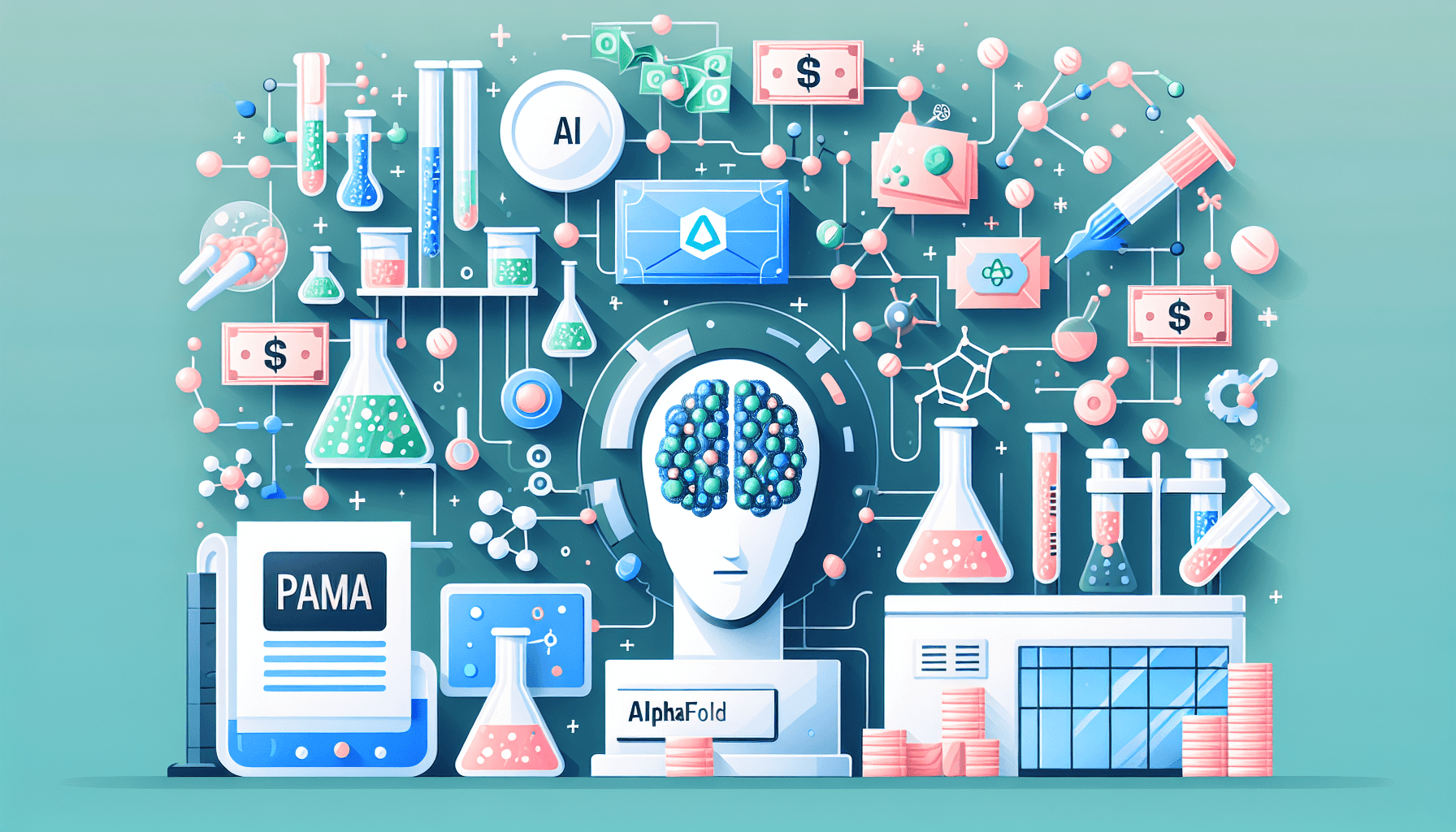
Alphabet’s $600M Bet on AI Drug Discovery: What Isomorphic Labs Is Really Building
Alphabet’s $600M Bet on AI Drug Discovery: What Isomorphic Labs Is Really Building
TL;DR: Alphabet’s Isomorphic Labs has reportedly raised $600 million to accelerate AI-driven drug discovery. The cash signals a scale-up moment for industrializing models like AlphaFold 3 into real, validated medicines. Expect heavy spend on compute, talent, wet labs, and clinical validation—and watch for milestone-rich pharma partnerships to convert into INDs and early clinical trials. It’s a big bet with real promise, but success hinges on rigorous biology, data quality, and regulatory fit.
Why this funding matters now
Isomorphic Labs—an Alphabet company spun out of Google DeepMind’s research—has reportedly raised $600 million to fuel its push into AI-enabled therapeutics discovery. The New York Times broke the news, underscoring how tech’s largest players are moving from proofs of concept to industrial-scale drug R&D platforms.[1]
Two things make the timing notable:
- Model breakthroughs meet infrastructure. Advances like AlphaFold 3 promise richer biological reasoning (for example, modelling protein–ligand and biomolecular complexes), but turning that into medicines requires expensive compute, purpose-built wet labs, diverse data, and end-to-end validation workflows.
- Pharma is buying in—cautiously. Isomorphic Labs has inked multi-year discovery collaborations with major pharmas, a sign that the industry wants access to these tools but prefers milestone-based risk sharing.[2]
What Isomorphic Labs is (and isn’t)
Founded in 2021 by Demis Hassabis, Isomorphic Labs aims to “reimagine drug discovery from first principles” using machine learning for structure prediction, molecular design, and target–ligand reasoning. It sits alongside Google DeepMind within Alphabet, sharing lineage with the research behind AlphaFold.[3]
Crucially, the company isn’t just a model provider. To be relevant in therapeutics, it must operate across the discovery stack: data engineering, modelling, design–make–test cycles, ADME/Tox, and preclinical validation that stands up to regulatory scrutiny. The $600M suggests a push to scale that entire stack—not merely train bigger models.
The tech: AlphaFold 3 and the road to designable biology
AlphaFold 2 changed structural biology by predicting protein structures from sequences; AlphaFold 3 extends that capability toward biomolecular complexes—including protein–ligand and protein–nucleic acid interactions—crucial for drug design. Google DeepMind and Isomorphic Labs highlighted these advances in 2024, alongside a public server for non-commercial use.[3]
What this unlocks for drug discovery:
- Better starting hypotheses: If you can more reliably model how a small molecule fits (or fails to fit) into a binding site, you can triage ideas earlier and focus wet-lab effort.
- Richer optimization signals: Complex-aware models can inform structure–activity relationship (SAR) cycles and multi-parameter optimization beyond single-target affinity.
- Design in context: The ability to reason over multimers, cofactors, ions, and nucleic acids helps align in silico predictions with biological reality.
Limits still apply. Structural accuracy doesn’t automatically translate to drug-like properties, ADME/Tox, or clinical efficacy. The bottlenecks move—but they don’t vanish.
Follow the money: partnerships and milestones
Isomorphic Labs’ business model appears to blend internal programs with partnered discovery. In 2024, the company announced collaborations with Eli Lilly and Novartis; Reuters reported these could be worth billions in potential milestones, a common structure that pays as programs advance rather than up front.[2]
Why this matters for the $600M:
- Capacity build-out: To prosecute multiple partnered and internal programs, Isomorphic needs compute, wet labs, and in vivo capabilities at scale.
- Data advantage: Partnerships often come with access to high-quality, non-public datasets—vital fuel for training and validating models.
- Path to value: Milestone economics align incentives with validated progress (e.g., lead nomination, IND, clinical phases), not just model benchmarks.
What $600M likely funds
- Compute and modelling: Training and inference for large, complex, multi-modal models; orchestration across GPUs/TPUs; and robust evaluation frameworks.
- Wet-lab automation: High-throughput synthesis and screening, cell-based assays, and advanced biophysics to close the design–make–test loop.
- Translational biology: Omics, target validation, and disease models to reduce late-stage attrition.
- Regulatory-grade data ops: Provenance, audit trails, and model risk management that map to evolving FDA/EMA expectations.[4][5]
Risks and reality checks
- From structure to medicine: High structural fidelity won’t guarantee bioavailability, safety, or efficacy. ADME/Tox and translational relevance remain hard problems.
- Data bias and generalization: Models trained on biased or narrow datasets can mislead, especially for novel biology or underrepresented targets.
- Wet-lab throughput: Even with automation, synthesis and assays gate progress. The pace of iteration—not just model quality—drives success.
- Regulatory fit: Agencies are signaling openness to AI, but they expect transparency, validation plans, and fit-for-purpose use of models through the drug lifecycle.[4][5]
How to gauge progress over the next 12–24 months
- Program disclosures: Look for target areas, modality mix (small molecules vs. biologics), and evidence of differentiation (e.g., hitting tough or previously “undruggable” targets).
- Milestone triggers: Preclinical achievements (development candidate selection) and IND filings from partnered programs.
- Clinical entry: First-in-human studies will be the true test of whether AI-enabled design converts into safety/efficacy signals.
- Model transparency: Validation datasets, benchmarks beyond structure accuracy (e.g., prospective design tasks), and clear limits-of-use statements.
- Regulatory dialogue: Evidence of engagement with FDA/EMA on model governance and data integrity processes.
The headline is big—$600 million—but in biopharma, value is created through disciplined iteration. The winners will pair state-of-the-art modeling with relentless experimental validation and clear paths to patients.
Bottom line
Alphabet’s infusion gives Isomorphic Labs the means to scale from promising algorithms to a full-stack discovery engine. The science is exciting, the partnerships are real, and the market opportunity is enormous. Now comes the hard part: reproducible biology, credible milestones, and early clinical wins.
Sources
- The New York Times (via Google News). Isomorphic Labs, Google’s A.I. Drug Business, Raises $600 Million. https://news.google.com/rss/articles/CBMimAFBVV95cUxOMFBMSGNpVTdoM0FTcXFrN21vZnh6TW1tcjZJUDg3XzFITEZSUGE4TDAwRUtEWHRjMWlUcXppcnBCbWtpUjhmYlBfN0R1VV9ZTE0xbjFxVHRJRVZISHJsaXJQdVRhYnBvWWJUNDk2VHFmb28yY2hrc2VLVE1XWHk4MGs0M1RFT0dpWTBrYV9GZTdsSGFaMVMzSA?oc=5&hl=en-US&gl=US&ceid=US:en
- Reuters. Alphabet’s Isomorphic Labs signs drug discovery deals with Lilly, Novartis (Jan. 16, 2024). https://www.reuters.com/technology/science/alphabets-isomorphic-labs-signs-drug-discovery-deals-with-lilly-novartis-2024-01-16/
- Google DeepMind blog. Advancing biology with AlphaFold 3 (May 8, 2024). https://deepmind.google/discover/blog/advancing-biology-with-alphafold-3/
- U.S. Food and Drug Administration. Discussion Paper: Artificial Intelligence and Machine Learning in Drug Development (May 2023). https://www.fda.gov/drugs/science-and-research-drugs/discussion-paper-artificial-intelligence-and-machine-learning-drug-development
- European Medicines Agency. Reflection paper on the use of artificial intelligence in the medicinal product lifecycle (2023). https://www.ema.europa.eu/en/news/reflection-paper-use-artificial-intelligence-medicinal-product-lifecycle
Thank You for Reading this Blog and See You Soon! 🙏 👋
Let's connect 🚀
Latest Insights
Deep dives into AI, Engineering, and the Future of Tech.
I Tried 5 AI Browsers So You Don’t Have To: Here’s What Actually Works in 2025
I explored 5 AI browsers—Chrome Gemini, Edge Copilot, ChatGPT Atlas, Comet, and Dia—to find out what works. Here are insights, advantages, and safety recommendations.
Read Article


