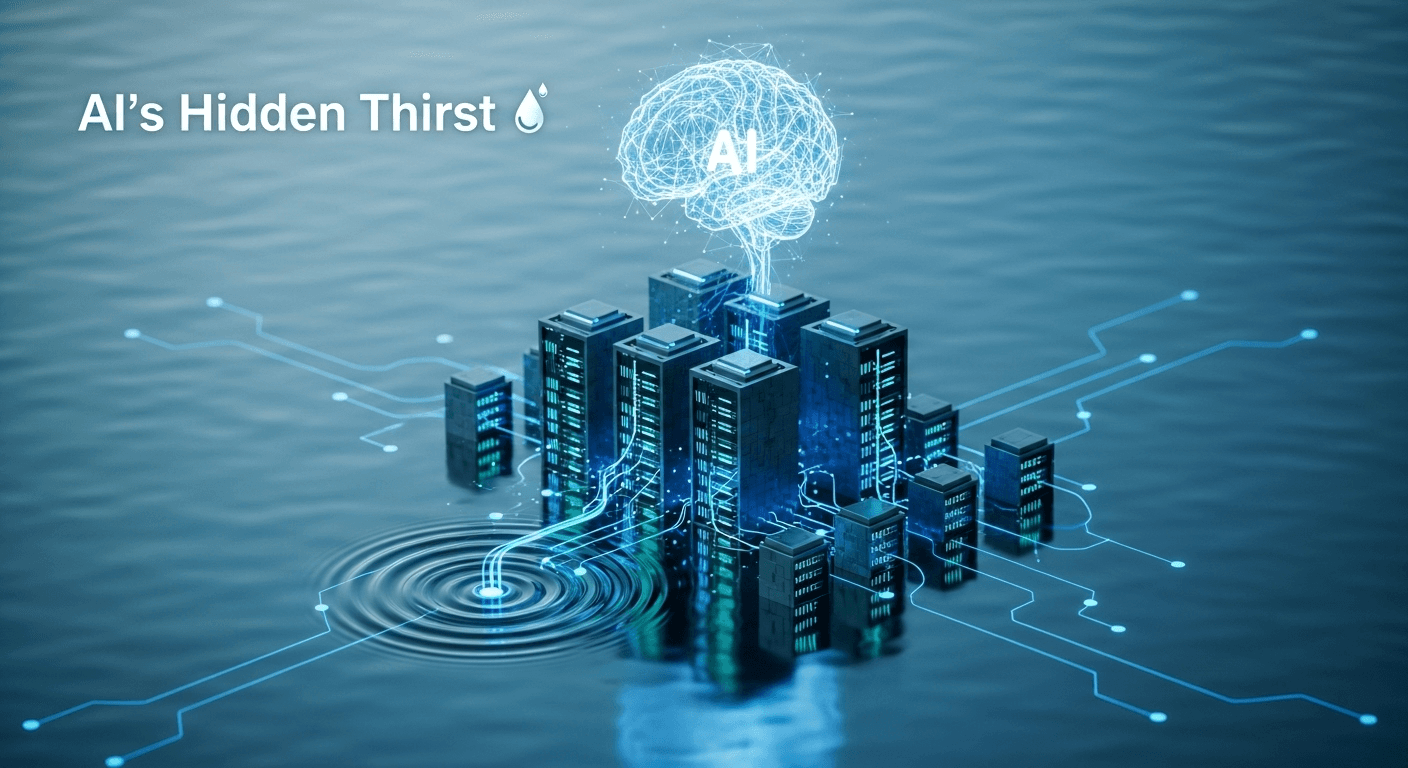
AI’s Hidden Thirst: Understanding the Water Footprint of Our Algorithms
Introduction: The Hidden Resource Driving AI
When we talk about artificial intelligence, we often focus on GPUs, training costs, and electricity usage. However, an aspect frequently overlooked is its significant water footprint. Every time you use an AI model or receive a product recommendation, there’s a data center working behind the scenes to keep everything cool. The cooling processes demand substantial amounts of water, particularly in hot or dry periods. As AI usage continues to rise, it is crucial for communities, businesses, and anyone passionate about sustainable technology to understand this often-hidden water footprint.
This article explores the reasons why AI requires water, assesses the implications, summarizes current research, and outlines actionable steps to adopt more water-efficient AI practices. We rely on credible public sources such as peer-reviewed studies, corporate sustainability reports, and responsible journalism to present clear and informed insights.
Why AI Requires Water
Modern AI functions within large data centers filled with servers and networking equipment that generate heat. Excessive heat can lead to reduced performance or even failures; thus, effective cooling is essential. While some data centers depend solely on air cooling, many prefer evaporative (adiabatic) systems or cooling towers that utilize water for efficient heat removal.
Additionally, there’s an indirect water footprint associated with electricity generation for data centers, which typically consumes or withdraws water. The overall impact varies based on the energy mix in a particular area. For instance, thermal power plants (coal, gas, nuclear) withdraw significant amounts of water for cooling, while renewable sources such as wind and solar have markedly lower water needs. Hence, where AI operates and how it’s powered play critical roles in its water demand.
Key points to remember:
- Direct water use primarily arises from cooling in data centers.
- Indirect water use comes from the electricity required to power the hardware.
Insights from Research on AI’s Water Footprint
A 2023 study led by Shaolei Ren provided one of the first comprehensive examinations of AI’s water footprint during both training and inference processes. The findings suggest that training large language models can consume substantial quantities of clean water through cooling demands at data centers. Additionally, the inference process—essentially handling user queries—can accumulate significant water usage, especially at scale. While the specific amounts depend on hardware, efficiency, and local climates, the core takeaway is clear: as AI becomes more prevalent, so too does its associated water consumption, often without users realizing it (Ren et al., 2023).
Industry observations support this trend. Annual sustainability reports from major cloud providers indicate a rise in water consumption as they expand their data center capacities and integrate AI workloads. Companies like Microsoft and Google have documented year-on-year increases in global water use, each setting targets to achieve “water positive” status by 2030, aiming to replenish more water than they consume across their operations (Microsoft Sustainability Reporting; Google Water-Positive by 2030).
Though these reports do not break down AI’s water use from other cloud demands, they clearly highlight a broader infrastructure trend: increased computing generally leads to greater need for cooling, which often translates to higher water consumption—especially in regions utilizing evaporative systems.
Training vs. Inference: Breaking Down Water Usage
AI’s water demand can be categorized into two distinct phases, each with unique characteristics:
- Training: This phase involves extensive computation across large clusters to develop a model, consuming significant energy and requiring substantial cooling. It can often be scheduled strategically to leverage cooler periods or more water-aware planning.
- Inference: Following deployment, this phase handles billions of user requests. Although individual requests may require minimal water, the cumulative effect can be significant. Unlike training, inference is less flexible with timing since it must meet user expectations for response time.
The study by Ren et al. emphasized the importance of both phases. Depending on the context, training might dominate water use, while in other cases, the heavy production usage during inference could become the larger contributor. This distinction is crucial for teams aiming to enhance efficiency (Ren et al., 2023).
Cooling Basics: Understanding Water Usage in Data Centers
Data centers aim to maintain optimal temperature and humidity levels through various methods, including:
- Air cooling: This method circulates chilled air through designated hot and cold aisles and may incorporate outside air under favorable conditions.
- Evaporative cooling: This technique uses water evaporation to dissipate heat. Although energy-efficient, it does consume significant amounts of water.
- Chilled water systems: Centralized plants produce chilled water that circulates through the facility, often using cooling towers that expel evaporated water.
- Liquid cooling: This advanced method directs coolant closer to chips or submerges servers, potentially reducing energy consumption as well as water needs, though the effectiveness can vary based on design choices.
Industry professionals employ a metric known as Water Usage Effectiveness (WUE) to monitor the ratio of water utilized for operational purposes relative to the energy consumed by IT equipment. A lower WUE indicates higher water efficiency. This metric complements Power Usage Effectiveness (PUE), enabling comparisons between designs or tracking efficiency over time (The Green Grid – WUE).
Factors Influencing Water Impact: Location, Climate, and Timing
The water impact of data centers varies based on their geographic context. Using one liter of water in a resource-abundant area during cooler months poses a different risk than doing so in a drought-prone location during a heatwave. There are three primary factors that shape this impact:
- Local water stress: Is water availability limited or contested in the area? Managers of data centers often collaborate with utility providers to secure water rights or seek alternative sources.
- Climate: Warmer, arid regions may favor evaporative cooling for improved energy efficiency at the cost of increased water usage, whereas cooler, humid locations can frequently utilize free-air cooling.
- Grid mix: In regions where power generation relies heavily on thermoelectric plants, the indirect water footprint tends to be elevated.
For instance, The Dalles, Oregon, made headlines by revealing substantial water usage connected to Google data centers. This case underscores community interest in transparency and infrastructure planning (OPB reporting).
Understanding the Scale of the Issue Today
Comparing different facilities can be challenging due to variations in design, location, and reporting practices. Nevertheless, certain trends are evident:
- With the rapid expansion of AI, the demand for data center capacity and energy is rising. Projections suggest that global data center electricity usage could approximately double by 2026, consequently influencing water demand through both cooling and power generation (IEA, 2024).
- Companies report escalating water withdrawals as they expand their cloud and AI operations while also committing to achieving water-positive targets and investing in efficiency initiatives (Microsoft; Google).
- Academic research is starting to quantify the water usage for both training and inference, emphasizing that the demand can be substantial, particularly during peak usage periods or in water-stressed environments (Ren et al., 2023).
To summarize: the water footprint of AI is significant and increasing. However, it is manageable through thoughtful design, site selection, and operational strategies.
What Drives Water Consumption in AI Workloads?
Various technical and operational decisions influence water usage:
- Model size and architecture: Larger models require more computational resources. Techniques such as mixture-of-experts (MoE), retrieval-augmented generation (RAG), sparsity, and quantization can cut down on compute needs while maintaining quality.
- Hardware efficiency: Modern GPUs and accelerators provide increased performance per watt, diminishing both energy and cooling demands.
- Utilization and scheduling: Maximizing hardware utilization and scheduling computational tasks during cooler periods can significantly lower peak cooling requirements and water consumption.
- Cooling design: Selecting air or hybrid cooling solutions in appropriate climates, or employing liquid cooling approaches that minimize evaporation, can reduce water use.
- Software optimization: Techniques like compiler improvements, kernel fusion, adaptive precision, and caching can lower computational cycles and indirectly reduce cooling needs.
Discerning Between Direct and Indirect Water Footprints
To understand the total environmental impact, it’s important to distinguish between direct and indirect effects while considering local contexts:
- Direct: This involves water used on-site for cooling, humidification, and evaporative systems, generally reported in sustainability metrics like WUE or total water withdrawal/consumption.
- Indirect: This pertains to water used in electricity generation and upstream supply chains (including the water footprint of semiconductor production). The indirect impacts vary widely based on local energy sources and vendor practices.
Organizations looking for genuine reductions must evaluate both dimensions. For instance, an initiative that saves energy in an area predominantly reliant on dry-cooled power plants may have a negligible effect on indirect water usage, while similar efforts in a water-intensive energy grid could yield significant improvements.
Corporate Responses to Water Footprint Challenges
Leading cloud and AI providers have established water management targets and initiated investments, including:
- Microsoft pledges to be water positive by 2030, encompassing replenishment strategies and advanced cooling methods (Microsoft 2030 water-positive goal).
- Google aims for the same water-positive goal by 2030 and publishes progress through annual sustainability updates, incorporating strategies such as sourcing non-potable water where possible (Google water commitments; Google Environmental Report).
Industry associations and research bodies are also formulating best practices and standards for measuring water usage. For instance, The Green Grid has developed the WUE metric as a complement to PUE, assisting in technology selection and site planning decisions (WUE definition). Furthermore, national laboratories have published guidelines on optimizing cooling strategies to harmonize energy and water consumption, reflecting the interdependence between both resources (NREL, 2022).
Effective Design Strategies to Minimize AI’s Water Footprint
Organizations can substantially reduce water usage without sacrificing performance by adopting the following technological and operational adjustments:
1) Select Optimal Locations
- Prioritize areas with lower water stress and cooler climates to facilitate more air-side cooling throughout the year.
- Evaluate the local energy mix, favoring low-water-intensity sources like wind and solar energy.
- Engage proactively with local utilities and communities to ensure sustainable sourcing and clear communication.
2) Enhance Cooling Systems
- Implement liquid cooling at the rack or chip level where it can effectively lower total water and energy usage.
- Utilize closed-loop systems and non-potable or recycled water when feasible to lessen reliance on freshwater.
- Increase supply air temperature within ASHRAE-recommended limits to mitigate overcooling (ASHRAE data center guidance).
- Continuously monitor and refine WUE and PUE metrics, as improvements in one can impact the other.
3) Improve Model Efficiency
- Incorporate techniques like quantization, pruning, sparsity, and distillation to reduce computational demands.
- Explore advanced architectures, such as mixture-of-experts and retrieval-augmented models, to maintain quality without requiring extensive compute resources.
- Utilize caching for frequent responses and apply more efficient models for routine tasks, reserving larger models for complex challenges.
4) Schedule Work According to Climate
- Redirect non-critical training tasks to cooler evening hours or to times of lower cooling demand.
- Optimize load balancing across regions to exploit favorable weather and water availability when possible.
5) Focus on Measurement
- Regularly track direct water withdrawal and consumption per unit of compute, per training run, and per request where applicable.
- Account for indirect water usage related to electricity generation and upstream supply chains.
- Ensure transparent reporting and align metrics with industry standards to facilitate comparisons and progress tracking.
Actions for Users and Teams Today
Whether you’re building, operating, or utilizing AI systems, there are steps you can take to mitigate water impacts:
- Select Efficient Defaults: Utilize the smallest model that meets your needs and enable caching and batching of requests.
- Optimize Requests: Limit prompt and output lengths to what is truly necessary.
- Embrace RAG and Specialized Models: Retrieve pertinent information instead of solely relying on large, general models.
- Establish SLO Tiers: Recognize that not every request needs to be handled by the nearest, most powerful region. Route less urgent tasks to more water-efficient areas.
- Monitor Utilization: Continuously track token usage, latency, and model selection to identify opportunities for improvement.
Common Misconceptions
Myth: Water use is merely an energy issue.
Truth: Energy and water often interact but are distinct concerns. For example, evaporative cooling may reduce electricity consumption while simultaneously requiring water. Optimal solutions depend on regional climate and the energy mix.
Myth: Training is the only phase that matters.
Truth: Inference conducted at the scale of the internet can be continuous and, over time, may surpass the water impacts of training, especially for widely utilized services (Ren et al., 2023).
Myth: There’s one universal metric for AI’s water use.
Truth: Water usage can vary significantly depending on model, hardware, cooling strategies, site location, season, and even time of day. Context is key.
Case Studies and Real-World Examples
Community Interest and Transparency
With rising community interest in water consumption by data centers, The Dalles, Oregon, released data indicating substantial water use associated with Google facilities. This situation sparked broader discussions regarding optimal siting, community benefits, and conservation efforts (OPB).
Corporate Commitments and Challenges
Both Microsoft and Google aim to achieve water positivity by 2030. Realizing these commitments entails a blend of investments in efficiency enhancements, water reuse and recycling, watershed restoration, and thoughtful site selections to balance energy, water, and latency requisites (Microsoft; Google).
Technological Innovation
Liquid cooling systems are gaining traction as the density of hardware increases. Some implementations can lower both total energy usage and evaporative losses, although the effects highly depend on specific setups. Research from national laboratories illustrates how methods like air-side economization, adiabatic cooling, and chiller optimization can impact both energy and water efficiency (NREL).
Policy and Transparency: Building Trust Through Data
Improved public data leads to better decision-making. Policymakers, utilities, and local communities are increasingly demanding transparent reporting concerning water use. Metrics like WUE can be beneficial, but they should be supplemented with context-specific data. Desired disclosures include:
- Total annual water withdrawal and consumption, broken down by region and season.
- Proportion of non-potable or recycled water utilized.
- Types of cooling systems in use and respective efficiency measures (WUE, PUE).
- Estimates of training and inference loads linking back to corresponding water and energy consumption.
- Investments in local watersheds and measurable outcomes.
Organizations that maintain transparent, consistent reporting help cultivate trust and foster effective collaboration with local stakeholders to plan resilient infrastructure.
Looking Forward: Designing Water-Smart AI
AI does not have to be at odds with effective water management. The goal is to treat water as a prominent design criterion alongside cost, latency, and carbon footprint. This entails:
- Investing in efficiency across all levels—model, software, hardware, and facilities.
- Strategically locating operations in areas that minimize both direct and indirect water usage.
- Shifting flexible workloads in terms of time and location to align with favorable weather and water availability.
- Reporting progress in a manner that supports accountability and comparability.
As the landscape of AI continues to change, we can expect to see more chips optimized for liquid cooling, facilities using recycled water, and software that seamlessly routes tasks to achieve optimal cost, latency, water usage, and carbon emissions. With clear objectives and effective tools, we can advance AI that is both powerful and mindful of our water resources.
Conclusion
The water footprint of AI may often be unnoticed, but it is vital not to overlook its significance. Cooling is a necessity, and in many locations, that involves significant water consumption. The encouraging news is that a growing array of strategies is available to lessen this impact—from innovative models and advanced chips to improved cooling designs and site selections. Together, as companies, communities, and users, we can ask the pertinent questions, advocate for greater transparency, and adopt practices that honor water as an essential resource.
FAQs
Does AI actually consume large amounts of water?
Yes, it can. Large, continuously operating data centers commonly rely on evaporative cooling, which uses significant amounts of water, and electricity generation adds an indirect water footprint. The extent of this usage depends on factors like local climate, grid mix, and design choices (Ren et al., 2023; NREL).
Which aspect uses more water: training or inference?
This varies. While training is intensive and time-limited, inference can be ongoing and, depending on usage patterns, may overshadow training impacts across a model’s lifecycle. Factors like location and cooling strategies also play crucial roles (Ren et al., 2023).
Is it feasible to have water-free cooling options?
No cooling method is entirely free of water across the lifecycle, but techniques like air-side economization, closed-loop liquid systems, and optimized temperature settings can substantially minimize on-site water consumption in the right climates. The best approach depends on specific facility and regional circumstances (NREL).
Do renewable energy sources minimize water usage?
Generally, yes. Wind and solar power utilize very little water compared to thermoelectric plants. Using low-water-intensity energy to drive AI processes helps reduce the overall indirect water footprint (UCS overview).
What metrics should teams track for managing AI’s water use?
Monitor direct water withdrawal and consumption, WUE, and the indirect water associated with electricity production. It’s helpful to connect metrics to significant units, such as per training run or per million inference requests, to guide decision-making and showcase progress (WUE).
Sources
- Ren, S. et al., 2023 – Making AI Less Thirsty: Uncovering and Addressing the Secret Water Footprint of AI Models (arXiv)
- Microsoft – Environmental Sustainability Reporting
- Microsoft – Water Positive by 2030 Announcement
- Google – Environmental Report Hub
- Google – Water Positive by 2030
- The Green Grid – Water Usage Effectiveness (WUE)
- NREL, 2022 – Water, Energy, and Data Center Operations
- IEA, 2024 – Data Centres and Data Transmission Networks
- OPB, 2022 – The Dalles Releases Google Data Center Water Use
- Union of Concerned Scientists – Energy and Water Use Overview
- ASHRAE – Data Center Technical Resources
Thank You for Reading this Blog and See You Soon! 🙏 👋
Let's connect 🚀
Latest Insights
Deep dives into AI, Engineering, and the Future of Tech.
I Tried 5 AI Browsers So You Don’t Have To: Here’s What Actually Works in 2025
I explored 5 AI browsers—Chrome Gemini, Edge Copilot, ChatGPT Atlas, Comet, and Dia—to find out what works. Here are insights, advantages, and safety recommendations.
Read Article


