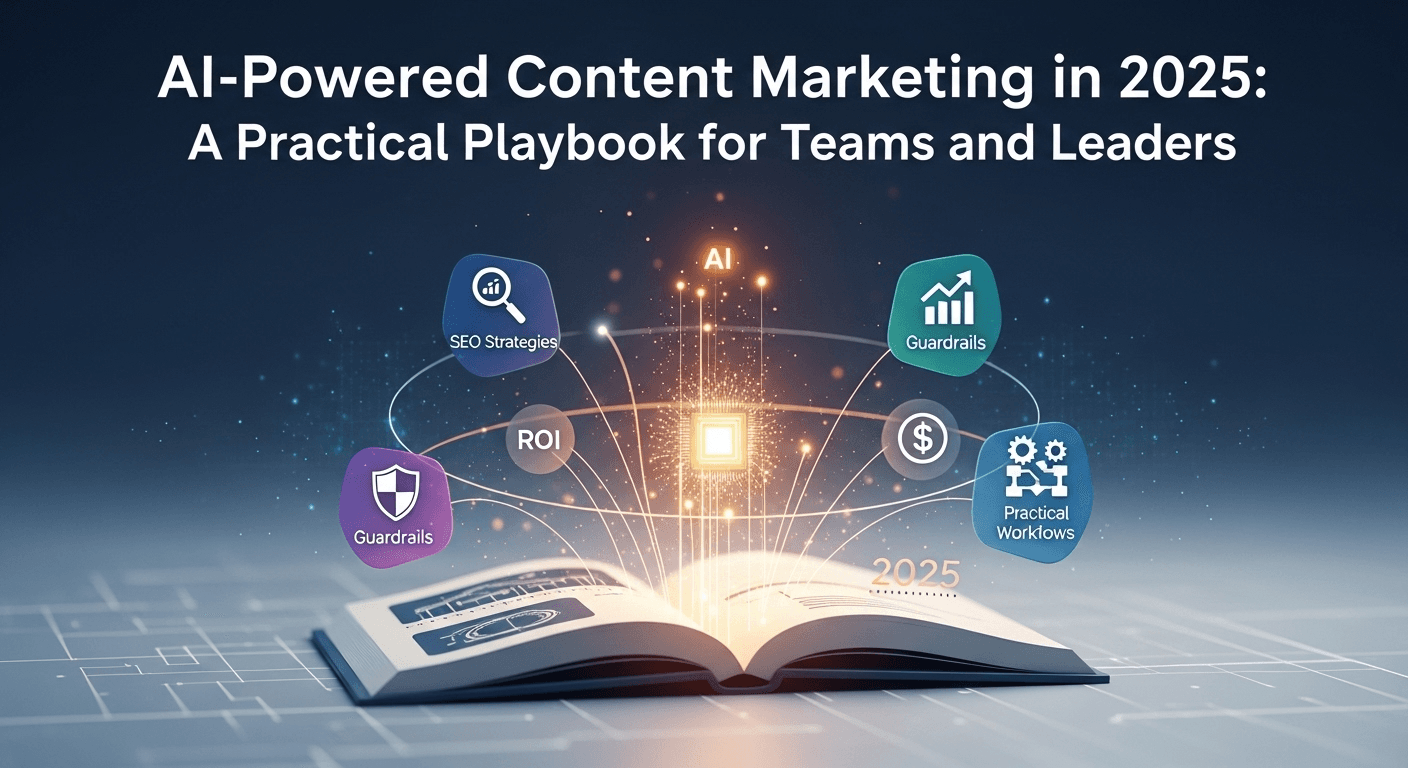
AI-Powered Content Marketing in 2025: A Practical Playbook for Teams and Leaders
AI-Powered Content Marketing in 2025: A Practical Playbook for Teams and Leaders
AI is revolutionizing content planning, creation, distribution, and measurement. Once merely a drafting assistant, AI has evolved into a comprehensive toolkit that encompasses research, production, multimedia, personalization, and analytics. If you are leading marketing initiatives or creating content for a business, 2025 is your year to responsibly operationalize AI and transform experimentation into consistent outcomes.
Why 2025 is a Game-Changer
Three significant shifts mark this pivotal time:
- Model Maturity and Multimodality: Modern AI systems can seamlessly manage text, images, audio, and video within a single workflow. This capability opens the door to comprehensive use cases, from research and briefs to drafts and multimedia content.
- Declining Costs: The cost of inference is continually decreasing, and tools are becoming more effective. Many teams are now utilizing lightweight, domain-specific models for routine tasks.
- Establishing Governance: Standards and guidelines have caught up, facilitating the safe deployment of AI in marketing. For instance, Google Search provides guidance on AI-generated content that emphasizes usefulness and Expertise, Authoritativeness, Trustworthiness (E-E-A-T) rather than the method of production, along with the NIST AI Risk Management Framework for organizational controls (Google Search Central; NIST AI RMF).
As a result, AI has moved beyond being a novelty; it is now a powerful catalyst for enhancing research quality, production speed, personalization, and measurement accuracy. When used effectively, AI enhances speed, quality, and consistency. However, if mismanaged, it may lead to generic content, brand inconsistency, and wasted resources. This playbook will guide you in reaping the benefits while minimizing potential risks.
Current Capabilities of AI in Content Marketing
Strategy and Planning
- Demand and Topic Mapping: Utilize AI to cluster intent-driven topics, align them with the buyer journey, and identify content gaps. Combine AI insights with first-party data to prioritize impactful content.
- Voice and Positioning: Refine or few-shot train models with your most successful content and voice guidelines to generate on-brand outlines and briefs.
- Cross-Functional Alignment: Transform product notes, call transcripts, and sales enablement documents into clear creative briefs and messaging frameworks.
Research and Insights
- Customer Language Mining: Analyze support tickets, sales calls, and community posts to uncover pain points and effective phrasing. Ensure sensitive data is redacted and align with your data policies.
- Competitive and Market Analysis: Generate structured reports from public sources, complete with citations and confidence indicators for human validation.
- Guided SME Interviews: Prepare targeted questions using AI and summarize transcripts into valuable quotes and key takeaways.
Content Creation
- Briefs, Outlines, and First Drafts: AI can expedite initial content development, but a human touch is essential for fact-checking and maintaining brand nuance.
- Microcontent at Scale: Transform a long-form piece into social media posts, email snippets, ad copy variations, and tailored summaries for different platforms.
- Localization: Translate and adapt content for target markets while preserving brand voice and adhering to regulatory requirements.
Multimedia and Creative
- Image and Illustration Generation: Create visuals such as concept art, hero images, and diagrams based on briefs. Always verify licensing terms before publication.
- Audio and Video Support: Generate scripts, voiceovers, video edits, captions, and B-roll storyboards. Clearly disclose the use of synthetic media and ensure compliance with your brand and legal standards. Refer to FTC guidelines on AI claims and disclosure (FTC).
- Emerging Innovations: New tools are enhancing video generation’s accessibility, but it is crucial to maintain rights, safety, and quality controls. Stay informed about vendor policies and indemnification.
Distribution and Personalization
- Channel Optimization: Tailor content length, tone, and structure for each platform while AI generates A/B testing variants and enforces brand guidelines automatically.
- 1-to-1 Messaging: Engage in dynamic email and on-site modules that adapt headlines, examples, and calls-to-action based on user behavior while prioritizing privacy.
- Lifecycle Orchestration: Transform product updates and event recaps into nurturing sequences, webinar invites, and knowledge base updates with consistent messaging.
SEO and Discoverability
- Search-First Structure: Employ AI to create content architectures, internal linking strategies, and schema suggestions, emphasizing helpfulness and originality. Google advocates for high-quality, user-centric content, regardless of production method (Google Search guidance).
- Content Quality Assurance: Automate checks for uniqueness, citations, reading levels, and factual inaccuracies. Direct potentially high-risk claims to human reviewers before publication.
- Optimizing for Answers: Structure content to perform well in snippets, knowledge panels, and other search experiences. Clear headings, concise summaries, and organized answers are essential.
Measuring Impact and ROI
AI should enhance productivity and outcomes without sacrificing quality. Assess both production metrics and business performance:
Production Metrics (Leading Indicators)
- Time to brief and time to first draft
- Revisions per asset and editor acceptance rates
- Brand and compliance pass rates
- Localization cycle times and error rates
Performance Metrics (Lagging Indicators)
- Organic visibility and qualified traffic
- Engagement depth (scroll, time on page, return visits)
- Conversion to leads, opportunities, and influenced revenue
- Content-assisted sales velocity and win rates for relevant deals
Effective Experiment Design
- Define a clear counterfactual. Make comparisons against historical baselines or side-by-side variants.
- Isolate a single variable when feasible (e.g., AI-assisted headlines versus human-only headlines).
- Monitor both efficiency and effectiveness: faster output is meaningless if outcomes decline.
- Implement quality assurance rubrics focusing on factual accuracy, clarity, and user value. Ensure human reviewers are held accountable.
Comprehensive studies indicate that generative AI can significantly boost productivity in specific knowledge tasks when combined with training and proper oversight. For instance, McKinsey estimates that generative AI could contribute trillions in annual economic value across various functions, including marketing, with the greatest benefits arising from its integration into workflows and data systems (McKinsey).
Guardrails: Ensuring Quality, Safety, and Compliance
AI can only be scaled as quickly as it is governed. Establish light but effective controls.
Factuality and Reliability
- Human-in-the-Loop Review: Mandate subject-matter expert or editorial sign-off for claims, expert content, or regulated subjects.
- Retrieval-Augmented Generation: Source answers from your vetted knowledge base, incorporating in-line citations. Prefer systems that highlight both evidence and uncertainty.
- Risk-Based Tiers: Implement more stringent workflows for medical, legal, or financial content compared to general marketing materials.
Brand Voice and Consistency
- Unified Source of Truth: Keep style guides, tone guidance, and reference examples as machine-readable assets utilized in your prompts and templates.
- Automated Quality Checks: Ensure compliance with brand standards by screening for banned phrases, inclusive language, and appropriateness before editorial review.
Privacy and Security
- Data Minimization: Avoid sharing personally identifiable information with external services. Utilize redaction and role-based access strategies.
- Vendor Controls: Opt for enterprise solutions that guarantee data isolation, hold SOC 2 or ISO 27001 certifications, and have clear data retention policies. NIST provides valuable risk management insights (NIST AI RMF).
- Auditability: Maintain detailed logs of prompts, outputs, and approvals for high-risk assets.
Copyright and Licensing
- Usage Rights: Verify licenses for images, fonts, and training data as applicable. Some vendors offer indemnity for enterprise use; review terms carefully (OpenAI Copyright Shield Overview).
- Disclosure: If synthetic voices or generated images are used, disclose this transparently and avoid misleading claims. The FTC has released guidance to ensure AI claims remain truthful and substantiated (FTC).
- Regulatory Awareness: Monitor evolving regulations such as the EU AI Act and platform-specific policies, especially if operating in multiple regions (European Commission Overview).
A Practical Workflow Blueprint
Here’s a repeatable content workflow designed to balance speed and quality:
1) Insight Intake
- Gather inputs from sales, product, support, and research teams. Summarize and categorize themes utilizing AI while ensuring sensitive data is redacted.
- Prioritize topics based on business value, search demand, and distribution alignment.
2) Brief and Outline
- Draft a structured brief detailing audience, goals, angles, key takeaways, sources, and SEO objectives.
- Create an outline with headings, placeholders for evidence, and calls to action. Include internal links and schema recommendations.
3) Draft and Enrich
- Generate a first draft complete with citations and quotes. Include examples, customer stories, and data visualizations. Use your knowledge base for reference where possible.
- Create supplementary assets including images, charts, short clips, and microcontent for social media and email distribution.
4) Review and Govern
- Run automated checks for originality, brand compliance, readability, and factual accuracy.
- Engage in a human editorial review focusing on clarity, accuracy, and usefulness. Include legal review as needed.
- Conduct accessibility checks for alt text, captions, and color contrast in visuals.
5) Publish, Distribute, and Learn
- Publish with structured data. Share variations across channels, accompanied by tailored hooks and calls to action.
- Monitor performance metrics and integrate insights back into the intake process to adjust topics and formats.
Building Blocks for Scaling: Prompts, Templates, and Data
Exceptional output stems from quality inputs. Focus on three key components:
- Prompt Libraries: Maintain a collection of tested prompts for briefs, outlines, drafts, and quality assurance checks. Each should specify roles, audiences, goals, voice rules, constraints, and evaluation criteria.
- Structured Templates: Implement content models for blogs, case studies, landing pages, and emails. Template fields reduce rework and enhance analytics.
- Reliable Data: Ensure generation is powered by verified facts, product specifications, and citations through retrieval-augmented generation, so AI does not make unsupported assumptions.
Whenever possible, ethically connect first-party data, such as CRM segments, intent signals, and product usage events. Ensure data usage is purpose-limited and compliant with privacy standards.
Team Design: Clearly Defined Responsibilities
While AI enhances strategy and creativity, it does not replace them. Effective teams delineate clear roles:
- Content strategists establish goals, prioritize topics, and outline the editorial calendar.
- Editors oversee brand voice, accuracy, and overall quality, approving AI-assisted outputs and guiding the team.
- Creators and SEOs leverage prompts, templates, and tools for drafting, metadata management, and optimization.
- Operations and analytics handle workflow tools, tagging, A/B testing, and performance tracking.
- Data, IT, and legal ensure compliance with privacy and security protocols, aligning with frameworks like NIST AI RMF.
Case Snapshots
Results can vary based on use case, maturity, and governance. Here are some anonymized examples of typical outcomes:
- B2B SaaS Blog Engine: Following the implementation of AI-assisted briefs and outlines, a mid-market SaaS team reduced publishing time by 40% and boosted organic traffic to prioritized pages by 28% within 6 months, facilitated by improved internal linking and consistent structural elements.
- Global Ecommerce Localization: A retailer adopted AI for translation in conjunction with human transcreation and legal review, resulting in a 55% reduction in turnaround time and a 10% decline in returns due to unclear descriptions, attributed to standardized attribute tables and enhanced sizing guides.
- Sales Enablement at Scale: A hardware manufacturer integrated product specifications and FAQs into a retrieval system, allowing AI to generate branded one-pagers and follow-up emails from meeting notes. This led to an 8% improvement in sales cycle time for deals utilizing these new materials.
Your experience may differ, but the underlying theme is a disciplined workflow with human oversight.
Vendor Landscape: Build, Buy, or Blend
The landscape is dynamic and diverse. Align tools with your existing workflow rather than adapting your workflow to fit tools:
- Foundation and Hosted Models: Evaluate text, image, audio, and video solutions for factors such as cost, latency, safety controls, and indemnification.
- Content Platforms: Seek out tools for planning, writing, and optimization that support multi-user workflows, enforce style guidelines, offer retrieval capabilities, and provide analytics.
- Creative Tools: Focus on applications for images, layouts, and video that prioritize brand kits, templates, and rights management.
- Data and Governance Layers: Ensure systems enable PII redaction, data retention, and access controls. Confirm enterprise-level security and auditing capabilities.
Conduct proofs of concept with defined time limits and evaluate against existing KPIs. Prioritize interoperability and the ability to export to avoid lock-in.
90-Day Implementation Roadmap
Days 0-30: Establish the Foundation
- Select 2-3 high-value use cases, such as briefs, first drafts, microcontent, or localization.
- Craft prompts, templates, and a reviewer rubric. Establish baseline KPIs.
- Identify secure tools and outline data handling protocols. Conduct training for your team.
Days 31-60: Pilot Phase
- Execute controlled experiments against clearly defined baselines.
- Implement QA checks and gather editor feedback.
- Refine prompts, templates, and sourcing strategies based on results.
Days 61-90: Scale Up
- Expand to 2-3 additional content types and consider multimedia if governance is established.
- Automate reporting with dashboards for efficiency and performance evaluation.
- Document your playbook and schedule quarterly reviews for continuous enhancements.
Addressing SEO Risks and AI Detection
There is no universal tool for detecting AI-generated content that is officially endorsed by search engines. What matters to search platforms is content quality, originality, and trustworthiness. Google has explicitly asserted that it prioritizes content quality over creation methods. Therefore, your content processes should emphasize accuracy, value, and clear authorship. Avoid publishing generic, unverified content at scale. Focus on providing expertise, experience, and credible citations. Refer to Google’s guidance on helpful content and E-E-A-T (Google Search Central).
Looking Forward: The Upcoming 12 Months
- Greater Multimodality: Anticipate stronger integration of text, images, audio, and video throughout workflows, along with enhanced editing tools.
- Agentic Workflows: Tasks will evolve from sequential prompts to goal-driven flows complete with clearer oversight.
- First-Party Data Advantages: The most successful organizations will leverage AI to harness their proprietary insights while maintaining privacy and security standards.
- Quality Gap Deterioration: As the market becomes flooded with low-effort content, original research, expert interviews, and data-backed storytelling will stand out more than ever.
Conclusion: Making AI Your Editorial Engine, Not Your Autopilot
AI shines when it accelerates human expertise in identifying issues, crafting meaningful narratives, and building trust with customers. Treat AI as an essential tool that enhances research, structure, and scalability, while human editors and experts retain control over judgment and quality. With a well-defined workflow, robust guardrails, and transparent measurement practices, 2025 can mark the year your content program evolves to be faster, smarter, and more beneficial to your audience.
FAQs
Will AI Replace Content Marketers?
No. While AI effectively manages repetitive and structured tasks, strategic thinking, storytelling, and subject expertise are irreplaceable human qualities. The most effective teams leverage AI to enhance research, drafting, and distribution, while editors and experts ensure quality control.
Does Google Penalize AI-Generated Content?
Google does not penalize content simply for being AI-assisted. It assesses the quality and usability of the content. Poorly constructed or low-value content can negatively impact performance regardless of its creation method. Consult Google’s guidance on helpful content (Google).
How Can We Maintain Brand Voice Consistency Across AI Outputs?
Document your brand voice in machine-readable formats and leverage prompts and templates that ensure tone, vocabulary, and structure consistency. Implement automated checks for disallowed phrases and reading levels, requiring editorial approval before publication.
How Can We Minimize Hallucinations and Factual Errors?
Utilize retrieval mechanisms from verified sources, mandate citations for claims, and establish risk-based reviews for accuracy. Flag low-confidence results and involve subject-matter experts before publishing complex or regulated topics.
What About Legal and Privacy Risks?
Implement a data policy that minimizes risk, refrain from sharing PII with external providers, and choose vendors that prioritize robust security and transparent data retention policies. Properly disclose synthetic media, confirm licenses for generated or stock materials, and adhere to guidance from the FTC and NIST (FTC; NIST).
Sources
- Google Search Central: Guidance on AI-Generated Content
- Google Search Central: Creating Helpful, Reliable, People-First Content
- NIST: AI Risk Management Framework
- FTC Business Blog: Keeping AI Claims in Check
- McKinsey: The Economic Potential of Generative AI
- European Commission: Overview of the AI Act
- HubSpot: Guide to AI in Marketing
- Content Marketing Institute: Research Hub
Thank You for Reading this Blog and See You Soon! 🙏 👋
Let's connect 🚀
Latest Insights
Deep dives into AI, Engineering, and the Future of Tech.

I Tried 5 AI Browsers So You Don’t Have To: Here’s What Actually Works in 2025
I explored 5 AI browsers—Chrome Gemini, Edge Copilot, ChatGPT Atlas, Comet, and Dia—to find out what works. Here are insights, advantages, and safety recommendations.
Read Article


