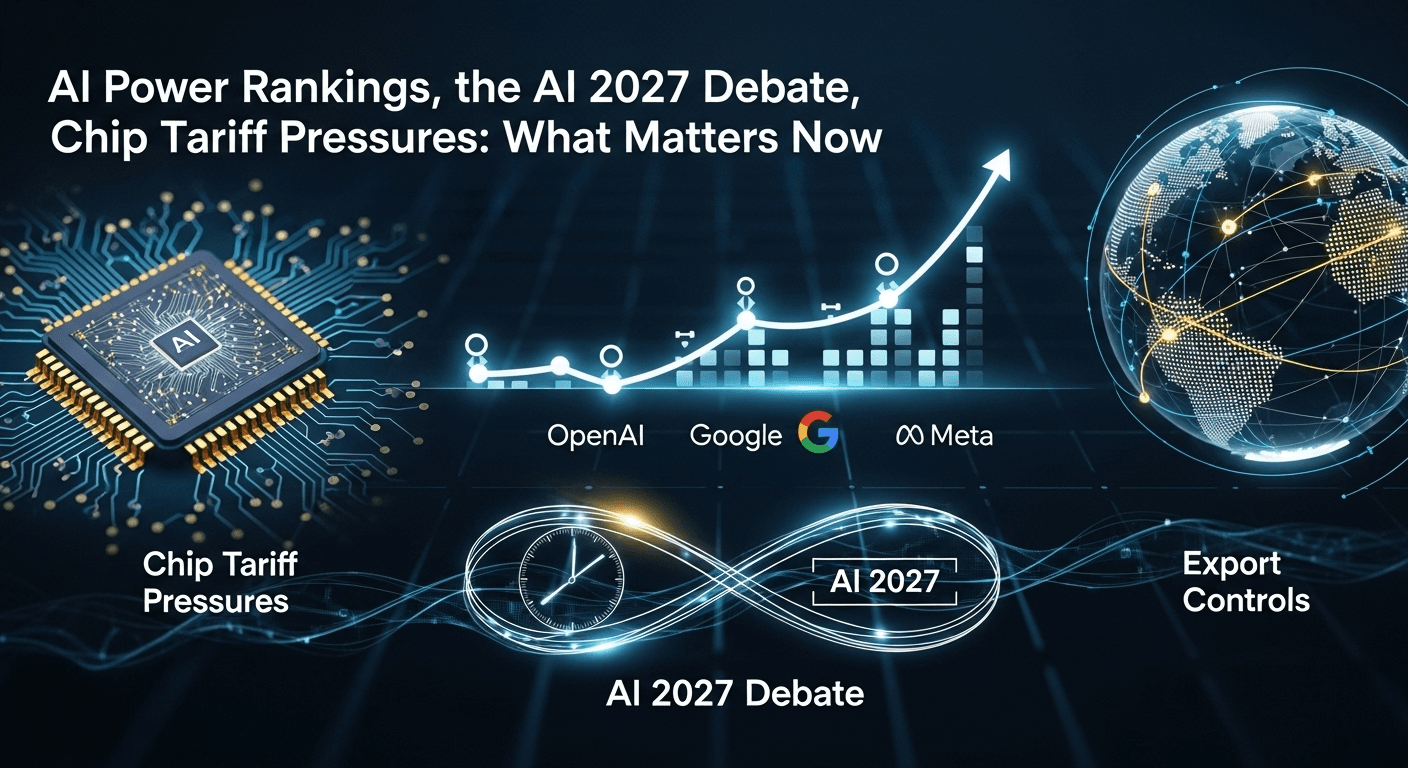
AI Power Rankings, the AI 2027 Debate, and Chip Tariff Pressures: What Matters Now
AI Power Rankings, the AI 2027 Debate, and Chip Tariff Pressures: What Matters Now
As Google, OpenAI, and Meta vie for dominance in rapidly evolving AI leaderboards, a series of forecasts indicates that the coming two to three years could be both transformative and challenging. Meanwhile, semiconductor export controls and tariffs are altering the economics surrounding the chips that fuel modern AI technologies. Here’s what this all means for developers, buyers, and policymakers.
Why the AI Leaderboard Jockeying Matters
With every significant model release from OpenAI, Google, and Meta, evaluations quickly emerge, assessing performances across various benchmarks. The media often declares a new leader, but the truth is more complex: different tests evaluate distinct capabilities, and performance evolves as models undergo fine-tuning or upgrades.
Two complementary scoreboards to keep an eye on include:
- Chatbot Arena – A blind, head-to-head comparison where users vote on their preferred model responses. Utilizing an Elo-style rating, it captures perceived quality across diverse prompts. For more, check the LMSYS team’s methodology and leaderboard context (LMSYS, Arena).
- Task Benchmarks – Standalone exams like MMLU (broad knowledge), GSM8K and MATH (math and reasoning), HellaSwag (commonsense), and MMMU (multimodal understanding). Each benchmark reveals specific capabilities, yet none delivers a comprehensive view (Stanford AI Index 2024).
In late 2023 and 2024, proprietary models from OpenAI and Anthropic have frequently topped preference-based leaderboards, while robust open models from Meta and others are closing the gap, especially in code and retrieval-augmented workflows (LMSYS update; AI Index). Continued advancements in training data, system prompts, and tool functionalities are likely to drive further leaps in performance.
Who is Winning Right Now? It Depends on What You Value
There’s no single model that excels at everything. Enterprises and developers typically prioritize different combinations of quality, latency, cost, and governance.
- General-Purpose Assistants – Leading proprietary models generally excel in open-ended reasoning and creative writing, as reflected in preference-based rankings (Chatbot Arena).
- Structured Reasoning and Code – Specialized models or those with larger context windows can outperform in mathematics, tool usage, and code generation. Improvements in function calling and tool orchestration can exceed minor raw benchmark advantages (AI Index).
- Multimodal Tasks – Image and audio comprehension are now standard, although performance is heavily influenced by prompt strategy, visual resolution, and the model’s integration capability with OCR or external tools (AI Index).
- Open Models – Meta’s Llama family and other powerful open-source releases have emerged as viable options for private deployments, offering advantages in cost control and customization, despite sometimes lagging in preference rankings (AI Index 2024).
The key takeaway is to select the model that best suits your specific use case and constraints. For many production scenarios, a well-prepared, moderately sized model with effective retrieval and safety measures can be more beneficial than the top-ranked model on the leaderboard.
The AI 2027 Debate: Fast Gains, Big Risks
Some influential predictions suggest that AI advancements could accelerate significantly by 2027, with systems nearing or exceeding human-level performance in numerous cognitive and reasoning tasks. This perspective is often referred to as the “AI 2027” thesis.
A key proponent is Leopold Aschenbrenner, whose 2024 essay collection posits that rapid improvements in computational power, algorithmic efficiency, and data utilization could yield transformative capabilities by mid-decade (Situational Awareness). However, he also cautions about potential security and geopolitical threats if advanced models emerge without sufficient safety and access protocols.
Not everyone concurs with this timeline or the associated risks. Independent evaluations highlight concerns related to benchmark overfitting, data deficiencies, and the costs of achieving high-quality model alignment, which could impede progress. The Stanford AI Index 2024 notes notable year-over-year performance gains across various tasks but emphasizes that capabilities are uneven and current evaluations often overlook robustness, safety, and real-world reliability. NIST’s AI Risk Management Framework underscores the importance of systematic, domain-specific evaluations and controls before high-stakes deployments (NIST AI RMF).
Nonetheless, the underlying trend is hard to ignore: rapid advancements in computational power and model quality are accelerating, with adoption rates increasing across industries. Organizations that proactively prepare for swift capability shifts while adhering to rigorous evaluations and governance will be in a stronger position than those who wait for a broader consensus.
Chips, Export Controls, and Tariffs: The Policy Backdrop to AI Progress
All modern AI breakthroughs depend on advanced semiconductors, high-bandwidth memory (HBM), and specialized interconnects. This supply chain is highly concentrated and geopolitically sensitive. Over the past two years, export controls and increased tariffs have significantly impacted the economics and accessibility of these essential components.
Export Controls and License Limits
- Since October 2022, the U.S. has reinforced export restrictions on advanced AI chips and semiconductor manufacturing equipment to China, with further updates in October 2023 and 2024 aimed at tightening rules and clarifying performance thresholds (U.S. BIS Press Release).
- The Netherlands has imposed restrictions on certain ASML exports of advanced lithography tools to China, further limiting access to cutting-edge chipmaking technology (Reuters).
Tariffs and Near-Term Price Pressure
- In May 2024, the White House announced increased Section 301 tariffs on various Chinese imports, including a planned rise on semiconductors to 50 percent by 2025 (White House Fact Sheet).
- These initiatives, coupled with a surge in demand for HBM from AI accelerators, have induced persistent cost and lead-time pressures across cloud providers and on-premise buyers (Reuters on HBM Demand).
What It Means for AI Builders
- Availability and Pricing – The availability of cloud GPUs may vary, and usage-based pricing could fluctuate as supply and policy dynamics change. Adopting multi-cloud strategies and maintaining flexible model portfolios can help mitigate risks (AWS Bedrock Pricing; Google Vertex AI Pricing; Azure OpenAI Pricing).
- On-Prem and Edge – Open models fine-tuned for smaller accelerators or CPUs can diminish dependence on scarce, high-end GPUs, especially for applications sensitive to latency or privacy concerns (AI Index).
- Compliance – Organizations operating internationally must stay informed about export control scopes, engineering workarounds, and partner compliance. CSET offers valuable resources on compute governance and control frameworks (CSET Research).
The State of Play: OpenAI, Google, Meta
Here’s an overview of how the big three players stack up, based on public reports and evaluations through late 2024.
OpenAI
- Strengths – High preference ratings in general chat and multimodal assistance, extensive ecosystem integrations, and robust tool application patterns in coding and data tasks (Chatbot Arena).
- Considerations – Costs and rate limits for extensive workloads; while enterprise controls have improved, careful configuration is crucial, particularly for sensitive data (AI Index).
- Strengths – Strong capabilities in long-context reasoning and multimodal functions integrated with Google’s search, Workspace, and Vertex AI tools. Extended context can enhance retrieval-augmented generation flows and document automation (AI Index).
- Considerations – Performance may vary by task; optimal value is gained by pairing models with effective retrieval strategies and routing mechanisms.
Meta
- Strengths – High-quality open models that are easily fine-tuned and deployed privately. They are especially attractive for cost-efficiency, reduced latency, and data residency (AI Index).
- Considerations – In certain areas like creative writing or intricate reasoning, leading proprietary models may still outperform in preference testing; careful assessment is critical in safety-sensitive situations.
Beyond the big three, companies like Anthropic, Cohere, and others remain competitive, particularly in domains requiring enterprise safety and retrieval-augmented solutions (AI Index).
Benchmarks Are Helpful, but Real-World Evaluation Wins
Public leaderboards can serve as a starting point, but production teams should develop their own evaluation sets tailored to business objectives.
What to Measure
- Task Accuracy – Conduct structured assessments on representative prompts and documents rather than relying solely on generic public benchmarks.
- Reliability – Track rates of inaccuracies, failures to comply with instructions, and inconsistencies resulting from minor changes in prompts.
- Latency and Cost – Analyze end-to-end time and costs per task, factoring in retrieval, function calls, and post-processing expenses.
- Safety and Compliance – Assess risks including biases, privacy breaches, and adherence to internal policies and regulations. The NIST AI RMF provides a practical framework (NIST AI RMF).
How to Evaluate
- Develop and maintain a dynamic test suite, version-controlled for consistency.
- Compare multiple models via the same API, adjusting based on quality and cost metrics.
- Involve human oversight for critical decisions.
- Log prompts and outputs with attention to privacy safeguards to facilitate rapid error analysis and regression testing.
Three Scenarios for the Next 24 Months
1) Steady Climb
Models achieve steady, incremental improvements, tool usage and long-context capabilities enhance, and costs decrease as supply aligns with demand. Enterprises scale narrow, measurable applications, with governance practices becoming standardized across various sectors. This scenario aligns with cautious interpretations of recent technological trends (AI Index).
2) Fast Break
Increased algorithmic efficiency and innovative training strategies facilitate significant advancements in reasoning and autonomy. Demand for computational resources may outstrip supply, despite the addition of new fabs and HBM production. Security and misuse concerns grow, leading to tighter access controls or licensing requirements (Situational Awareness; CSET Analysis).
3) Speed Bumps
High-profile failures or legal constraints may hinder deployment efforts. Costs and tariffs could strain infrastructure availability, prompting a transition toward improved retrieval and workflows rather than prioritizing the development of larger foundational models. Standards such as the NIST AI RMF and sector-specific regulations may act as gatekeepers for scalability (NIST AI RMF).
What Leaders Should Do Now
- Run a Multi-Model Portfolio – Evaluate at least one leading proprietary model alongside a strong open model for each use case. Adjust deployments based on task requirements, costs, and latency.
- Invest in Retrieval and Workflow – Prioritize high-quality RAG, tool orchestration, and evaluative measures, which may yield greater returns compared to merely switching models.
- Instrument for Quality and Safety – Create metrics to monitor accuracy, reliability, and risks, linking them to business KPIs.
- Hedge Infrastructure Risks – Utilize multi-cloud strategies and spot capacity where feasible, preparing for hardware lead times. Consider on-premises solutions when latency, privacy, or cost-effectiveness necessitate it.
- Track Policy and Compliance – Stay informed regarding export controls, tariffs, and specific sector regulations, which can significantly affect costs and permissible deployments. Allocate responsibilities and revise strategies quarterly.
Conclusion
AI leaderboards will continue to evolve, and projections about 2027 will remain contentious. What is evident is that computing economics and policy have become intertwined with AI capability and access. Organizations that couple careful evaluations with pragmatic adjustments in chips, clouds, and models will be well-prepared for rapid advancements while avoiding excessive commitments if the pace of progress slows. In uncertain times, disciplined experimentation is the best path forward.
FAQs
Are public AI leaderboards reliable for enterprise decisions?
While they offer useful insights, they shouldn’t be relied on exclusively. Use them as a starting point to shortlist models, but conduct your own assessments on representative data sets and tasks, as preference-based rankings do not capture domain-specific accuracy, latency, or safety requirements.
What is the AI 2027 thesis in simple terms?
It posits that AI may reach broadly human-level performance in various cognitive tasks by approximately 2027, thanks to rapid advancements in computing, algorithms, and data efficiency. Advocates see it as a pathway to enhanced productivity and autonomy, while skeptics highlight issues like data limitations and robustness. Both sides agree that improved evaluations and governance are vital.
Will chip tariffs significantly increase AI costs?
While tariffs and export controls can impact pricing and availability, the effect will vary based on your choice between cloud and on-prem solutions, model sizes, and geography. Multi-cloud strategies, open models, and optimized workflows can help mitigate some cost increases.
Should I prioritize the newest model or better retrieval and tooling?
For most production applications, enhancing retrieval, context, and tool orchestration typically provides more value than switching to a slightly superior base model. Focus on comprehensive quality and dependability.
How do export controls affect my AI deployments?
If your business operates in multiple regions, export controls can influence the availability of certain chips and services, as well as what can be exported. Collaborate with legal and compliance teams, stay updated on regulatory changes, and design with adaptable deployment strategies.
Sources
- LMSYS Chatbot Arena Methodology
- Chatbot Arena Leaderboard
- Stanford AI Index 2024
- NIST AI Risk Management Framework
- Situational Awareness by Leopold Aschenbrenner
- White House Fact Sheet on 2024 Tariff Actions
- U.S. BIS Press Release on 2023 Advanced Computing Export Controls
- Reuters: Some ASML Exports to China Blocked
- Reuters: HBM Chips and AI Demand
- AWS Bedrock Pricing
- Google Cloud Vertex AI Pricing
- Azure OpenAI Service Pricing
- CSET Research Library on AI Policy
Thank You for Reading this Blog and See You Soon! 🙏 👋
Let's connect 🚀
Latest Insights
Deep dives into AI, Engineering, and the Future of Tech.
I Tried 5 AI Browsers So You Don’t Have To: Here’s What Actually Works in 2025
I explored 5 AI browsers—Chrome Gemini, Edge Copilot, ChatGPT Atlas, Comet, and Dia—to find out what works. Here are insights, advantages, and safety recommendations.
Read Article


