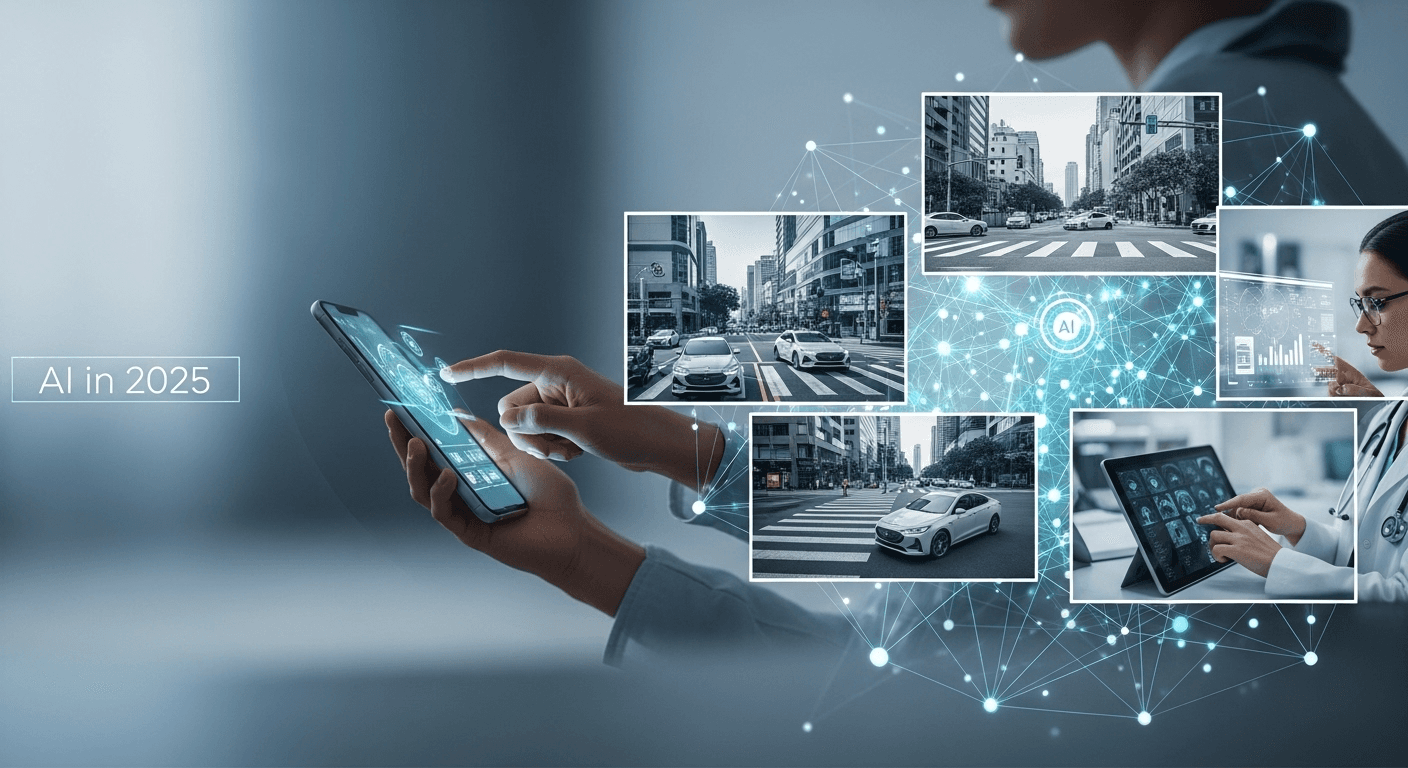
AI in 2025: The Quiet Revolution Reshaping Everyday Life
AI in 2025: The Quiet Revolution Reshaping Everyday Life
In 2025, artificial intelligence feels more like an integral part of daily life rather than something out of a science fiction novel. From your phone drafting emails and your car preventing collisions to your bank detecting suspicious charges and an ever-patient tutor helping you learn, the most significant AI changes are not just about machine capabilities but how seamlessly they operate in the background.
What Changed Between 2023 and 2025
AI has transitioned from attention-grabbing demonstrations to essential infrastructure in everyday use. Several key trends played a role in this evolution:
- Smarter Foundation Models: Advanced models have become increasingly precise, capable of understanding multiple modalities and contexts. This improvement contributes to real-world reliability in tasks like summarization, coding, and reasoning, as highlighted by the Stanford AI Index 2024.
- On-Device AI: Enhanced privacy and speed have been achieved as phones and laptops now run potent models locally, as seen in developments like Apple Intelligence in 2024 and Google Gemini’s on-device features, decreasing reliance on the cloud.
- AI Copilots Everywhere: From office suites to design applications, AI copilots have become the norm. Early findings show notable productivity improvements in coding and knowledge work—developers reported a 55% increase in task completion speed when using Copilot, with follow-up studies extending into 2023-2024 (GitHub).
- Regulatory Guardrails: Governments have shifted from theoretical principles to concrete policies. The EU implemented the AI Act in 2024, while the U.S. introduced Executive Order 14110 in 2023, with the NIST AI Risk Management Framework serving as a common reference.
- Compute and Efficiency: New chip technologies and inference optimizations have reduced costs and energy consumption per task. However, the IEA alerts us that data center power demand, including AI, may double by 2026, driving a push for greener AI solutions.
Where AI is Quietly Changing Your Life
1) Work: From Busywork to Co-Creation
As of 2025, AI is woven into virtually every digital interaction. It creates presentations, summarizes meeting notes, parses your company’s wiki into simple language, and transforms vague prompts into structured drafts. While workflows remain human-centric, AI alleviates many initial and final tasks.
- Productivity Assistants: Office productivity tools now come equipped with AI copilots that draft emails, summarize discussions, and formulate outlines. Early studies suggest considerable improvements for routine tasks, notably for less experienced users (NBER Working Paper on GPT-4 with consultants, 2023).
- Software Development: Code assistants recommend functions, generate tests, and refactor code snippets. Developers report a faster work pace and fewer context switches; however, thorough review and testing are still crucial (GitHub Research).
- Customer Support: AI efficiently triages tickets, prepares replies, and enhances self-service capabilities. Human agents still address complex cases requiring empathy and final approvals.
- Research and Analysis: Knowledge workers utilize AI for literature reviews and data analysis, achieving optimal outcomes when human oversight is applied for fact-checking and contextualization, per the NIST AI RMF’s guidance on human-in-the-loop practices.
On a broader scale, McKinsey estimates that generative AI could contribute trillions of dollars in annual economic value across sectors like marketing, sales, operations, and software engineering (McKinsey, 2023).
2) Health: Diagnostics, Triage, and Paperwork
In healthcare, AI operates as a supportive tool rather than a replacement for doctors, focusing on decision assistance. Algorithms identify anomalies in imaging, draft clinical notes, and predict patient risk.
- Imaging AI: Algorithms in fields like radiology and cardiology help detect fractures, lung nodules, and arrhythmias. The U.S. FDA has cleared numerous AI-enabled medical devices, particularly in imaging (FDA AI/ML SaMD).
- Clinical Documentation: Ambient scribe tools convert conversations into structured notes, alleviating clinician burnout and allowing more time for patient interaction.
- Guidance and Guardrails: The WHO emphasizes the need for careful validation, transparency, and human oversight in using generative AI in healthcare (WHO, 2023).
The focus is on augmentation rather than automation, with clinicians retaining accountability while AI handles repetitive and pattern-heavy tasks.
3) Money: Faster Service and Sharper Fraud Detection
Financial AI continuously monitors for anomalies, making digital banking experiences increasingly personalized.
- Fraud and Risk: Real-time models identify unusual transactions and synthetic identities more effectively than traditional rule-based systems, leading to improved detection rates and fewer false positives.
- Personalized Support: AI chat in banking apps addresses common queries, clarifies statements, and directs complex issues to human representatives.
- Operations: Document intelligence extracts data from forms and contracts, significantly reducing processing times and operational costs.
In banking, generative AI could contribute hundreds of billions in annual value through enhanced sales, productivity, and risk management decisions (McKinsey, 2023).
4) Learning: Tutors That Scale
In 2025, AI tutors provide explanations, quizzes, and adjust to individual learning paces. While they may not replace traditional teachers, they serve as instant feedback tools that, when combined with quality curricula and human guidance, enhance learning outcomes.
- Personalized Practice: Students benefit from targeted hints and customized exercises. For instance, Khan Academy’s Khanmigo is designed to support reasoning skills and encourage active thinking (Khan Academy).
- Early Evidence: The AI Index 2024 highlights studies showing significant improvements in writing, coding, and problem-solving when students leverage AI for drafting and feedback, especially among beginners.
- Teacher Time: AI assists in grading drafts, crafting rubrics, and tailoring instruction, freeing educators to focus on more valuable interactions with students.
It’s crucial for students to receive guidance on effectively utilizing AI, including citation practices and accuracy checks.
5) Transportation: Safer Assists and Gradual Autonomy
Improvements in driver assistance features have been noticeable, while fully autonomous driving is being cautiously rolled out.
- Advanced Driver Assistance: Features such as automatic emergency braking and lane-keeping substantially lower the risk of accidents. Research from IIHS indicates that front crash prevention can reduce rear-end collisions by 50% in vehicles equipped with forward collision warnings and AEB (IIHS).
- Robotaxis in Limited Zones: Companies like Waymo are expanding their services in select cities, adhering to strict safety protocols and monitoring safety metrics. NHTSA oversees recalls and investigations for automated systems (NHTSA).
- Augmented Navigation: Features such as live translation, traffic prediction, and contextual alerts enhance user experience and improve fuel efficiency through optimized routing.
The net result is a safer driving experience, incremental advancements toward autonomy, and a focus on maintaining driver attention and clear transitions between automated and manual control.
6) At Home: Smarter Assistants and Increased Privacy
In smart homes, AI is becoming more intuitive, processing more requests directly on-device.
- Natural Conversations: Smart assistants can better maintain context during interactions, compile to-do lists, and connect with calendars and devices more seamlessly.
- On-Device Processing: Features like local speech recognition enhance privacy by keeping data on the user’s device. Both Apple and Google are emphasizing this local AI capability in their 2024 offerings for enhanced privacy and responsiveness.
- Energy and Security: Home systems can learn user habits to minimize energy waste and detect unusual behaviors through cameras and sensors, alerting homeowners only when necessary.
What Is Different About This AI Wave
Unlike previous automation trends, generative AI allows the creation of compelling text, images, and code from simple prompts. This shift alters not only the speed of work but also who can accomplish certain tasks.
- Natural Language is the Interface: Instead of learning complex menus and macros, users can describe their goals in plain English, making it more accessible to a broader audience while also increasing the risk of confidently incorrect outputs.
- Frontier Capabilities Made Mainstream: While the underlying AI models are sophisticated, they manifest as helpful features in familiar tools.
- Human Strengths are Elevated: Skills like critical thinking, domain knowledge, taste, and ethics are becoming more crucial as AI becomes widely accessible.
Risks and How to Manage Them
AI in 2025 is both beneficial and flawed. Understanding its limitations can make its use safer.
- Hallucinations and Errors: Language models can generate inaccurate information. It’s vital to use citations, verify facts against authoritative sources, and maintain human oversight, consistent with the NIST AI RMF.
- Bias and Fairness: AI models may propagate biases present in their training data. The EU AI Act requires proportional risk assessments and transparency obligations.
- Privacy and Security: Sensitive data should be managed with minimal collection practices, robust access controls, and transparent retention policies. U.S. Executive Order 14110 advocates for protective measures against data misuse in high-risk AI applications.
- Deepfakes and Trust: Standards like C2PA aim to clarify content origins through verifiable metadata. Expect watermarks and provenance labels to become standard in 2025.
- Energy Use: The growth of AI workloads contributes to increased energy consumption in data centers. The IEA projects that power demand from data centers, including AI, could double by 2026, necessitating a focus on efficiency and sustainable energy sources.
How to Get Value from AI Right Now
Here are practical steps to harness AI’s benefits while minimizing risks:
- Start with Low-Stakes Tasks: Use AI for drafting emails, summarizing lengthy documents, or brainstorming outlines. Validate outputs before sharing.
- Build AI Hygiene: Keep sensitive data private by avoiding unapproved tools and enabling privacy controls. Document AI-generated content and verify it as needed.
- Upgrade Prompts into Processes: Transform useful prompts into checklists or templates, adding clear instructions regarding tone, structure, and sourcing.
- Invest in Skills: Enhance knowledge in prompt design, critical analysis, data literacy, and domain-specific AI tools—these skills can dramatically boost your career.
- Measure Outcomes: Track time savings, quality metrics, and error rates to identify where AI is most effective.
What 2025 Means for the Next Few Years
We can anticipate steady enhancements over abrupt transformations. Expect:
- Improved Reasoning and Tool Utilization: AI models will increasingly integrate external tools and databases to mitigate inaccuracies.
- Personal AI That Travels With You: Personalized, secure AI models capable of remembering user preferences across devices while maintaining privacy.
- Industry Copilots: Specialized assistants tailored for industries like law, healthcare, engineering, and finance, featuring tested reliability and compliance.
- Greener AI: Development of more efficient architectures, low-bit inference models, and data centers powered by renewable energy sources.
- Clearer Regulations: With frameworks like the EU AI Act, U.S. Executive Order 14110, and the NIST RMF, organizations can navigate shared risk standards. Anticipate more sector-specific guidance and audits.
In essence, 2025 marks the moment AI became an everyday necessity. The most successful outcomes arise from pairing these tools with human judgment, quality data, and meaningful safeguards.
Frequently Asked Questions
Is AI Really Changing Everyday Life, or Is This Just Hype?
AI is subtly transforming daily experiences through improvements in autocomplete functionality, quicker customer service, enhanced fraud detection, and better safety features in vehicles. Productivity studies and industry benchmarks indicate significant gains, particularly for routine tasks (GitHub; NBER; AI Index 2024).
What Are the Biggest Risks I Should Watch For?
Potential risks include inaccuracies (hallucinations), privacy breaches, biased outputs, and over-reliance on AI. Utilize AI for drafting and brainstorming while verifying facts, safeguarding sensitive information, and retaining human oversight, in alignment with the NIST AI RMF.
How Can My Business Adopt AI Responsibly?
Begin with a thorough risk assessment, pinpoint low-risk use cases that provide clear ROI, apply data minimization techniques and implement access controls, ensuring human review and monitoring. Align practices with frameworks like the NIST AI RMF and stay updated on regulations such as the EU AI Act.
Will AI Replace My Job?
AI automates tasks but does not eliminate entire positions. Job roles will evolve to emphasize judgment, collaboration, and specialized knowledge. Those who adapt to working alongside AI often see productivity increases, as supported by multiple studies (NBER; GitHub).
Is AI Safe in Healthcare and Transportation?
AI can enhance safety and results when implemented with appropriate oversight and validation processes. Regulatory bodies approve certain medical devices post-review (FDA), and driver-assistance technologies are monitored by agencies like NHTSA. Human accountability remains key.
Sources
- Stanford AI Index Report 2024
- GitHub – Research on Copilot Productivity
- NBER Working Paper – Experimental Evidence on GPT-4 and Knowledge Work (2023)
- McKinsey – Economic Potential of Generative AI (2023)
- McKinsey – Generative AI in Banking (2023)
- European Union – AI Act
- U.S. Executive Order 14110 on AI (2023)
- NIST AI Risk Management Framework
- International Energy Agency – Electricity 2024
- U.S. FDA – AI/ML-Enabled Medical Devices
- WHO – Guidance on Generative AI in Health (2023)
- IIHS – Front Crash Prevention Study
- NHTSA – Automated Vehicles Safety
- Khan Academy – Khanmigo Overview
- C2PA – Content Provenance and Authenticity
Thank You for Reading this Blog and See You Soon! 🙏 👋
Let's connect 🚀
Latest Insights
Deep dives into AI, Engineering, and the Future of Tech.
I Tried 5 AI Browsers So You Don’t Have To: Here’s What Actually Works in 2025
I explored 5 AI browsers—Chrome Gemini, Edge Copilot, ChatGPT Atlas, Comet, and Dia—to find out what works. Here are insights, advantages, and safety recommendations.
Read Article


