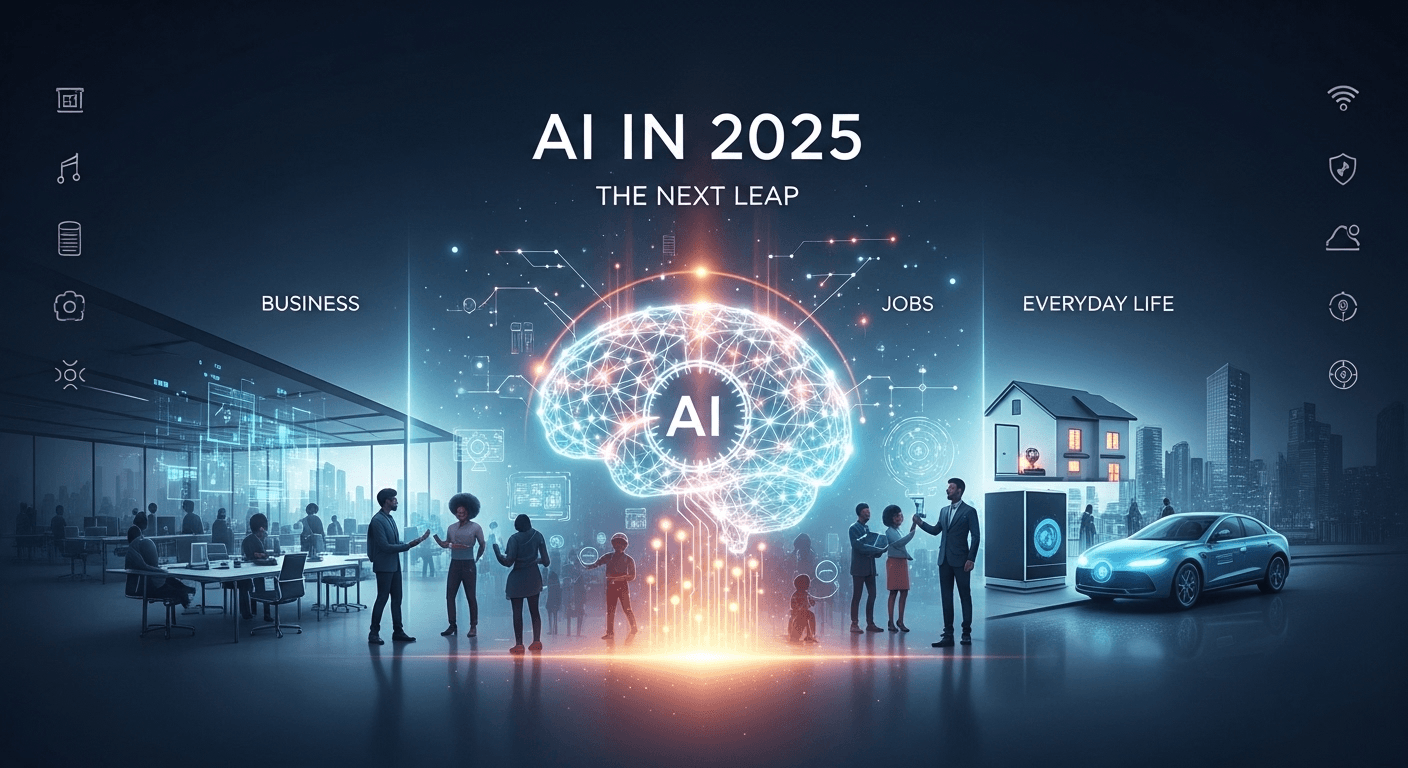
AI in 2025: The Next Leap for Business, Jobs, and Everyday Life
In 2024, artificial intelligence transitioned from a novelty to an essential tool. By 2025, AI is set to become the underlying infrastructure, seamlessly integrated into our devices, workflows, and daily lives. The crucial question is no longer whether AI matters, but rather how we can use it responsibly and profitably without falling behind.
This guide summarizes the imminent changes, their significance, and actionable steps for today. It maintains the essence of the original topic while updating the information with reliable, up-to-date sources.
Why 2025 Is A Turning Point For AI
Several shifts converge to make 2025 a pivotal year for artificial intelligence:
- Multimodal AI goes mainstream. AI models that can understand text, images, audio, and video are becoming standard in both consumer and corporate tools. This will lead to more natural interactions and enhanced automation. Examples include Google’s Gemini (Google) and OpenAI’s GPT-4o designed for real-time voice and vision interaction (OpenAI).
- On-device intelligence reduces latency and risk. New laptops and smartphones now feature neural processing units (NPUs) that can execute many AI tasks locally, thus improving speed and ensuring privacy. Examples include Microsoft’s Copilot+ PCs (Microsoft) and Apple’s Intelligence features, which are designed for on-device processing whenever feasible (Apple).
- Clearer regulations are being implemented. The EU’s AI Act came into effect in 2024, with its obligations starting in 2025. This framework introduces risk tiers and mandates transparency for AI deployments (European Commission). In the U.S., a 2023 Executive Order and subsequent guidance emphasize safety, transparency, and civil rights protections (White House).
- Measurable productivity and value are evident. Independent research indicates significant performance improvements from AI copilots. McKinsey estimates that generative AI could contribute between 2.6 to 4.4 trillion dollars annually across various sectors, highlighting its substantial automation potential for knowledge work (McKinsey). Trials also showcase significant efficiency gains for analysts, support agents, and engineers (NBER; Science; GitHub).
How AI Is Transforming Business In 2025
For many organizations, advancements in AI in 2025 are more about practical integration than flashy innovations. The most significant benefits arise from embedding AI into existing systems to enhance quality, shorten cycle times, and decrease costs.
Where Value Is Emerging First
- Customer service and sales. Generative AI is adept at drafting responses, summarizing cases, and recommending the next best actions. Teams are experiencing faster response times and a more consistent tone, especially when tools are synchronized with CRM data. Controlled trials have shown improved performances among less experienced agents, helping to close skill gaps (NBER).
- Marketing and content operations. AI accelerates briefs, ideation, and localization while ensuring brand standards are maintained. Features like Content Credentials help identify AI-assisted assets for improved transparency (Content Credentials).
- Software development. Code copilots aid in proposing functions, crafting tests, and elucidating codebases, reducing mundane tasks and simplifying onboarding. Studies have reported quicker task completion and less cognitive burden when developers use copilots alongside code reviews and thorough testing (GitHub).
- Finance and legal workflows. AI assists in variance analysis, reconciliations, and document reviews, retaining its role as a copilot rather than a fully autonomous agent due to the need for accuracy, explainability, and regulatory compliance. Retrieval-augmented generation (RAG) against vetted knowledge bases enhances reliability (RAG paper).
- Operations and supply chain. AI enhances demand forecasting, routing, and inventory management through multimodal signals and simulations. It aids in scenario-testing for disruptions and recommending mitigation strategies, with humans retaining the final decision-making responsibility.
- Cybersecurity. AI assists in triaging alerts, correlating signals, and drafting incident summaries. As attackers also adopt AI, defenders employ secure-by-design strategies and model red teaming to maintain an advantage (NCSC/CISA).
From Pilots to Scalable Platform Capabilities
Leading organizations are shifting from isolated pilot projects to platform patterns that can scale:
- Multimodal copilots integrated with business systems. Chat-based and voice interfaces that can interpret documents, charts, and screens minimize context switching and reduce training time.
- RAG + tools. Combining models with authorized knowledge sources and tools (search, CRM, ticketing, calculators) ensures answers are based on current data while logging every action.
- On-device and edge AI. Running sensitive tasks locally reduces latency and mitigates data exposure, particularly for regulated sectors. NPUs in new laptops and smartphones facilitate this at scale (Microsoft).
- Content provenance and auditing. Adopting standards like C2PA helps in attaching tamper-evident metadata for compliance attestation (C2PA).
Measurable Outcomes to Aim For
- Reduced cycle times for case resolutions, releases, and approvals.
- Higher first-touch resolution rates and improved customer satisfaction.
- Minimized manual rework through better drafts and testing.
- Enhanced employee experience by automating low-value tasks.
- Improved compliance evidence through logging and transparency.
McKinsey’s recent State of AI survey reveals increased adoption beyond pilot projects, with top companies capturing bottom-line impacts while investing in risk management and workforce training (McKinsey).
Work And Jobs: Changes and Continuities
AI is more likely to change individual tasks than eliminate entire jobs. In the near term, the trend is one of augmentation, where people leverage AI to manage aspects of their workflows while retaining human oversight and accountability.
Insights from the Evidence
- Task automation is varied. Generative AI has significantly transformed clerical and routine tasks that involve text but has less impact on roles requiring physical skills or intricate interpersonal interactions. The International Labour Organization notes that most jobs are expected to change rather than disappear, although clerical positions are more susceptible to disruption (ILO).
- Productivity gains are tangible but task-specific. Field research has demonstrated considerable improvements in writing and brainstorming tasks, while tasks demanding cutting-edge domain expertise without constraints may show smaller or even negative effects (Science).
- Skills will increasingly focus on AI fluency. Emerging roles like AI product manager, data engineer, ML operations, model risk manager, and AI auditor are on the rise. Proficiency in prompting is evolving into a broader skill set that involves discerning when, how, and whether to use AI for specific tasks.
Practical Guidance for Individuals
- Explore your toolset: experiment with a code copilot, document assistant, and data analysis tool on real projects, treating them like interns who improve with context and guidance.
- Enhance your judgment: corroborate information with sources, create checklists, and incorporate a human review step for critical decisions.
- Develop sustainable skills: focus on data literacy, prompt design, basic scripting, and understanding the distinctions between RAG and fine-tuning.
- Track your impact: document saved time, quality improvements, and errors identified to showcase ROI and inform better usage patterns.
Practical Guidance for Leaders
- Focus on tasks, not job titles: pinpoint high-friction tasks that AI can assist with, then redesign roles and performance metrics accordingly.
- Invest in change management: link tools with relevant training, establish communities of practice, and create incentives that promote safe adoption of AI technologies.
- Set clear guardrails: define acceptable data usage, review protocols, and escalation procedures. Align with established risk frameworks like NIST AI RMF (NIST).
- Measure meaningful outcomes: monitor cycle time, quality, compliance, and employee sentiment while avoiding superficial metrics like the quantity of prompts generated.
Everyday Life: AI Becomes More Helpful and Less Obtrusive
By 2025, AI will be increasingly personalized, contextual, and framed with privacy in mind. Here’s what to expect:
- Enhanced assistants. Voice-first and multimodal supports that can view your screen, comprehend documents, and take actions like scheduling or summarizing meetings are on the rise. Models like GPT-4o and Gemini enable real-time, low-latency interactions (OpenAI; Google).
- On-device privacy. Many routine tasks, from transcription to image editing, will begin to run locally on NPUs, keeping sensitive data off the cloud whenever feasible (Apple).
- Accessibility enhancements. Features like live translation, captioning, and image descriptions will create more inclusive environments for those with disabilities and in multilingual settings. The WHO supports AI for health and accessibility with rigorous governance (WHO).
- Safer content ecosystems. Watermarking and content credentials will help distinguish AI-generated media and trace its origins, reducing the potential for misinformation (C2PA).
Safety, Governance, and Trust
As AI takes on more critical roles, building trust becomes essential. Organizations need to integrate risk management throughout the AI lifecycle instead of treating it as an afterthought.
Key Regulations and Standards to Watch
- EU AI Act. Implements risk-based obligations, imposing stricter conditions on high-risk systems and transparency requirements for generative models. Phased implementation begins in 2025 (European Commission).
- U.S. Executive Order and agency guidelines. Focus on safety assessments, watermarking, and civil rights protections for federal AI applications (White House).
- NIST AI Risk Management Framework. A vendor-agnostic guide to govern AI through its lifecycle, encompassing risk assessment, measurement, and ongoing performance monitoring (NIST).
- Secure AI development guidance. Best practices for threat modeling, supply chain security, and model fortification from the UK’s NCSC and the US CISA (NCSC/CISA).
Copyright, Data, and Transparency
- Copyright. In many jurisdictions, works produced solely by AI lack copyright protection. In the US, the Copyright Office mandates the disclosure of AI assistance during registration and affirms that only human-authored elements are eligible for copyright (USCO).
- Training data and litigation. Ongoing lawsuits concerning the use of copyrighted material for AI training remain unresolved in several jurisdictions, highlighting the need for robust provenance and licensing strategies (Reuters).
- Data governance. Treat prompts, outputs, and logs as confidential data. Implement data loss prevention measures, limit data retention, and separate development and production environments.
- Content provenance. Utilize C2PA Content Credentials to signify generated media and bolster consumer trust (Content Credentials).
The Technology Behind the Moment, Explained Simply
Understanding the fundamentals helps you make informed decisions about tools and risks.
- Large language models (LLMs). These models predict the next token in a sequence, capable of generating text, code, and summaries. Multimodal LLMs also interpret images, audio, and video.
- Retrieval-augmented generation (RAG). Before generating answers, the model retrieves relevant information from an approved knowledge base and cites it, enhancing accuracy and timeliness (RAG paper).
- Tool use and agents. Models can engage tools such as search engines, calculators, or enterprise applications. Cumulatively used tools with memory can create agents capable of performing multi-step tasks with oversight.
- Fine-tuning vs adapters. Fine-tuning customizes a model using your data; lighter adapters and prompt engineering may suffice for many tasks and are often less resource-intensive.
- Edge and on-device AI. Executing models locally minimizes latency and risk for sensitive data, supported by NPUs in contemporary devices (Microsoft; Apple).
Limitations to Consider
- Hallucinations. Models may produce confident but erroneous outputs. Employ RAG, citations, and human oversight for critical assignments.
- Contextual limitations. Longer documents and intricate projects may necessitate chunking and structured approaches.
- Cost and latency. API usage can incur expenses. On-device and hybrid setups can help manage costs and improve responsiveness.
- Security. Prompt injection and data exfiltration are genuine threats. Adhere to secure-by-design practices and routinely evaluate models against threats (NCSC/CISA).
A 90-Day Playbook for Moving from Hype to Action
Whether you are leading a team or operating a small enterprise, this straightforward plan assists you in advancing quickly without sacrificing quality.
Days 1-30: Discover and Minimize Risks
- Select 3 to 5 high-friction tasks with clear outcomes, such as managing support emails, summarizing meetings, or reconciling invoices.
- Define success criteria: time saved, error rates, customer satisfaction, and regulatory compliance.
- Establish guardrails: specify the permitted data, who reviews outputs, what gets recorded, and data retention limits.
- Choose a tool strategy: opt for RAG in conjunction with documents, plus a copilot system that integrates with existing business workflows.
Days 31-60: Pilot and Measure
- Conduct a controlled pilot involving 10 to 30 users. Compare results against a baseline based on your predefined metrics.
- Log everything: record prompts, citations, user feedback, and corrections to enhance performance and ensure compliance.
- Train for critical thinking: guide users on when to leverage AI, when to refrain from using it, and how to validate information.
Days 61-90: Expand and Govern
- Roll out AI tools to additional teams that met pilot objectives. Ensure a human-in-the-loop for essential steps.
- Integrate with identity management, employ least-privilege access, and implement data loss prevention measures. Treat prompts and results as sensitive information.
- Establish an AI working group comprising product, security, legal, compliance, and HR representatives to meet weekly with a clear agenda.
- Draft a concise AI usage policy for employees and clients, referencing frameworks like NIST AI RMF and relevant local regulations (NIST; EU AI Act).
What to Anticipate in 2025
- Richer multimodal workflows. Expect routine use of voice, images, and visual comprehension in workplaces, going beyond mere demonstrations.
- Agentic automation with safeguards. AI will execute safe actions in business applications within strict permissions and oversight frameworks.
- Default on-device AI. A greater volume of tasks will be processed locally on your laptop or smartphone, while cloud systems will be designated for heavier computational needs.
- Standardized content provenance. Widespread adoption of content credentials in creative and marketing workflows.
- Enhanced evaluation practices. Red teaming, task-linked benchmarks, and objective reporting will become essential.
Conclusion: A Balance of Optimism and Responsibility
AI in 2025 signifies a shift away from science fiction narratives towards tangible advantages. Organizations that combine practical use cases with robust governance will operate more swiftly, spend less, and cultivate greater trust. Individuals who cultivate AI fluency, data literacy, and sound judgment will see their work enhanced rather than replaced.
The strategy is clear: begin small, track metrics effectively, scale successful initiatives, and build trust in tandem with growing capabilities. The future is not marked by AI replacing humans but rather by humans and AI collaborating to create superior outcomes.
FAQs
Will AI take my job?
AI is likely to transform tasks rather than eliminate entire roles. Most jobs will experience augmentation rather than removal, though clerical work may face significant disruption. Emphasizing skills that complement AI, such as judgment, communication, data literacy, and specialized knowledge, will be key to navigating the future (ILO).
Is generative AI accurate enough for work?
This varies based on the task. For drafting and summarization, AI can be effective. In high-stakes or novel scenarios, incorporate RAG, citations, and human review. Continuously monitor errors and refine prompts and knowledge sources over time (RAG paper).
What should small businesses do first?
Start with 2 to 3 routine tasks like managing customer emails, reconciling invoices, or creating social media content. Opt for tools that integrate smoothly with existing applications, establish clear success metrics, and document efficiency gains. Ensure sensitive data is kept local or anonymized.
How can I learn AI skills in 2025?
Tackle a genuine problem and learn through hands-on experience. Experiment with tools like code copilots, document assistants, and data analysis platforms. Familiarize yourself with fundamental concepts like prompting, RAG, and data privacy. Joining a professional community, either at work or online, can also provide valuable resources.
Is my data safe with AI tools?
It can be, provided you select tools equipped with enterprise-level safeguards. Look for options that support on-device processing, features for data retention management, encryption standards, content authenticity tracking, and audit logging capabilities. Follow secure-by-design principles and align with established frameworks like NIST AI RMF (NIST; NCSC/CISA).
Sources
- Google: Introducing Gemini
- OpenAI: Hello GPT-4o
- Microsoft: Copilot+ PCs
- Apple: Apple Intelligence
- European Commission: The AI Act
- White House: Executive Order on AI
- NIST: AI Risk Management Framework
- McKinsey: Economic Potential of Generative AI
- McKinsey: The State of AI in 2024
- NBER: Generative AI at Work
- Science: Navigating the Jagged Technological Frontier
- GitHub: Copilot Research
- RAG: Retrieval-Augmented Generation
- C2PA: Coalition for Content Provenance and Authenticity
- Content Credentials
- NCSC/CISA: Secure AI System Development
- WHO: Ethics and Governance of AI for Health
- ILO: Generative AI and Jobs
- WEF: Future of Jobs Report 2023
- US Copyright Office: AI Guidance
- Reuters: NYT vs OpenAI/Microsoft lawsuit
Thank You for Reading this Blog and See You Soon! 🙏 👋
Let's connect 🚀
Latest Insights
Deep dives into AI, Engineering, and the Future of Tech.
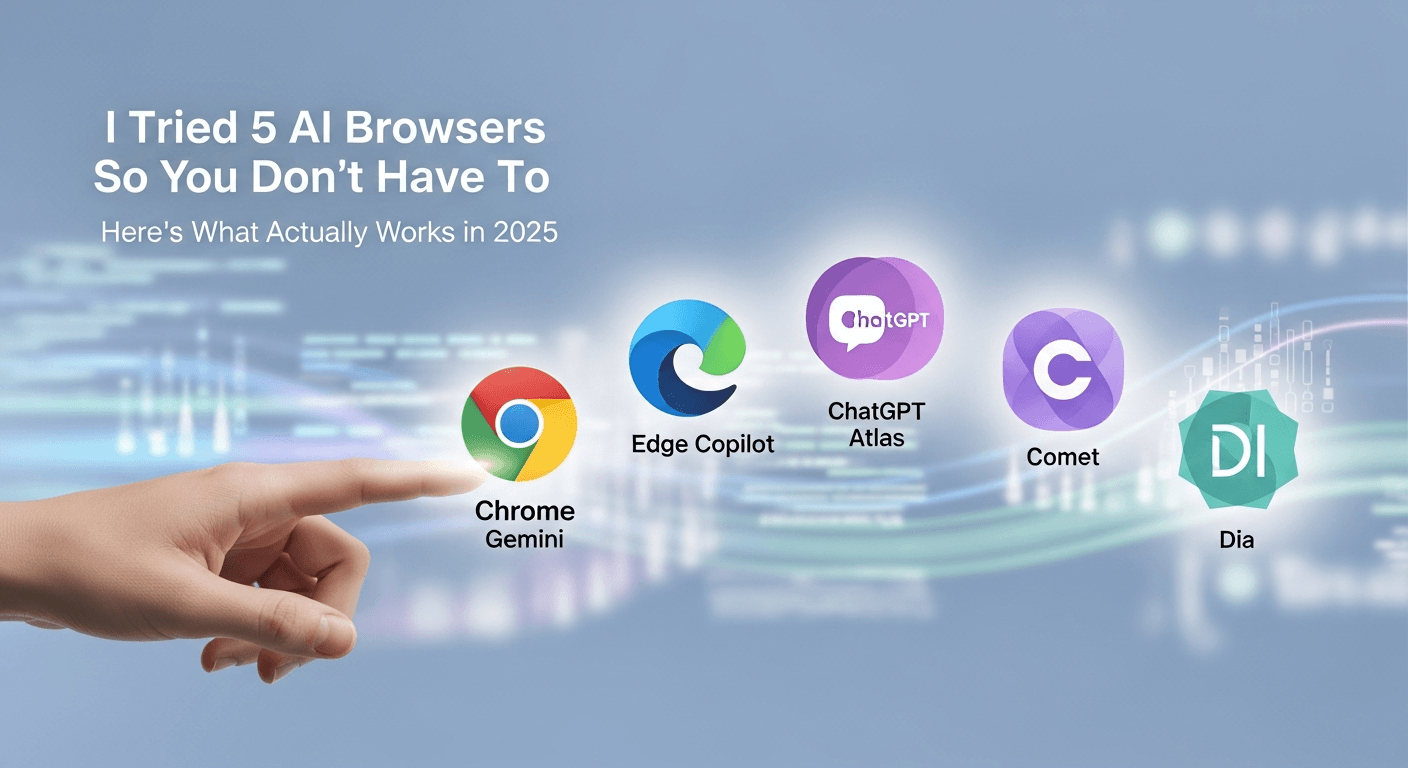
I Tried 5 AI Browsers So You Don’t Have To: Here’s What Actually Works in 2025
I explored 5 AI browsers—Chrome Gemini, Edge Copilot, ChatGPT Atlas, Comet, and Dia—to find out what works. Here are insights, advantages, and safety recommendations.
Read Article


