AI in 2025 and Beyond: What Changes to Anticipate and How to Prepare
The year 2024 has made artificial intelligence feel inescapable. Powerful multimodal models have transitioned from research demonstrations into practical tools for daily use, with AI copilots emerging in familiar applications and on-device AI becoming increasingly feasible. As we approach 2025, the pressing question is not whether AI will be significant, but how it will transform industries, work practices, and policies over the coming years.
This guide breaks down the evolving landscape of AI, highlighting what is changing, what developments are likely to endure, and how to gear up for these shifts. It offers a pragmatic perspective for curious individuals, AI practitioners, and business leaders, with credible sources linked throughout.
The Current State of AI
Several key trends have emerged between 2023 and 2024 laying the groundwork for what’s to come in 2025:
- Multimodal Capabilities by Default: AI models that can understand and generate text, images, audio, and video are now common in mainstream products. In May 2024, OpenAI released GPT-4o, enabling real-time, cross-modal interactions designed for natural voice and vision communication (OpenAI).
- Extended Context Windows: Google DeepMind’s Gemini 1.5 showcased the ability to handle context windows up to 1 million tokens, allowing for an analysis of long documents, videos, and codebases (Google DeepMind).
- Enhanced Reasoning: Models like Anthropic’s Claude 3 emphasized stronger reasoning capabilities and safety, improving performance on complex tasks while reducing hallucinations (Anthropic).
- Open and Closed Model Options: Meta’s Llama 3 and Llama 3.1 expanded robust open-source choices for developers and on-device applications (Meta AI; Meta AI).
- AI Copilots in Productivity Tools: Major companies like Microsoft and Google have integrated AI assistants into their email, document, spreadsheet, and meeting tools, effectively turning generative AI into an everyday asset (Microsoft Copilot; Google Workspace).
- On-Device AI Maturity: Apple introduced Apple Intelligence, merging on-device models with private cloud computing to enhance writing, image handling, and notifications on devices like the iPhone, iPad, and Mac (Apple).
Together, these trends indicate a future filled with ambient multimodal assistants capable of seeing, hearing, talking, and acting within software. The focus for 2025 will be on ensuring that these tools are reliable, cost-effective, and trustworthy at scale in enterprises.
Expected Changes in 2025 and Beyond
1) Multimodality Becomes Standard
Prepare for AI interactions that feel more natural, incorporating voice, vision, and text. Expect real-time verbal assistants, screen-aware copilots, and camera-centric experiences to become integral in consumer and enterprise workflows. With the long context of Gemini 1.5, AI can analyze lengthy meetings or codebases, while GPT-4o has demonstrated fluid, low-latency voice responses in 2024 (Google DeepMind; OpenAI).
This transition means AI could assist in summarizing product demo videos, drafting tickets, and suggesting solutions, thereby unlocking richer analytics and enhancing accessibility for teams.
2) Agentic Workflows Transition from Tests to Production
AI agents capable of planning and executing multi-step tasks, interfacing with tools, and returning control to humans will increasingly be seen. In 2024, OpenAI’s o1 reasoning models were introduced, focusing on step-by-step problem solving and tool usage, highlighting a shift in the industry towards deliberate reasoning capacities over mere fluency (OpenAI).
These agents are set to operate within CRMs, ERPs, web browsers, and code editors. Initial applications include automated test writing, customer support workflows, and back-office functions. The primary goals will be ensuring reliability, implementing guardrails, and establishing observability to track agent behavior.
3) On-Device and Edge AI Gain Traction
Rapid advancements in NPUs and the emergence of efficient open models will enable more tasks to be processed locally, enhancing speed, privacy, and cost-effectiveness. Apple’s strategy combines on-device processing with a privacy-conscious cloud solution when necessary (Apple). Tech giants like Qualcomm, Intel, and AMD are advancing AI capabilities on laptops and PCs, facilitating offline summarization, translation, and creative tasks (Qualcomm; Intel; AMD).
By 2025, expect hybrid architectures that combine small, swift models in devices and browsers while larger models are handled in the cloud for deep reasoning and retrieval tasks.
4) Cost Reduction as New Chips Emerge
The cost of training and inference will decrease per capability unit, although total spending is likely to rise due to high demand. Nvidia’s Blackwell platform, slated for 2024, aims to deliver substantial performance and efficiency improvements in both these areas (Nvidia). Competing accelerators and LPUs, along with software enhancements like quantization and model compilation, will further reduce inference expenses.
For teams, the key takeaway is to design for adaptability. Utilize model-agnostic interfaces to ensure flexibility in swapping out models and hardware as pricing and performance evolve.
5) Robotics Enhanced by Vision-Language-Action Models
Large multimodal models are increasingly aiding robots in carrying out everyday tasks. Google’s RT-2 integrated language and vision with robot actions, while Figure and OpenAI showcased natural language control of humanoid robots in 2024 (Google DeepMind; Figure). In the short term, expect growth in logistics, quality inspections, and light manufacturing tasks, paving the way for broader applications in households and healthcare.
Impact on Industries: From Hype to Practical Applications
Software Development
AI coding assistants are already transforming developer workflows. According to GitHub, developers using AI tools completed tasks up to 55% faster in controlled studies, experiencing increased satisfaction with fewer context switches (GitHub Research).
- Short-term: AI can draft boilerplate code, tests, and documentation while human developers focus on architecture and security.
- Medium-term: AI agents will manage refactors, migrations, and integration tests, still with human oversight.
- Key risk: silent errors and insecure coding patterns. Integrate code scanning and policy checks into AI workflows.
Customer Support and Operations
The combination of retrieval-augmented generation (RAG) with action-oriented agents will facilitate end-to-end case resolution: categorizing tickets, suggesting answers from knowledge bases, executing actions (like refunds), and logging the results. Expect tighter CRM and IT service management integrations, along with enhanced analytics to track deflection rates, customer satisfaction, and compliance.
Marketing and Sales
Personalization at scale will be a key focus: segmenting audiences, generating tailored content, and rapidly testing variations. Maintaining brand voice and accuracy will be crucial, leading to native integrations within email, advertising platforms, and CRMs instead of standalone AI tools.
Finance
Potential applications include drafting reports, reconciling accounts, processing invoices, and detecting anomalies. Explainability, necessary approvals, and audit trails will become non-negotiable. Vendors will deliver AI features that align with Sarbanes-Oxley (SOX) compliance and model risk management guidelines.
Healthcare
Ambient clinical documentation is quickly transitioning from pilot programs to full-scale rollouts. Tools such as Nuance DAX and Abridge are already generating clinical notes from conversations, significantly reducing clinician workload and burnout (Nuance; Abridge). The fields of drug discovery and imaging also continue to benefit from foundational models and advancements in protein structure prediction like AlphaFold (Nature).
Regulatory frameworks are become increasingly robust: the FDA is maintaining an expanding list of AI-enabled medical devices, and healthcare systems are adopting internal AI governance and evaluation playbooks (FDA).
Education
Adaptive tutoring systems and teacher copilots will help reduce administrative burdens and enhance accessibility. For example, Khan Academy’s Khanmigo provides Socratic support for students and planning assistance for educators, incorporating guardrails to ensure answers are not simply handed out (Khan Academy).
Creative Work
Writers, designers, and video editors are increasingly collaborating with AI. This presents opportunities for speed and iteration, but it also raises questions of originality, rights management, and ethical sourcing. Look out for the growing adoption of standards like C2PA Content Credentials to label AI-assisted content (C2PA; Content Credentials).
Economics, Computing, and Sustainability
Decreasing Costs Amid Rising Demand
Both hardware advancements and software efficiencies continue to lower the costs associated with tokens and task execution, even as enterprises expand their usage. This means that business cases should consider a broad array of factors, including model pricing, workflow design, caching, and on-device inference for predictable functions.
Chips and Supply Chain Innovations
New product announcements for 2024 suggest substantial performance enhancements in 2025, with new GPUs and AI accelerators set to launch in volume (Nvidia Blackwell). At the same time, open weights and specialized models will reduce compute requirements for a variety of workloads.
Environmental Impact: Power and Water Use
AI data centers are substantial consumers of energy. The International Energy Agency (IEA) forecasts that data center electricity consumption could approximately double from 2022 to 2026, with AI being a considerable factor depending on its adoption and operational efficiency (IEA). Expect continued innovations focused on efficiency, renewable sourcing, liquid cooling, and workload scheduling to handle peak demand.
Data Quality and Synthetic Data Issues
Access to high-quality, rights-cleared data continues to be a significant bottleneck. While synthetic data holds promise, relying on models trained solely on generated content could lead to performance degradation — a scenario often referred to as model collapse. Researchers have advised caution against the indiscriminate reuse of synthetic outputs without thoughtful curation (Shumailov et al., 2023).
Safety, Governance, and Regulation
In 2025, establishing trust and safety will be at the forefront of policy and product development. Three main pillars will shape this landscape:
1) Regulation and Standards
- EU AI Act: The EU passed the AI Act in 2024, implementing phased obligations starting in 2025-2026, which include requirements for high-risk use cases and transparency rules for specific systems (European Commission).
- US Executive Order 14110: Issued in October 2023, this order establishes standards, safety testing, and reporting requirements for advanced AI models, with additional guidance expected in 2024 (White House).
- NIST AI Risk Management Framework: A voluntary guideline designed to assist organizations in managing AI risks through mapping, measuring, and governance phases (NIST).
2) Model Evaluation and Red Teaming
Organizations are investing in evaluations and stress tests that surpass generic multiple-choice assessments. Anticipate domain-specific evaluations aimed at assessing safety, robustness, tool-use reliability, as well as prompt injection and data leakage risks. The UK and US have initiated national institutes to enhance AI safety testing and best practices (UK AI Safety Institute; US AI Safety Institute Consortium).
3) Provenance, Privacy, and Intellectual Property
Content provenance standards like C2PA will help label how assets were created or modified. Privacy-preserving strategies, including on-device processing and differential privacy, are becoming competitive advantages. Additionally, clear licensing agreements, comprehensive dataset documentation, and indemnification policies will significantly influence enterprise adoption.
A Practical Playbook for 2025
Here’s a straightforward approach to implementing AI while minimizing risks.
Begin with High-Impact, Low-Risk Workflows
- Summarize meetings and documents; draft emails and reports.
- Automate quality assurance, test generation, and log analysis.
- Use RAG on your own knowledge base before engaging in free-form generation.
Establish Governance from the Start
- Define acceptable usage, data handling protocols, and human-in-the-loop requirements.
- Utilize the NIST AI RMF framework to standardize risk discussions among stakeholders (NIST).
- Maintain records of model versions, prompts, and outputs to ensure auditability.
Design for Reliability
- Implement retrieval augmentation, function calling, and constrained outputs to improve accuracy.
- Add evaluation frameworks to assess correctness, safety, latency, and expense.
- Incorporate monitoring for agent actions and require approvals for significant steps.
Build for Flexibility
- Create abstractions for different model providers and utilize standard interfaces.
- Integrate on-device, edge, and cloud models based on factors like privacy, speed, and costs.
- Cache intermediate results and reuse embeddings to minimize spending.
Focus on Value Measurement Rather Than Demos
- Assess task success, cycle time, and user satisfaction, rather than just token counts.
- Conduct A/B testing against established baselines and hold-out datasets.
- Evaluate total cost of ownership, including human oversight and rework.
Key Skills to Develop
The most crucial AI skill in 2025 will be product-centric thinking: understanding user needs, aligning tasks with capabilities, and designing effective guardrails. Areas to consider for growth include:
- From Prompting to System Design: Evolve from one-off prompts to creating reusable chains, tools, and evaluators.
- Data Stewardship: Focus on the curation, labeling, and privacy-aware management of data pipelines.
- Agent Operations: Stay on top of monitoring, approvals, and managing exceptions for autonomous processes.
- Domain Expertise: Contextual knowledge often outweighs clever techniques; pair subject matter experts with developers.
Risks and Their Mitigation
- Hallucinations and Overconfidence: Mitigate by employing retrieval techniques, citations, and human oversight for high-stakes scenarios.
- Prompt Injection and Data Leakage: Use sandboxed environments, limit context exposure, and evaluate inputs and outputs that may pose risks.
- Bias and Fairness: Conduct assessments across diverse user groups and maintain documentation of limitations.
- Operational Fragility: Create systems for retries, fallbacks, and clear transitions to human intervention.
- Vendor Lock-In: Maintain cloud- and model-agnostic layers; ensure your data and prompts can be exported.
Future Scenarios for 2025-2027
Base Case: AI as a Reliable Copilot
Most knowledge workers will utilize AI daily for drafting, analysis, meetings, and software tasks. Enterprises will implement governance and evaluation protocols; on-device AI will cover routine tasks while cloud models manage complex reasoning. Even with increased usage, costs per task will decrease.
Optimistic Scenario: Agents Conduct End-to-End Work with Minimal Supervision
Agent reliability will improve through better tool integration, memory, and planning capabilities. In sectors like customer support, finance, and quality assurance, agents will autonomously resolve numerous tickets. Robotics pilot initiatives in warehousing and inspection will expand.
Pessimistic Scenario: Trust Issues Hinder Deployment
Widespread failures, legal controversies about training data, or energy constraints could lead to a slowdown. Organizations may prioritize retrieval and summarization while cautiously rolling out advanced generative capabilities. Regulatory scrutiny will increase, along with audits and reporting requirements.
Conclusion: Transform AI into a Reliable, Useful Utility
The next significant leap for AI is not about flashy demonstrations but rather the development of dependable and understandable systems that save time and improve workflows. Teams that successfully blend strong governance with practical experimentation will achieve the most value. The steps are straightforward: start with limited yet valuable workflows, embed reliability measures, and maintain a flexible architecture as the ecosystem develops.
In 2025 and beyond, success will not belong to those who chase every new model release but to those who convert AI into a trusted utility.
Frequently Asked Questions
What are the key AI trends for 2025?
Expect advancements in multimodal assistants, agentic workflows, on-device AI, and stricter governance. Anticipate improved reasoning abilities, longer context handling, and deeper integration into everyday applications.
How should companies approach AI implementation safely?
Start with retrieval-augmented summarization and drafting tasks using your own data, incorporate human evaluation, and adopt a governance framework like NIST AI RMF. Implement measures to assess quality, cost, and latency from the outset.
Will AI replace jobs shortly?
In the near term, AI is likely to reshape tasks rather than replace entire roles. It will automate repetitive procedures and support analytical tasks while humans retain responsibilities for decision-making, contextual understanding, and accountability. Over time, roles will likely evolve towards more strategic functions.
What about privacy and intellectual property concerns?
Prioritize on-device or private solutions for sensitive data, select providers with transparent data handling policies, and document sources properly. For content creation, use provenance labels such as C2PA.
Which AI models should businesses consider?
Select models based on task requirements and constraints, such as accuracy, latency, privacy, and cost. Maintaining a model-agnostic architecture allows for flexibility as offerings become available or change over time.
Sources
- OpenAI – Introducing GPT-4o (2024)
- Google DeepMind – Announcing Gemini 1.5 (2024)
- Anthropic – Claude 3 models (2024)
- Meta AI – Llama 3 (2024) and Llama 3.1 (2024)
- Microsoft – Copilot and Google Workspace – AI features
- Apple – Introducing Apple Intelligence (2024)
- Nvidia – Blackwell platform (2024)
- Google DeepMind – RT-2 (2023)
- Figure – Collaboration with OpenAI (2024)
- GitHub – The impact of AI on developer productivity (2023)
- Nuance – Ambient Clinical Intelligence and Abridge – EHR integration
- Nature – Highly accurate protein structure prediction with AlphaFold (2021)
- FDA – AI/ML-enabled medical devices
- European Commission – EU AI Act
- White House – Executive Order 14110 (2023)
- NIST – AI Risk Management Framework
- IEA – Data centres and data transmission networks (2024)
- Shumailov et al. – The Curse of Recursion: Training on Generated Data (2023)
- OpenAI – Introducing o1 preview (2024)
- C2PA – Coalition for Content Provenance and Authenticity
- Content Credentials – Initiative
- UK AI Safety Institute and US AI Safety Institute Consortium
Thank You for Reading this Blog and See You Soon! 🙏 👋
Let's connect 🚀
Latest Insights
Deep dives into AI, Engineering, and the Future of Tech.
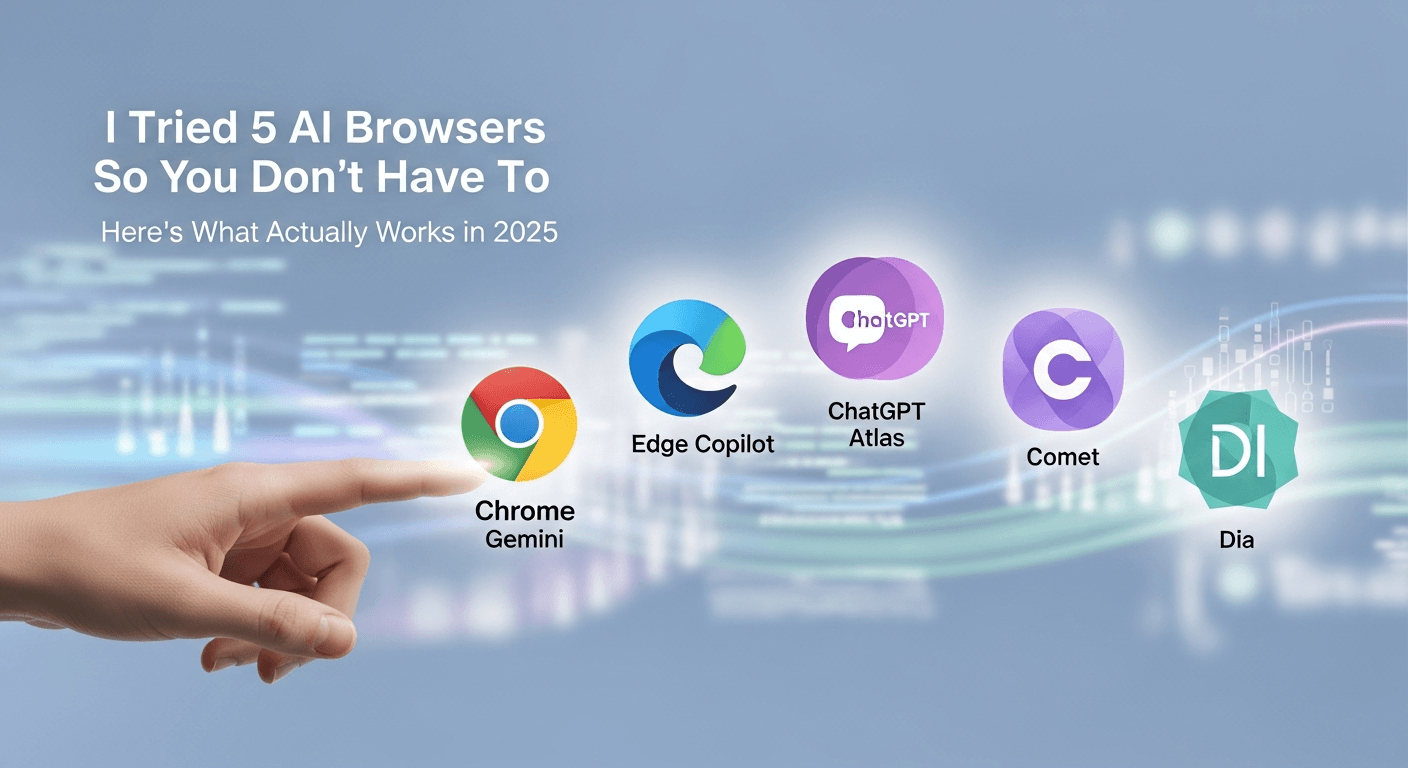
I Tried 5 AI Browsers So You Don’t Have To: Here’s What Actually Works in 2025
I explored 5 AI browsers—Chrome Gemini, Edge Copilot, ChatGPT Atlas, Comet, and Dia—to find out what works. Here are insights, advantages, and safety recommendations.
Read Article


