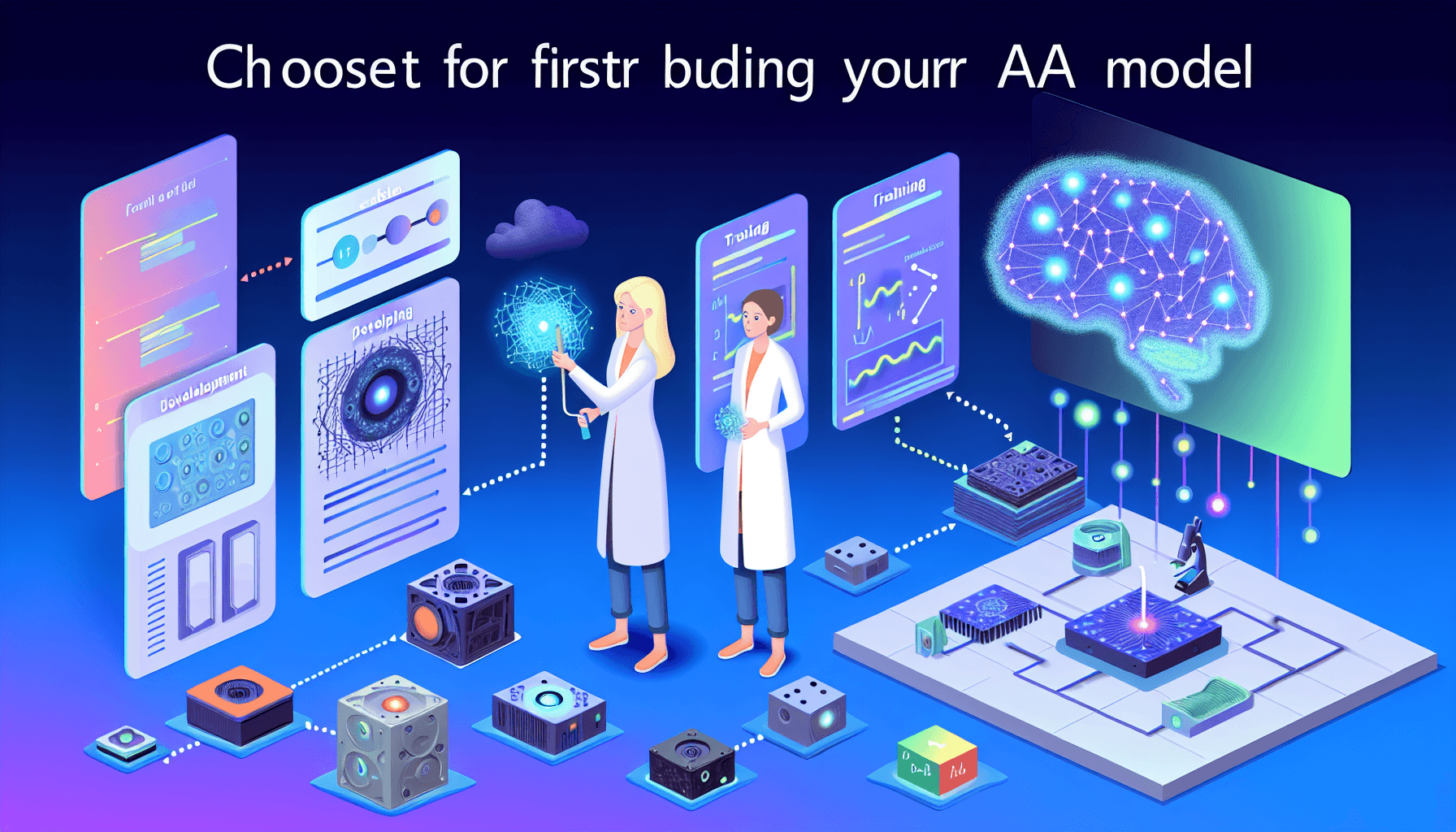
AI for Beginners: How to Build Your First Model
Welcome to the exciting world of artificial intelligence! If you’re a novice eager to build your first AI model but don’t know where to start, this guide is for you. Together, we’ll walk through the process step-by-step, ensuring you gain the foundational knowledge needed to embark on your AI journey.
Understanding AI and Machine Learning Fundamentals
Before diving into the practical aspects of AI, it’s crucial to grasp some basic concepts. Artificial Intelligence (AI) is a broad field where machines mimic cognitive functions typically associated with human minds, such as learning and problem-solving. Machine Learning (ML), a subset of AI, focuses on the idea that systems can learn from data, identify patterns, and make decisions with minimal human intervention.
Choosing the Right Tools and Languages
Choosing the right tools is vital for your success in AI. Python is widely regarded as one of the best programming languages for beginners due to its simplicity and the extensive libraries available such as TensorFlow, PyTorch, and Scikit-learn. These tools offer a blend of simplicity and power, helping you efficiently process data and build models.
Setting Up Your Environment
Setting up your environment involves installing Python and the necessary libraries. You can use platforms like Anaconda to manage your packages and environments easily. Additionally, Jupyter Notebook is an excellent tool for writing and testing your code, allowing you to visualize data and results effectively.
Gathering and Preparing Your Data
Data is at the heart of every AI model. You’ll need to collect relevant data for your project. This can involve gathering datasets from sources like Kaggle or creating your own datasets by collecting information manually. Once you have your data, it’s important to preprocess it to optimize the model’s performance, which includes tasks like handling missing values, normalizing data, and splitting the data into training and test sets.
Building Your First Model
With your environment set and data prepared, it’s time to build the model. For beginners, starting with a simple model like a linear regression can be instructive. You can gradually move to more complex models like neural networks as you gain more confidence and knowledge. Using Python libraries such as Scikit-learn, you can easily train your model with just a few lines of code.
Evaluating Your Model
Once your model is built, the next step is to evaluate its performance. This involves applying your test set to the model and using metrics like accuracy for classification models or mean squared error for regression models. Evaluation helps you understand how well your model is likely to perform on unseen data.
Improving and Tuning Your Model
Developing an AI model is an iterative process. Based on the performance of your model, you may need to tune hyperparameters, such as the learning rate or the number of layers in a neural network, to optimize your model. Tools like GridSearchCV in Scikit-learn can automate the search for the best parameters.
Deploying Your Model
Lastly, deploying your model means making it accessible for users or integrating it into an existing system. Depending on your needs, you can deploy your model as a web application using frameworks like Flask or Django, or integrate it into mobile apps.
We hope this guide has given you a solid start towards building your first AI model. Remember, the key to success in AI is continuous learning and experimentation. Explore more, build more, and learn more. Good luck!
Thank You for Reading this Blog and See You Soon! 🙏 👋
Let's connect 🚀
Latest Insights
Deep dives into AI, Engineering, and the Future of Tech.

I Tried 5 AI Browsers So You Don’t Have To: Here’s What Actually Works in 2025
I explored 5 AI browsers—Chrome Gemini, Edge Copilot, ChatGPT Atlas, Comet, and Dia—to find out what works. Here are insights, advantages, and safety recommendations.
Read Article


