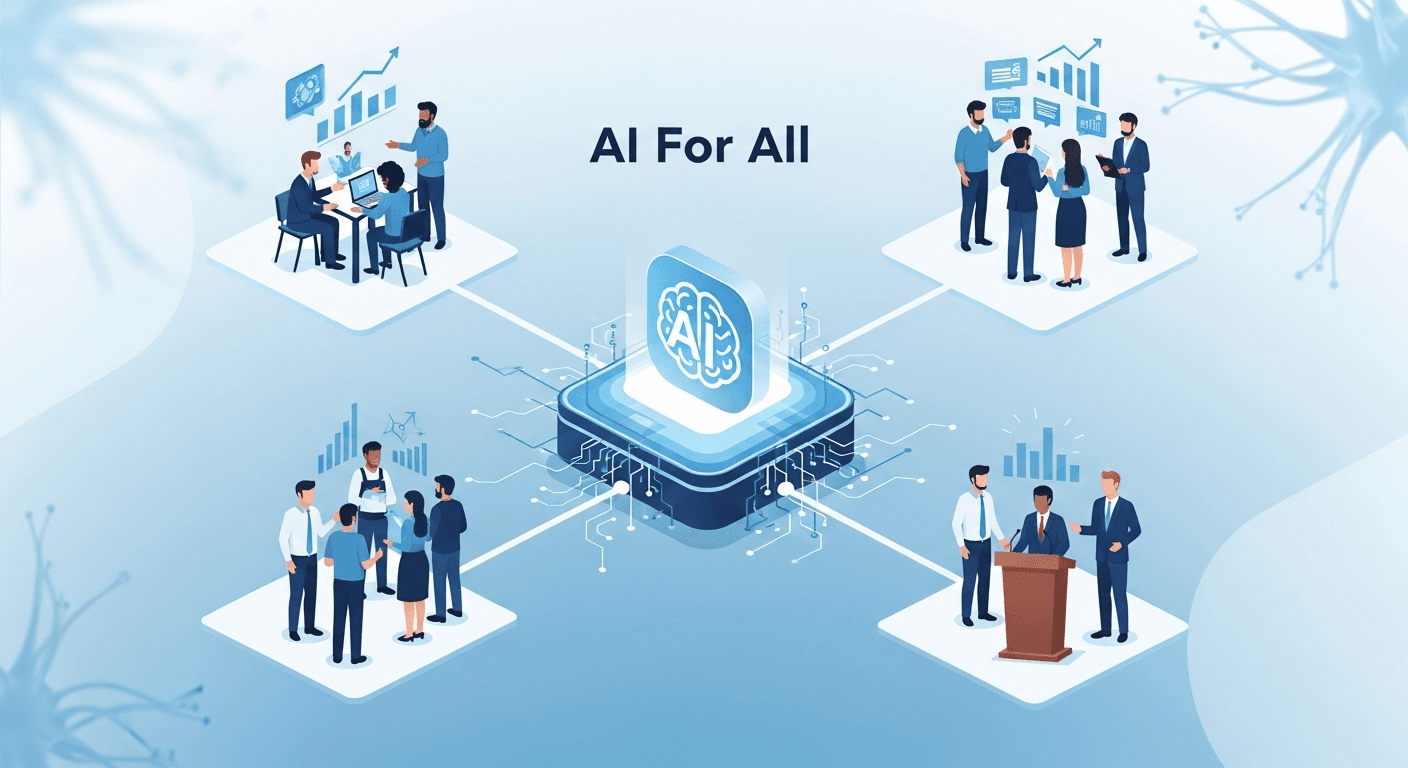
AI For All: Practical Ways to Expand Economic Opportunity Now
AI For All: Practical Ways to Expand Economic Opportunity Now
AI has evolved from a novelty to a necessity. The critical question facing leaders, workers, and communities today is whether AI will exacerbate inequality or empower more people to thrive. The answer hinges on how we develop, deploy, and ensure equitable benefits from this technology. This guide simplifies the conversation with clear evidence, real-world examples, and actionable steps to transform AI into a catalyst for widespread economic opportunity.
Why Economic Opportunity is the Right Lens for AI
Throughout history, technological advancements have influenced not just productivity, but the distribution of wealth and opportunities, making it clear that the outcome is a choice we must make. Initial findings show that AI can enhance productivity while changing job structures and skill requirements. For instance, a study on customer support agents indicated that those with access to a generative AI assistant experienced a 14% boost in productivity, especially among less-experienced employees who utilized real-time guidance and best practices (NBER).
Macro-level research aligns with these findings. The IMF estimates that approximately 40% of global jobs are now exposed to AI, with advanced economies experiencing higher exposure but also greater opportunities for gains through the right adoption of tools that complement human capabilities (IMF). McKinsey predicts that generative AI could add trillions to the economy by automating certain knowledge tasks and enhancing decision-making, assuming organizations commit to redesigning workflows and upskilling their workforce (McKinsey).
While the potential is substantial, so are the risks. The ILO warns that generative AI tends to modify job quality and intensity rather than eliminating roles entirely, emphasizing the need for robust worker protections and reskilling initiatives (ILO). The OECD notes that workers currently utilizing AI report higher job satisfaction and reduced burnout, but highlights that adoption is not uniform across different firms and sectors (OECD).
Where AI Already Expands Opportunity
The true economic value of AI lies in its ability to enhance human capability. Here are some key areas where this promise is already being realized.
1) Everyday Productivity for Small Teams and Solo Entrepreneurs
- Drafting and refining emails, proposals, and marketing content.
- Converting notes, transcripts, and spreadsheets into actionable summaries.
- Automating routine support tasks such as FAQs and onboarding forms.
- Assisting with bookkeeping, inventory management, and basic forecasting.
For small businesses, these efficiencies can be the difference between launching a new idea, securing a contract, or efficiently scaling services. Research indicates that generative AI can help bridge capability gaps for resource-limited firms by reducing the cost of expertise (Brookings).
2) On-the-Job Learning and Skills Mobility
AI assistants can deliver contextual guidance, code suggestions, and instant explanations. In the aforementioned call center study, novice agents learned more efficiently thanks to AI tools providing proven responses at the moment (NBER). For workers transitioning careers, generative AI can translate existing skills into adjacent roles by outlining tasks and skills, generating practice projects, and preparing interview resources (Microsoft Work Trend Index).
3) Accessibility That Unlocks Talent
Inclusive design in AI tools allows wider participation. Features such as multimodal visual assistance enable users to describe their environment, read labels, and navigate complex interfaces. Initial trials, such as those conducted with Be My Eyes, have shown that AI can significantly enhance independence for individuals with visual impairments by pairing human guidance with AI-generated descriptions (Be My Eyes). Embracing inclusive design isn’t merely ethical—it creates opportunities for underutilized talent and improves productivity across the board.
4) Creativity and Entrepreneurship
Generative tools lower the barriers to entry for entrepreneurs and creative professionals. Innovations allow for quick prototyping of logos, testing of messaging, and rapid storyboarding, making these processes faster than ever. AI models that integrate text, visuals, audio, and video streamline redundant tool usage, enabling small teams to achieve more with fewer resources (Stanford AI Index).
Managing Risks for Shared Gains
Leveraging AI to broaden economic opportunity necessitates confronting associated risks proactively.
- Displacement and Uneven Impacts. Routine tasks across clerical and support roles are likely to change rapidly. Without proper training and transitioning support, some workers may be left behind (ILO).
- Bias and Fairness. AI systems can perpetuate and amplify existing inequities. For high-stakes applications, it is essential to conduct bias testing, employ representative data, and incorporate human oversight (NIST AI RMF).
- Privacy and Security. Protecting sensitive data is crucial. Organizations should establish clear protocols around data retention, access, and model usage (OECD).
- Concentration of Benefits. If only large corporations or high-wage professions effectively adopt AI, the gap could widen. Ensuring affordable access and training for small businesses is critical (Brookings).
Principles for Broad-Based Opportunity
The following principles can guide leaders and policymakers in aligning AI technologies with equitable prosperity.
- Complement, Don’t Just Automate. Focus on tools that enhance human judgment, creativity, and service quality rather than merely replacing jobs. This leads to better outcomes and higher user acceptance.
- Access and Affordability. Ensure that small institutions, educators, and nonprofits can adopt AI securely with predictable pricing and data control measures.
- Lifelong Learning. Promote immediate and flexible upskilling programs tailored to meet individuals where they are in their careers: be it through community colleges, workforce agencies, boot camps, or employer-led training.
- Transparent Evaluation. Clearly communicate the capabilities and limitations of AI models; measure impacts based on productivity, equity, and well-being—not just raw output.
- Open Ecosystems. Support APIs, plugins, and standards that empower developers to create tailored solutions for specific local and sectoral needs.
What We Are Building to Help
OpenAI’s mission is to guarantee that artificial general intelligence benefits everyone. Part of this mission involves crafting tools and programs that enhance access, boost productivity, and foster opportunity while prioritizing safety. Here are some initiatives we’re pursuing to reach that goal.
Tools That Empower Workers, Students, and Small Organizations
- Multimodal AI for Everyday Work. AI models capable of processing text, images, audio, and video facilitate more intuitive problem-solving, from document drafting to visual analysis and accessibility support (GPT-4o).
- Secure AI for Small Teams. ChatGPT Team offers advanced AI solutions with administrative controls and privacy features for startups and small enterprises (ChatGPT Team).
- Education-Focused Deployments. ChatGPT Edu provides universities with tools to bolster research, teaching, and student services, incorporating centralized controls and safeguards (ChatGPT Edu). Arizona State University has piloted AI initiatives to enhance access to tutoring and campus support (ASU News).
- Nonprofit Access. Discounted offerings allow nonprofits to integrate AI for vital tasks like case management, volunteer coordination, and donor outreach (OpenAI for Nonprofits).
Enabling Developers and Entrepreneurs
- Customization and Orchestration. The Assistants API and tailored tools streamline the creation of specialized AI applications for various sectors (Assistants API).
- Investment and Ecosystem Support. The OpenAI Startup Fund backs early-stage companies that apply AI to impactful challenges, translating research innovations into real-world solutions (OpenAI Startup Fund).
- On-Ramps for New Talent. The OpenAI Residency offers individuals from diverse backgrounds pathways into AI research and safety roles (OpenAI Residency).
Safety, Transparency, and Learning
- Safety by Design. We emphasize evaluations, red teaming, and staged rollouts to assess capabilities, misuse risks, and societal impacts.
- Responsible Use Guidance. We supply guidelines, system cards, and educational resources to assist organizations in deploying AI responsibly while adhering to regulations, such as the NIST AI Risk Management Framework (NIST AI RMF).
- Iterating with Users. We collaborate with educators, nonprofits, small businesses, and researchers to identify effective strategies, share best practices, and refine tools based on real-world feedback.
Policy Ideas to Maximize Shared Gains
No single product decision will yield equitable outcomes. Public policies play an essential role in realizing AI’s potential and driving broad-based progress.
- Skills-First Workforce Systems. Fund swift training initiatives in AI literacy, data-driven skills, and crucial human-centered competencies like communication and problem-solving, linking funding to successful earnings and job placement.
- Support for Small Business Adoption. Provide technical assistance, vouchers, or matching grants to help small businesses cautiously experiment with AI and measure its ROI. Encourage collaborative training through chambers, incubators, and community colleges.
- Portable Benefits and Transition Support. Update unemployment insurance, wage support, and career navigation strategies to mitigate risks associated with job changes.
- Public-Interest Research and Evaluation. Broaden access to computational resources and datasets for academic and nonprofit research focusing on AI’s impact on labor markets and bias reduction.
- Clear Safety and Privacy Standards. Adopt risk-based frameworks that align with international benchmarks to safeguard consumers and foster responsible innovations (NIST AI RMF).
Getting Started: A Pragmatic Playbook
For Leaders and Small Businesses
- Pick 3-5 High-Friction Tasks. Examples could include customer support triage, taking meeting notes, drafting standard documents, or performing basic analytics.
- Choose a Secure Toolset. Opt for enterprise or team solutions that include administrative controls, data retention settings, and audit capabilities.
- Pilot with a Small Cohort. Set specific goals (like time savings, quality improvements, or customer satisfaction) and implement a review process for results.
- Measure and Iterate. Keep track of productivity, error rates, employee satisfaction, and customer feedback; only scale if the pilot outperforms your established baseline.
- Upskill Continuously. Provide short training modules tailored to roles and encourage peer practice sessions.
For Workers and Independent Professionals
- Build AI Literacy. Familiarize yourself with effective prompting techniques, verification methods, and structured inputs to enhance results.
- Create Your Library. Develop a repository of reusable prompts and checklists for frequent tasks, treating them as living standard operating procedures (SOPs).
- Practice Verification. Always review outputs, cite sources, and rely on your documents for accuracy whenever feasible.
- Grow Adjacent Skills. Combine AI usage with critical human skills such as storytelling, client management, ethics, and domain expertise.
How We Will Measure Progress
Measuring economic opportunity extends beyond GDP. We will track whether AI tools and programs help:
- Workers enhance their earnings, increase mobility, and improve job quality.
- Small Organizations decrease costs, gain new customers, and broaden services.
- Educators and Students access high-quality learning and support on a large scale.
- Communities bridge digital divides and foster greater inclusion.
Our findings will be shared publicly, and we will adapt our approach to ensure that AI’s benefits reach as many people as possible.
Conclusion: A Practical Path to Inclusive AI
AI has the potential to be a transformative force for economic opportunity, provided we take the right steps. By focusing on tools that empower people, ensuring access remains affordable, investing in skill development, and measuring outcomes that genuinely matter for individuals and communities, we can harness today’s advancements to create a more productive and inclusive economy.
FAQs
Will AI take my job?
AI is more likely to change your tasks than eliminate your job altogether, especially in the short term. Workers who leverage AI to enhance their work often experience productivity increases, which can lead to better opportunities. However, some roles may evolve significantly, making reskilling and career navigation essential (ILO).
What skills matter most in an AI-enabled economy?
Essential skills include AI literacy, data fluency, and efficient workflow design. Human skills like communication, critical thinking, ethics, and domain expertise will become even more pivotal when paired with AI capabilities.
How can small businesses start with AI safely?
Begin by identifying low-risk, high-impact tasks such as drafting or summarizing documents. Utilize secure team tools that offer administrative controls, define output approval processes, and track performance against clear metrics. Explore vendor-neutral training through community colleges or small business support organizations.
How do we prevent AI from increasing inequality?
Focus on ensuring affordable access to tools, provide rapid upskilling options, and maintain safety protocols for bias, privacy, and security. Policy support for small business adoption, together with transition assistance and public-interest research, is also crucial.
What is OpenAI doing to ensure these benefits are widely shared?
We are developing accessible tools for teams and educational institutions, providing nonprofit access, supporting entrepreneurs through initiatives like the Startup Fund, and investing in safety practices and transparent evaluations. We also collaborate with educators, researchers, and community organizations to assess impact and share best practices.
Sources
- Brynjolfsson, E., Li, D., & Raymond, L. (2023). Generative AI at Work. NBER Working Paper 31161.
- IMF (2024). Gen-AI: Artificial Intelligence and the Future of Work.
- McKinsey (2023, updated 2024). The Economic Potential of Generative AI.
- International Labour Organization (2023). Generative AI and Jobs: A Global Analysis.
- OECD (2023). Employment Outlook: Artificial Intelligence and the Labour Market.
- Microsoft & LinkedIn (2024). Work Trend Index: 2024 State of AI at Work.
- Be My Eyes (2023). Introducing Virtual Volunteer.
- Stanford HAI (2024). AI Index Report.
- Brookings (2024). Can Generative AI Benefit Small Businesses?
- NIST (2023). AI Risk Management Framework 1.0.
- OpenAI (2024). Hello GPT-4o.
- OpenAI (2024). Introducing ChatGPT Team.
- OpenAI (2024). Introducing ChatGPT Edu.
- ASU News (2024). ASU Partners with OpenAI to Bring ChatGPT Enterprise to Campus.
- OpenAI (2024). OpenAI for Nonprofits.
- OpenAI (2023). Introducing the Assistants API.
- OpenAI (2022). OpenAI Startup Fund.
- OpenAI (2021-). OpenAI Residency.
Thank You for Reading this Blog and See You Soon! 🙏 👋
Let's connect 🚀
Latest Insights
Deep dives into AI, Engineering, and the Future of Tech.
I Tried 5 AI Browsers So You Don’t Have To: Here’s What Actually Works in 2025
I explored 5 AI browsers—Chrome Gemini, Edge Copilot, ChatGPT Atlas, Comet, and Dia—to find out what works. Here are insights, advantages, and safety recommendations.
Read Article


