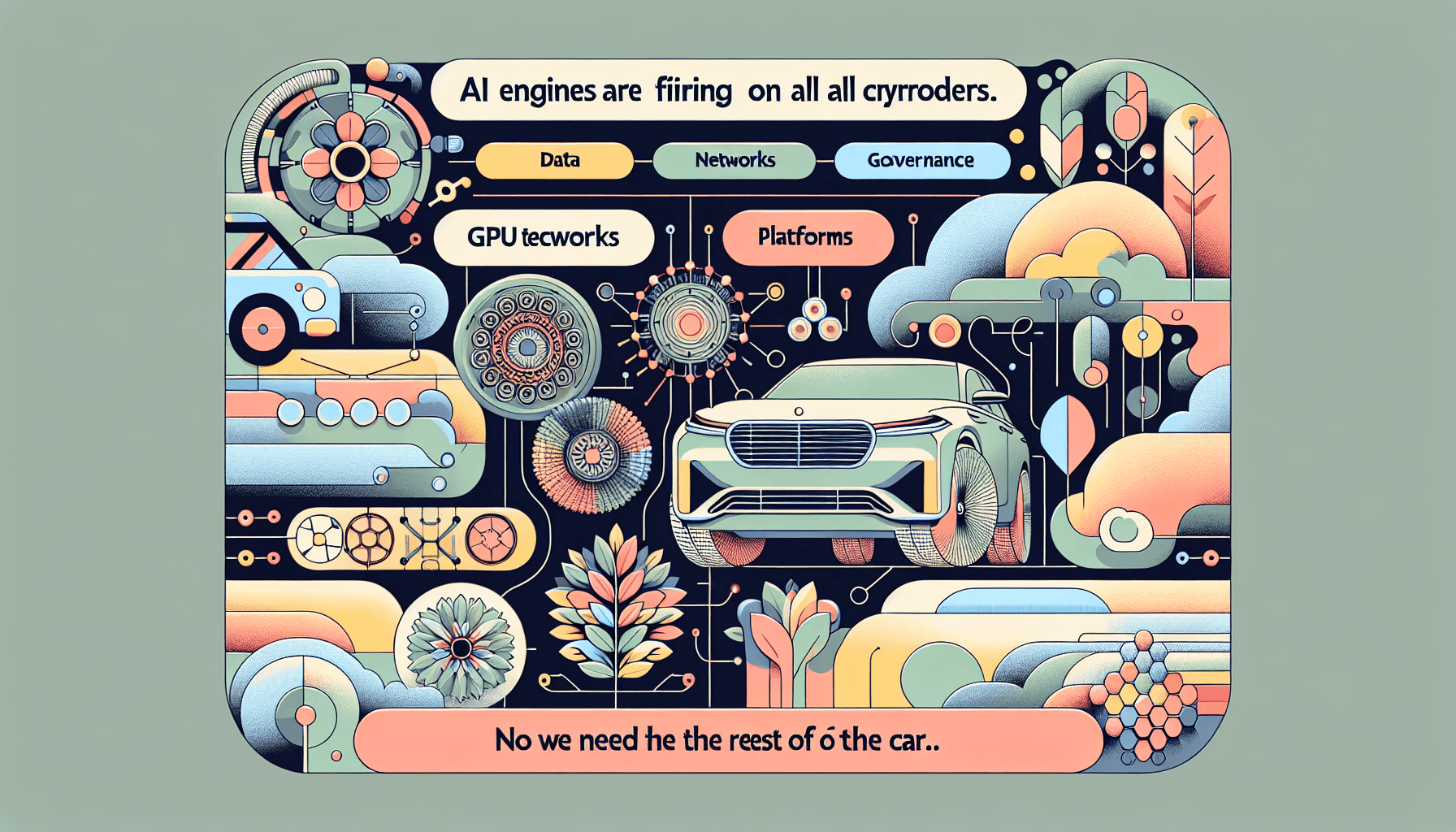
AI Engines Are Firing On All Cylinders. Now We Need The Rest Of The Car.
AI Engines Are Firing On All Cylinders. Now We Need The Rest Of The Car.
GPUs are fast, models are impressive, and demos are dazzling. Yet many teams stall when moving from proof-of-concept to production. The engine is ready. Where is the rest of the system?
Why this matters now
Over the last two years, AI compute and models have leapt forward. Training and inference records keep falling, and turnkey stacks can deliver state-of-the-art results in hours. But real value shows up only when AI integrates with data, applications, networks, people, and policy. That is where most organizations feel the drag.
Benchmarks prove the raw horsepower: MLPerf results show rapid gains across training and inference on modern accelerators, including GPUs and specialized silicon [MLPerf Inference v3.1]. At the same time, reliability, governance, energy, and integration challenges are becoming the gating factors [NIST AI RMF], [EU AI Act], [Uptime Institute].
The engine is ready: what that really means
Today, it is straightforward to stand up an AI engine that is fast and capable:
- Accelerators and interconnects deliver high throughput with lower precision formats like FP8 and INT8, while compiler stacks and runtimes squeeze latency further [TensorRT], [ONNX Runtime], [Apache TVM].
- Inference servers and serving stacks make deployment repeatable: NVIDIA Triton Inference Server, KServe, Ray, and vLLM.
- Model choices abound: open weights for customization, proprietary APIs for convenience, and domain models for specific tasks. Retrieval-augmented generation (RAG) is maturing fast with vector databases and pgvector [Pinecone Learn], [Milvus], [pgvector].
So, yes, you can get a powerful AI engine running quickly. But production success depends on the rest of the car: fuel (data), transmission (networks), chassis (platforms), brakes and airbags (governance), and a good driver (operations).
What is still missing in most organizations
1) Reliable, governed data pipelines
Models are only as good as the data and context they receive. Teams need:
- Clean ingestion and transformation with lineage and access controls.
- Search and retrieval that respect privacy and retention policies.
- Feedback loops to measure usefulness, drift, and hallucinations.
Frameworks like the NIST AI Risk Management Framework and ISO/IEC AI standards help define responsible practices across the lifecycle [NIST AI RMF], [ISO/IEC JTC 1/SC 42].
2) Networks and interconnect that keep up
Fast compute without fast pipes creates bottlenecks. At scale, AI depends on:
- High-speed east-west networking (400G-800G Ethernet or equivalent) and congestion control for predictable tail latency [Ethernet Alliance].
- Low-latency interconnects for cluster communication and memory sharing (RDMA, NVLink-class fabrics) [GPUDirect RDMA].
- Edge connectivity for on-prem and multi-cloud data gravity.
3) Memory and storage throughput
Large models are memory bound. Fast NVMe, tiered storage, and clever caching matter:
- Model sharding and tensor parallelism balanced with I/O limits.
- Quantization and distillation to shrink footprints without losing quality.
- Warm caches and compiled plans to avoid cold-start latency spikes.
4) Power, cooling, and sustainability
High-density AI racks need power, cooling, and resiliency investments that many data centers have not yet made. Liquid cooling and power distribution upgrades are rising priorities, with direct impacts on cost and time-to-deploy [Uptime Institute 2024 AI in the Data Center].
5) MLOps and platform engineering
Production AI is a team sport. Repeatable workflows across training, evaluation, deployment, and monitoring are essential:
- Automation and CI/CD for models and prompts with canary rollouts.
- Observability for latency, cost, quality, and safety using OpenTelemetry and custom evals [OpenTelemetry].
- Guardrails, content filters, and human-in-the-loop review for sensitive tasks.
6) Security, compliance, and policy
Privacy, IP, and safety cannot be bolted on later. Teams are mapping deployments to regulations and guidance including the EU AI Act, sector rules (health, finance), and internal acceptable-use policies [EU AI Act], [US AI EO].
7) Talent and operating model
The new bottleneck is not always compute. It is the combination of data engineering, SRE, security, and product skills required to ship AI features safely and repeatedly. Platform teams that offer paved roads and golden paths accelerate adoption across the enterprise.
Telco and edge: where AI meets real-time constraints
Communications networks are a vivid example of the gap between AI engines and end-to-end systems. Operators see real opportunities in automation, customer experience, and new services, but they must deliver under tight latency, reliability, and regulatory constraints.
High-value use cases
- RAN optimization and energy savings with near-real-time control via RIC xApps and rApps [O-RAN Alliance].
- Network anomaly detection and self-healing for 5G core and transport.
- Intent-based operations and copilots for OSS/BSS workflows.
- Traffic prediction, slicing policy, and QoS tuning at the edge.
- UPF offload and data plane acceleration using DPUs/SmartNICs for low-latency packet processing [ETSI CNF].
Why the rest of the system matters
- Edge placement is dictated by user latency and data locality. Multi-access edge computing standards provide guidance for deployment models [ETSI MEC].
- Cloud-native orchestration is now table stakes for telco workloads, with Kubernetes, service meshes, and observability spanning far-edge to core [CNCF Networking 2024].
- APIs, exposure, and policy controls at the network edge require secure integration with enterprise apps and partners [GSMA Open Gateway].
A practical blueprint: from demo to dependable
- Start with a top-3 use case list tied to measurable business outcomes. Define success metrics upfront: latency, accuracy, cost per query, and safety thresholds.
- Choose the right model for the job. Favor smaller, specialized models when they meet quality bars. Add RAG to inject enterprise context before fine-tuning.
- Quantify cost-to-serve. Track tokens per request, batch sizes, and concurrency. Model energy per request and total cost of ownership.
- Design for privacy by default. Segment data, implement role-based access, and log retrieval events. Keep audit trails.
- Build a minimal but solid platform: a model server, a feature/retrieval store, an evaluation harness, and centralized observability.
- Automate evaluation. Combine offline tests (accuracy, robustness) with online guardrails and human feedback for continuous improvement.
- Harden the runtime. Add rate limits, isolation between tenants, prompt and output filtering, and red-teaming playbooks.
- Plan capacity and placement. Profile where compute, memory, storage, and network become the bottleneck. Place latency-sensitive inference at the edge when needed.
- Run canaries. Roll out gradually with kill switches and fallbacks to deterministic flows for critical paths.
- Document and govern. Map your system to the NIST AI RMF functions (govern, map, measure, manage) and your regional regulatory obligations.
Metrics that actually predict success
- Quality: task-specific accuracy, groundedness, and hallucination rate under realistic prompts.
- Experience: P95 latency, tail behavior at peak, and time-to-first-token.
- Economics: cost per successful task, tokens per dollar, and amortized TCO by utilization.
- Resilience: error budgets met, recovery time, and graceful degradation paths.
- Sustainability: energy per request and data center PUE/WUE where you deploy [IEA – Data Centres].
Build, buy, or partner?
There is no one-size-fits-all answer. A helpful rule of thumb:
- Build when your data and workflows are unique and strategic, and you can sustain a platform team.
- Buy when the task is commodity and the risk of drift or downtime is low.
- Partner when integration, compliance, or edge constraints are the true hard problems.
Either way, avoid lock-in by favoring open interfaces: ONNX for model portability, OpenAPI for service contracts, and OpenTelemetry for observability.
Conclusion: the system is the product
It is tempting to obsess over model leaderboards or the latest silicon. But most production setbacks trace back to the rest of the system. If you get data, networks, platforms, governance, and operations right, your AI engine will shine. If you do not, the best engine will idle.
The engine is ready. Now build the rest of the car.
FAQs
Do I need GPUs for all AI workloads?
No. Many tasks run well on CPUs or smaller accelerators, especially with compact models, quantization, and batching. Use GPUs where parallelism and tensor throughput pay off. Profile first.
What is the difference between RAG and fine-tuning?
RAG keeps the base model fixed and retrieves relevant context at query time. Fine-tuning changes model weights to embed new knowledge or style. RAG is faster to ship and easier to govern; fine-tuning helps when behavior changes are needed.
How do I estimate inference cost?
Multiply tokens per request by cost per token and adjust for batch size, concurrency, and cache hit rates. Track P95 latency and utilization, because they often determine how much hardware you actually need.
What should I monitor in production?
Latency, throughput, and errors, plus task quality (accuracy, groundedness), safety signals, cost per successful task, and drift indicators. Add alerts tied to user impact, not just infrastructure metrics.
How does regulation affect my rollout?
Map your use cases to risk categories and obligations in your region (for example, EU AI Act) and adopt lifecycle practices from frameworks such as NIST AI RMF. Build auditability and data controls from the start.
Sources
- MLPerf Inference v3.1 Results – MLCommons
- NIST AI Risk Management Framework
- EU AI Act – European Commission
- AI in the Data Center 2024 – Uptime Institute
- NVIDIA TensorRT
- ONNX Runtime
- Apache TVM
- NVIDIA Triton Inference Server
- KServe
- Ray
- vLLM
- Pinecone Learn
- Milvus Vector Database
- PostgreSQL pgvector
- Ethernet Alliance Technology Roadmap
- NVIDIA GPUDirect RDMA
- ISO/IEC JTC 1/SC 42 Artificial Intelligence
- O-RAN Alliance Specifications
- ETSI Multi-access Edge Computing
- ETSI Cloud-Native Network Functions
- CNCF Cloud Native Networking Report 2024
- GSMA Open Gateway
- IEA – Data Centres and Data Transmission Networks
- US Executive Order on Safe, Secure, and Trustworthy AI
Thank You for Reading this Blog and See You Soon! 🙏 👋
Let's connect 🚀
Latest Insights
Deep dives into AI, Engineering, and the Future of Tech.
I Tried 5 AI Browsers So You Don’t Have To: Here’s What Actually Works in 2025
I explored 5 AI browsers—Chrome Gemini, Edge Copilot, ChatGPT Atlas, Comet, and Dia—to find out what works. Here are insights, advantages, and safety recommendations.
Read Article


