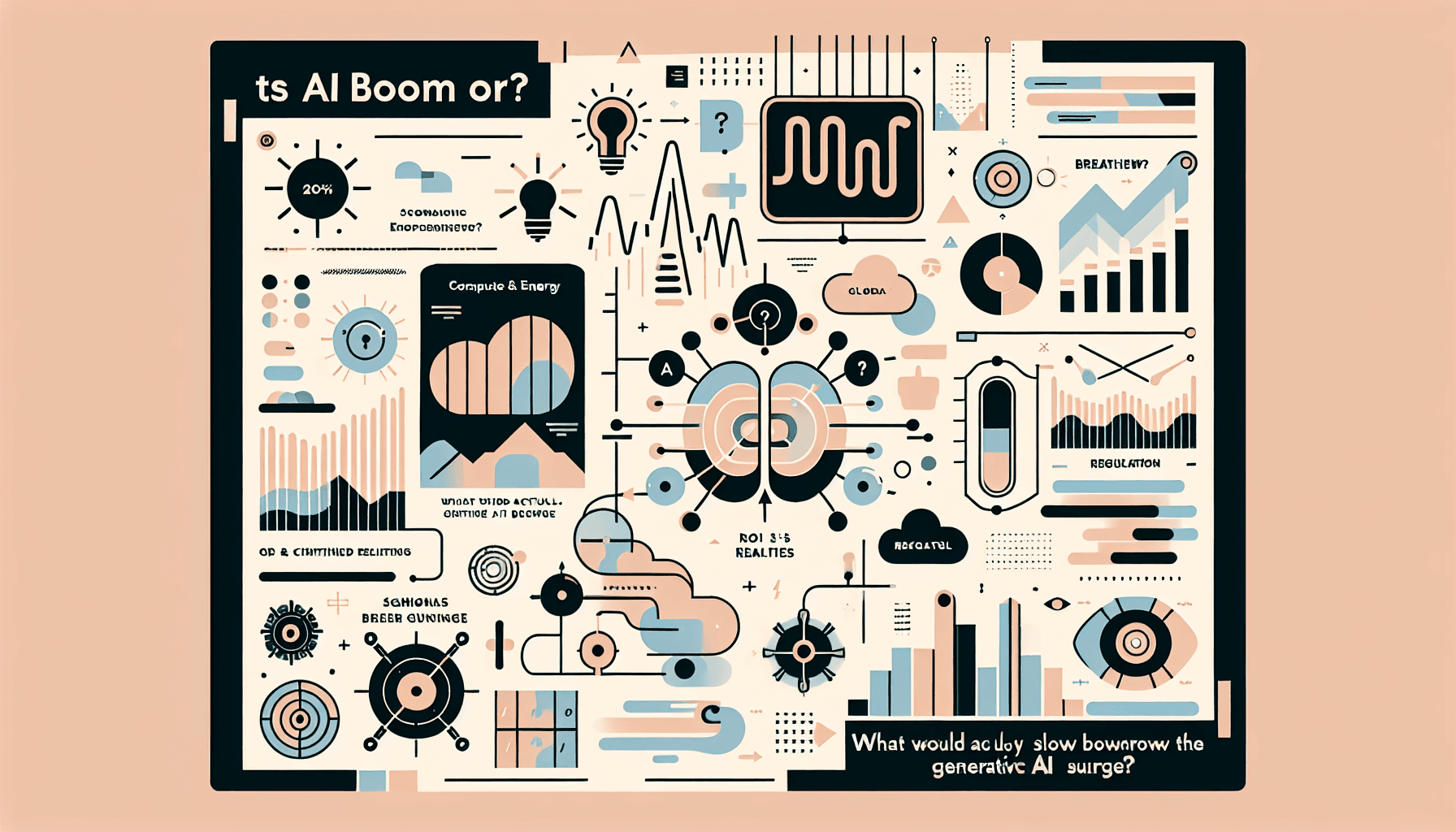
AI Boom or Breather? What Would Actually Slow Down the Generative AI Surge
Are We Near an AI Slowdown? Here's the Real Picture
After two years of head-spinning progress in generative AI, the question keeps popping up: Is the tech industry already approaching a slowdown? Some investors worry about rising costs, power constraints, and shaky returns. Others point to record infrastructure spending and rapid model releases as signs the boom is far from over.
This article takes a clear-eyed look at both sides—what could cool the generative AI surge, and what suggests the momentum remains strong—backed by recent, credible sources.
What a "Slowdown" Would Actually Mean
When people talk about an AI slowdown, they usually mean one or more of the following:
- Economic cooling: slower revenue growth for AI products or lower return on investment (ROI) for enterprise deployments.
- Infrastructure bottlenecks: compute, data center space, or electricity supply limiting rollout speed.
- Technical deceleration: diminishing quality gains per dollar spent on training and inference.
- Regulatory friction: compliance costs or restrictions dampening the pace of launches.
Each of these dynamics is evolving differently—and unevenly across regions and sectors.
Signals That Growth Could Cool
1) Power and Compute Constraints Are Real
Data centers are becoming voracious power users. The International Energy Agency estimates electricity consumption from data centers, AI, and crypto could roughly double between 2022 and 2026, approaching 1,000 terawatt-hours—about the usage of a mid-sized country. Many regions face grid interconnection delays and rising electricity prices, which can slow new capacity coming online.
On the compute side, demand for advanced GPUs has outstripped supply for much of the past two years. NVIDIA has announced its next-generation Blackwell platform, with claimed major efficiency gains for large-model inference, and shipments are ramping. But even with new hardware, power, cooling, and grid availability can become the gating factors, not the chips themselves.
2) High-Quality Training Data Isn't Infinite
Large language models (LLMs) thrive on diverse, high-quality text, code, and multimodal data. Several analyses suggest that the supply of easily accessible, high-quality human-generated text could tighten in the next few years as models consume most of what's readily available on the open web. For example, researchers at Epoch AI estimate that high-quality language data could be effectively exhausted by the middle of this decade without new sources or approaches (Epoch AI). That doesn't mean progress stops—but it could push the industry toward synthetic data, data licensing, or task-specific collection, each with trade-offs.
3) Diminishing Returns on Some Benchmarks
Performance on popular benchmarks has improved dramatically since 2022, but some are now saturated, making further percentage-point gains harder and more expensive. The 2024 Stanford AI Index notes a shift: as older tests saturate, new and harder evaluations emerge, and the cost of training state-of-the-art models continues to rise. In practical terms, easy wins are fewer; teams must focus on reliability, safety, and domain-specific quality—areas that often demand more data curation and engineering than pure model scaling.
4) ROI Is Uneven Across Enterprises
Executives are bullish on generative AI, but converting pilots into sustained value has proven uneven. McKinsey's State of AI 2024 report finds adoption has surged, yet many organizations struggle with cost, data readiness, and change management. The upshot: value is real—especially in software, customer operations, and marketing—but it concentrates in specific use cases, not generic chatbots.
Signals the Boom Is Still Accelerating
1) Hyperscaler Capex Is Hitting Records
The world's largest cloud providers continue to pour money into AI infrastructure—new data centers, power, and custom silicon. In 2024, Alphabet said capital expenditures would be meaningfully higher to support AI infrastructure (CNBC). Microsoft also reported rising capex tied to AI demand (CNBC), and Amazon noted that AI and AWS would drive increased investments (CNBC). These are multi-year, multi-billion-dollar commitments—hardly the posture of a sector preparing to slam the brakes.
2) Hardware Efficiency Is Improving Quickly
Alongside sheer scale, the industry is chasing efficiency. NVIDIA's Blackwell platform touts up to substantial total cost of ownership (TCO) and energy efficiency improvements for real-time large-model inference versus the previous generation (NVIDIA). Even modest per-generation gains, compounded across thousands of accelerators, meaningfully reduce the cost per token and can expand viable use cases.
3) Open Models Are Widening Access
Open and permissively licensed models are closing the gap with frontier systems, enabling teams to build on-prem or hybrid solutions with more control over cost and data. Meta's Llama 3 release in 2024 exemplified this trend, with strong performance on many standard benchmarks at substantially lower deployment cost than closed alternatives. Open models broaden experimentation and help enterprises avoid vendor lock-in—both pro-growth dynamics.
4) Tangible Productivity Wins Exist
While ROI is uneven, credible studies show measurable gains in the right contexts. Early field evidence from customer support found agents boosted productivity by roughly 14% with AI assistance, with the biggest improvements among less-experienced workers (NBER). Similar outcomes are appearing in coding, marketing copy, and analytics when tasks are well-scoped and tools are integrated into workflows.
Regulation: Speed Bump, Not Stop Sign
Policy is moving fast, especially in the EU and U.S. The EU AI Act establishes risk-based rules, foundation model obligations, and enforcement timelines. In the U.S., the White House issued an AI Executive Order in 2023, with subsequent federal guidance strengthening testing and reporting expectations; the NIST AI Risk Management Framework is becoming a common reference for governance.
Compliance adds cost and process, particularly for high-risk applications. But for most enterprise use cases (e.g., internal copilots, analytics, or content generation with human oversight), regulation looks more like a speed bump than a stop sign—encouraging better documentation, evaluations, and safeguards.
The Most Likely Path: From Frenzy to Focus
Rather than a broad freeze, the next phase of AI looks more selective:
- Use case focus: Fewer gimmicks; more targeted applications with clear unit economics (customer support deflection, code acceleration, sales enablement).
- Quality over scale: Data curation, retrieval augmentation, and human feedback improving reliability without always needing bigger base models.
- Cost-aware architectures: Hybrid stacks (mix of open models, distillation, and caching) to keep inference spend in check.
- Infrastructure realism: Builders working with utilities and governments on power, cooling, and siting—especially for AI-heavy regions.
This "focus" phase is typical of platform shifts: early exuberance gives way to pragmatic execution.
What to Watch Next
- Capex trajectories: Do hyperscalers sustain or temper AI data center buildouts into 2025?
- Grid and permitting: Are interconnection queues shrinking in key hubs? Are new data center regions emerging?
- Cost per token: Do model and hardware efficiency gains outpace growth in usage, keeping unit costs stable or falling?
- Benchmark evolution: Are next-gen evaluations (reasoning, tools, safety) showing steady, economically meaningful gains?
- Policy timelines: How quickly do EU AI Act obligations phase in, and how closely do other jurisdictions align?
Bottom Line
Yes, there are credible reasons to expect the AI boom to mature: power constraints, data limitations, higher costs, and ROI scrutiny. But the countervailing forces—record infrastructure investment, rapid hardware and model advances, and growing evidence of workplace impact—suggest a broad slowdown isn't imminent.
More likely, the industry shifts from "move fast and demo" to "ship durable value." That's not a winter; it's a sign of a technology moving from hype to habit.
FAQs
Is an AI winter likely?
An "AI winter" implies a sharp contraction in funding and progress. Current signals—especially hyperscaler capex and steady model improvements—point instead to a more selective, ROI-driven phase, not a freeze.
Will GPUs and inference get cheaper?
Over time, yes. New hardware (e.g., NVIDIA Blackwell) and software optimizations typically lower cost per token. However, soaring demand and power costs can keep total bills high in the near term.
Which sectors are seeing real value?
Software and IT services, customer support, sales and marketing, and parts of finance and healthcare show early wins—especially where tasks are repetitive, text-heavy, and well-documented.
How big a deal are energy constraints?
Significant in certain regions. Data centers need power, cooling, and grid connections; bottlenecks can delay deployments by months or years. Expect more geographic diversification and utility partnerships.
What should companies do now?
Prioritize a few high-ROI use cases, invest in data quality and governance, track unit costs, and build with portability in mind (open models, distillation, retrieval) to avoid lock-in.
Sources
- Is the Tech Industry Already on the Cusp of an A.I. Slowdown? — The New York Times (via Google News)
- Artificial Intelligence Index Report 2024 — Stanford HAI
- Data centres and data transmission networks — IEA
- The State of AI in 2024 — McKinsey
- NVIDIA Unveils Blackwell Platform — NVIDIA Newsroom
- Introducing Llama 3 — Meta AI
- Alphabet Q1 2024 earnings and capex commentary — CNBC
- Microsoft FY2024 Q3 earnings and capex commentary — CNBC
- Amazon Q1 2024 earnings and capex commentary — CNBC
- EU AI Act adoption — European Parliament
- AI Risk Management Framework — NIST
- Generative AI at Work: Evidence from Customer Support — NBER Working Paper
- Will We Run Out of Data? — Epoch AI
Thank You for Reading this Blog and See You Soon! 🙏 👋
Let's connect 🚀
Latest Insights
Deep dives into AI, Engineering, and the Future of Tech.
I Tried 5 AI Browsers So You Don’t Have To: Here’s What Actually Works in 2025
I explored 5 AI browsers—Chrome Gemini, Edge Copilot, ChatGPT Atlas, Comet, and Dia—to find out what works. Here are insights, advantages, and safety recommendations.
Read Article


