2025’s Most Innovative AI Companies: What the List Signals—and How to Act on It
Artificial intelligence isn’t just breaking news—it’s rewriting playbooks. Fast Company’s latest look at 2025’s most innovative companies in AI highlights how quickly the field is moving from flashy demos to real business impact. If you’re a curious reader, entrepreneur, or operator, here’s what the roundup signals about where AI is headed next—and how to use these shifts to your advantage.
Why this year’s AI innovators matter
The newest wave of AI leaders share a few patterns:
- Multimodal by default: Models that understand text, images, audio, and video are becoming standard, enabling more natural assistants and richer product experiences.
- From pilots to productivity: Copilots and AI agents are getting embedded into everyday workflows, measurable in hours saved and revenue generated.
- Infrastructure is the moat: Chips, cloud, data pipelines, and fine-tuning tools now separate experiments from scalable products.
- Safety and governance ship with the product: Eval suites, guardrails, and content provenance are no longer optional.
These themes echo what independent analyses report: AI investment and usage are accelerating, with multi-modal foundation models and enterprise deployment leading the charge.
Frontier models: Faster, more capable, and more practical
In 2024, frontier models took a leap: real-time, voice-native, and better at following instructions. That progress sets the tone for 2025.
- OpenAI’s GPT‑4o: Brought near real-time, voice-first interactions to the mainstream with natively multimodal inputs and outputs—promising more fluid assistants and agentic workflows (OpenAI).
- Google’s Gemini family: Unified multimodal reasoning across Search, Workspace, and the developer stack, signaling how deeply foundation models will be embedded in consumer and enterprise experiences (Google).
- Anthropic’s Claude 3: Showed strong performance on reasoning and harmlessness benchmarks, reflecting the industry’s safety-aware trajectory (Anthropic).
- Open-source momentum: Models like Meta’s Llama 3 expanded the open ecosystem, creating options for private deployment, cost control, and customization—especially important for startups and regulated industries.
Takeaway: Expect AI assistants to become more conversational, cross-modal, and context-aware—making customer support, sales, creative work, and analytics easier to automate and augment.
The infrastructure edge: Chips, cloud, and data pipelines
Behind every AI breakthrough is a serious infrastructure story. Leaders in 2025 are winning on the stack.
- GPUs and accelerators: NVIDIA’s rapid cadence—highlighted by its next-gen Blackwell platform—keeps raising training and inference ceilings, enabling larger and more efficient models (NVIDIA).
- Cloud + data gravity: Vendors are racing to integrate vector databases, governance, and MLOps into the core data stack so enterprises can move from proof of concept to production with confidence.
- Cost curves: Tooling for distillation, retrieval-augmented generation (RAG), and small, specialized models is pushing down unit economics, making AI viable beyond big-tech budgets.
Actionable tip: Model choice matters, but data readiness matters more. Clean pipelines, retrieval quality, and observability will make or break your ROI.
Copilots and agents: From pilots to production
Enterprises are shifting from isolated pilots to organization-wide workflows powered by AI copilots and agents.
- Productivity suites: Copilots embedded in email, documents, sheets, and code editors are now table stakes. The opportunity is orchestration—connecting these tools to your data and business logic.
- Vertical AI: Domain-tuned models in customer support, finance, legal, and healthcare are outperforming general models on accuracy and compliance, especially when paired with RAG and strong governance.
- Measuring impact: Leaders tie AI to KPIs: handle-time reduction, conversion lift, backlog clearance, and faster time-to-insight.
What’s next: Multi-agent systems that plan, call tools, and collaborate—moving from “autocomplete” to autonomous task execution, with approvals and audits built in.
Industry breakthroughs to watch
Healthcare and life sciences
AI’s footprint in healthcare is expanding from imaging triage to discovery and clinical operations.
- Drug discovery: Model-driven biology—from protein structure prediction to generative chemistry—is compressing timelines and increasing hit rates.
- Medical imaging: The FDA continues to clear AI-enabled tools for diagnostics support, accelerating adoption in radiology and cardiology.
- Clinical documentation: Ambient scribing and coding assistants are reducing clinician burnout and administrative costs.
Creative and marketing
- Video generation: Tools for text-to-video and video editing are getting more controllable, unlocking new formats for ads, explainers, and training content.
- Brand-safe workflows: Content provenance (e.g., C2PA) and enterprise guardrails are becoming standard in creative pipelines.
Operations and analytics
- Agentic analytics: Natural-language querying over metrics, logs, and documents is enabling non-technical teams to ask better questions—and get faster answers.
- Supply chain and finance: Forecasting and anomaly detection are getting a lift from foundation models married to structured data.
Open vs. closed: Choosing your AI stack in 2025
Leaders increasingly mix and match. Here’s a simple rubric:
- Closed (proprietary) models: Best for capabilities at the frontier, complex reasoning, and top-tier multimodality—often with the fastest path to value.
- Open-source models: Best for privacy, control, and cost optimization. Strong fit for on-prem, edge, and specialized tasks with narrower scope.
- Hybrid approaches: Use proprietary models for complex reasoning or generation and smaller open models for retrieval and classification.
Guardrails for any choice: perform domain-specific evals, monitor drift, and design human-in-the-loop checkpoints for high-stakes workflows.
A quick framework for leaders and founders
If you’re deciding where to invest, start here:
- Define the job to be done: Pick 1–3 use cases tied to direct KPIs. Avoid generic pilots.
- Right-size the model: Try a small, efficient model first. Move up only if you can’t hit your metrics.
- Harden your data: Establish a clean retrieval layer, metadata standards, and access controls.
- Plan for governance: Establish evaluation suites, red-teaming, and incident response. Track costs and quality together.
- Build with modularity: Keep abstractions between your app, orchestration, model layer, and data so you can swap components as tech evolves.
How lists like Fast Company’s pick up real signals
Yearly “most innovative” lists help surface early signals: which ideas are crossing from research to real products, and which companies are executing at scale. In 2025, expect honorees across:
- Frontier models and safety (multimodal, efficient, robust).
- Infrastructure (chips, cloud, data platforms, observability).
- Vertical applications (healthcare, finance, legal, manufacturing).
- Creative tools (video, design, marketing ops).
Pair that macro view with your own evaluation: does a vendor have a clear path to ROI in your context, not just a compelling demo?
What to watch through 2025
- Agentic systems: Tool-using, multi-step agents with verifiable plans and audit trails.
- Energy-aware AI: Efficiency gains in training and inference—plus demand for greener compute.
- On-device intelligence: Powerful small models bringing private, low-latency AI to phones, PCs, and edge hardware.
- Regulation and standards: Global AI rules and content provenance frameworks will shape product design and deployment.
Bottom line
The companies hailed as 2025’s most innovative in AI are not just building smarter models—they’re building better systems. If you’re leading a team or a business, the winning strategy is pragmatic: start from the workflow, pick the smallest model that gets the job done, harden your data layer, and measure outcomes relentlessly.
FAQs
What is a “frontier model”?
A frontier model is a state-of-the-art foundation model at the leading edge of capability—often multimodal and trained on vast datasets—used for a wide range of tasks like reasoning, generation, and tooling.
How do I pick an AI vendor?
Map vendors to your use case and constraints. Run head-to-head evals with your data, compare cost at your expected scale, and test governance features (guardrails, audit logs, privacy).
Is open-source AI ready for enterprise?
Yes—especially for well-bounded tasks, private deployments, and cost control. You’ll need strong MLOps, security, and monitoring. For complex reasoning, proprietary models may still lead.
What ROI should I expect from copilots?
Common wins include 20–50% time savings in drafting and analysis tasks, faster customer responses, and reduced backlog. Tie savings to specific KPIs and track baseline vs. post-deployment.
Where should a small team start?
Pick one high-frequency, high-friction workflow (e.g., support triage, report drafting). Prototype with a small model plus retrieval, add guardrails, measure results, and scale gradually.
Sources
Thank You for Reading this Blog and See You Soon! 🙏 👋
Let's connect 🚀
Latest Insights
Deep dives into AI, Engineering, and the Future of Tech.
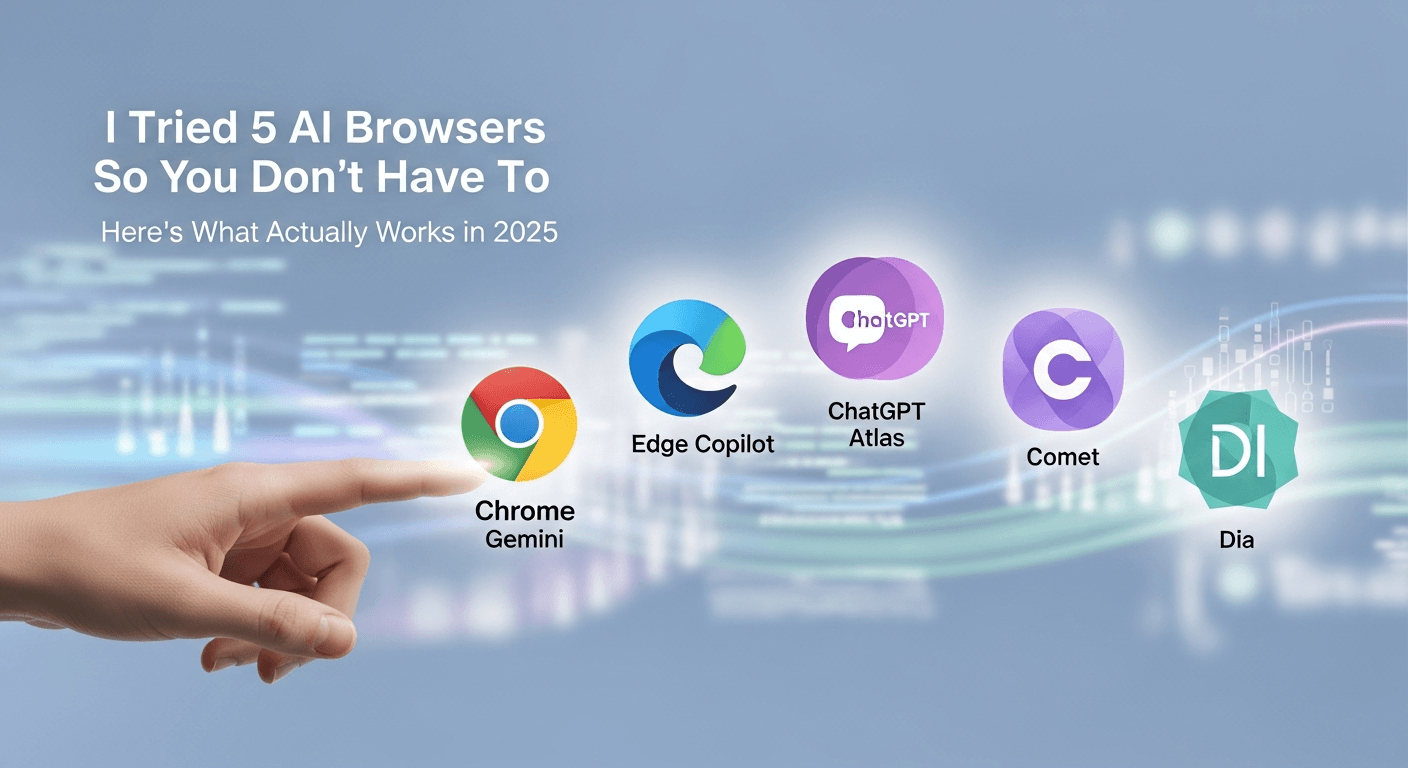
I Tried 5 AI Browsers So You Don’t Have To: Here’s What Actually Works in 2025
I explored 5 AI browsers—Chrome Gemini, Edge Copilot, ChatGPT Atlas, Comet, and Dia—to find out what works. Here are insights, advantages, and safety recommendations.
Read Article


